Two Stores, Two Prices: How an AI Marketing Team Turns Specialist Research into a Client Service
Published
The Economy Research Editorial*
*The Economy Research, 71 Lower Baggot Street, Dublin 2, Co. Dublin, D02 P593, Ireland

In two branches of a make-believe chain restaurant called Gordon Burger, located about two blocks apart, the price of the same item on the menu differs. The chain hires an AI marketing firm and asks if these prices should be kept and, if they are to be changed, what sales might follow. For the service firm, this is less a pricing problem than a question of how one assignment should be staffed, which members of the firm hold what kinds of judgement, and which of those judgements are relevant to the client. The request is taken through a firm organised into two task forces through the SIAI Framework for AI Workforce Restructuring. The task force Alpha, combining sales and analysis, frames questions, applies an accepted method, and communicates results to the client. The task force Beta, combining research and backend, creates new methods, implements tools, and evaluates the method in unanticipated cases. Evidence on demand estimation, uniform pricing across retail chains and in-store price experiments suggests that the effect of price is hard to separate from other influences on sales, and that some judgements still need a specialist. Two-way education trains each taskforce so they may more accurately understand and use each other's results and conclusions. While routine contact with the client may fall, the client may receive more interpretation of what the evidence supports, and the pricing decision stays with Gordon Burger.
1. Introduction - Two Stores Two Blocks Apart Charge Different Prices
There are two branches of Gordon Burger, a fictional restaurant chain, approximately two blocks apart, which, for simplicity will be referred to as Store North and Store South. The same menu item has a different price at each store, so someone strolling down the street, crossing the road and continuing on to the other store would pay a different price for the same item. Gordon Burger has engaged the services of an AI-based marketing team and wishes it to consider the merits of continuing to charge different prices in the two stores and the possible resulting levels of sales.
There are a number of candidate causes, all worth investigation. Although apparently similar, stores may have different cost levels, in particular for rent and labour. There may be different quantities and types of passing trade; for example, proximity to a rail station, or to offices where many staff leave on Friday, and a greater or lesser dependence on residents or on deliveries. One or more promotional offers may be or have been operating at one or both stores, so that the menu price may be temporarily reduced, or special vouchers or coupons issued. Each has consequences for the appropriate response. It makes a substantial difference to the business position whether a difference in menu prices broadly reflects a difference in costs of providing service, or differences in the price the customer would be prepared to pay, or even if it is merely a legacy of past promotion. It would be surprising if the manager of either store were able to say with confidence.
On its face, then, the enquiry is about prices and the effect on sales. But for the company, the primary issues are about how best to resource the work required to respond adequately to the enquiry: what skills and judgement will be required and where best located, and what information will be provided to the client. If organised conventionally, the enquiry from the store manager would be passed to Sales to elicit further details, who would raise a request to Data Analysis for information to be compiled and commented upon. Data Analysis would in turn ask Data Research to consider how best to estimate the relevant effects of price and what information was required, and Data Research would ask Data Backend to supply and update appropriate detail of all sales. Given that the stores are nearby, with apparently irregular variations in prices, some special study could be expected. Each step involves delay, and the detail and information conveyed in writing from one function to another will be progressively less comprehensive than that known by the original contact with the client. Ideally, some aspects of the special study would be incorporated in a general-purpose routine, and those with day-to-day client contact encouraged and trained to apply the routine where appropriate and to refer other matters to specialists. The quality of the response to Gordon Burger will depend to a large extent upon the sales staff's familiarity with and ability to explain the scope and limitations of what can be offered and on the extent to which the designers of routines have an understanding of the nature of the client's enquiries and the information required to inform their decisions.
It is now more important than ever for restaurants to be aware of the effects of prices. 60% of all respondents to a survey published by the National Restaurant Association in February 2026 reported a decline in the number of customers during the last 12 months and 42% said they were not profitable in 2025, and more than 90% considered food costs, wages, insurance, energy and credit card charges important issues.[1] 90% of full-service and 85% of fast-food and limited-service restaurants had increased prices in 2025 mainly in response to increased costs.[2] Based on the BLS price indexes, NRA economists estimated increases of about 36% in average menu prices between February 2020 and May 2026, and increases of approximately similar magnitude in total costs between 2019 and 2026.[3] These are self-reported returns and broad estimates, applying to restaurants generally. All indicate substantial price rises overall and that increases in prices may have accounted for much of any increase in takings while the number of customers had decreased. Customers' reaction to further increases would therefore be expected to have an important effect on future sales and losses from incorrectly assessing this reaction could be substantial.
Some major fast-food chains indicate that prices or recommendations as to prices will vary by individual store. McDonald's announced that its system generates recommended prices by individual restaurant, that franchisees are free to determine their own prices and are under no obligation to follow recommendations.[4] Following comments by its CEO in February 2024 that dynamic pricing would be tested on new display screens "as early as 2025", Wendy's attracted adverse publicity and subsequently clarified that it did not intend to increase prices during periods of maximum demand and that the screens would be useful to offer discounts and other special offers at quieter times.[5] Neither indicates in what way prices or recommended prices would be calculated, nor is that considered here. However, they are indications that at least some major chains will supply information about prices applicable to individual restaurants; that at least in principle the final decision on price is taken by, and is a significant responsibility of, the franchisee or other operator; and that significant public reaction may result from at least some price differences. It is into this environment that the enquiry about Store North and Store South must be answered, and errors may be highly costly to the client.
2. A Pricing Question Once Travelled Through Four Specialist Teams
Central to assessing the effect of changing prices would be the elasticity, that is, the response of quantity demanded to a change in price, with other material factors remaining constant. Elasticities greater or less than one correspond roughly to cases where quantity sold falls more or less than proportionately to the increase in price, or rises more or less than proportionately with a fall in price. Considerable difficulty can arise, however, in ensuring that other relevant factors remain constant. For instance, a restaurant may decide to increase prices anticipating a rise in customers, perhaps due to events in the locality or the time of year. Actual customers may be substantially increased and prices and sales both rise, misleadingly suggesting an increase in quantity demanded due to the increase in price. In general, actual sales reflect a combination of price and other influences on demand which the restaurant took into account in determining price. Berry and Haile emphasise this difficulty as fundamental to estimating demand functions, namely, the existence of unobserved determinants of demand which determine price and of which it is normally necessary to allow for constancy to derive an elasticity.[6] The store manager would wish to know the demand function, quantity demanded corresponding to each level of price, all other relevant matters constant. Sales data will provide only observations at various prices and quantities, probably reflecting many different demand functions.
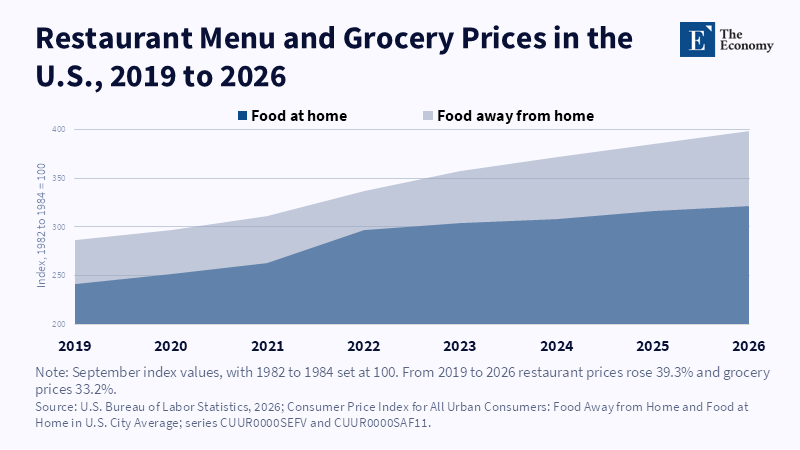
Furthermore, there is no reason a priori to suppose that the current elasticity would necessarily equal that prevailing in, say, 2021. As indicated above, food prices generally have risen very substantially since 2019. According to BLS price indexes, prices charged by restaurants, food away from home, increased by 39.3% between September 2019 and September 2026.[7] Prices paid for food purchased from grocers and cooked at home rose by 33.2% over the same period, but much of this was during 2022, followed by more moderate rises. Between September 2023 and September 2026, the corresponding increases were 11.6% and 5.9%. The index for September is quoted in each year as there was no published figure for October 2025. There has thus been a substantial increase over the last three years in the relative cost of eating out. Customers may well have altered their response to prices charged by any particular store as a result. Demand functions derived from 2021 experience could be very inappropriate to current conditions.
The fact of different prices at nearby stores may be termed local price variation, or more generally price differentiation. Price discrimination, however, has a specific meaning. Following Varian, goods are said to be price discriminated if they are sold at different ratios of price to marginal cost, the cost of serving one more customer; it would therefore not be price discrimination if different prices at the two stores corresponded simply to different costs.[8] It may or may not be the case here. It would, however, have different implications from prices determined by customers' readiness to pay or some similar factor. If asked to account for the price difference, it might be acceptable to refer a customer to higher costs, whereas if prices were discriminatory the customer could be expected to take a less favourable view. And again, estimation of customers' response to prices would be required. There may of course be current or recent promotions offering discounts and so on, reducing prices actually paid by some customers at one or both stores. Such an offer might appropriately be introduced at one or both stores to increase trade, with different effects on sales and profits. This would warrant separate consideration.
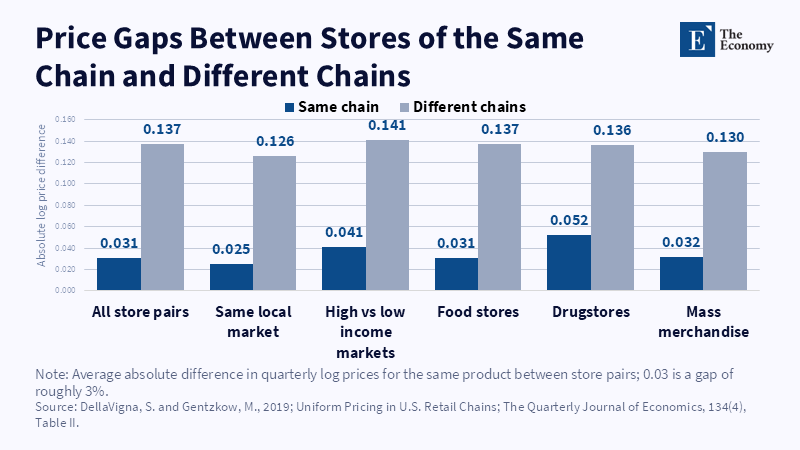
From extensive studies of retail chains in the U.S., DellaVigna and Gentzkow conclude that it is unusual for the same goods to be priced substantially differently in different outlets of the same chain.[9] In their main statistic, based on 73 chains and 22,680 outlets of food, drug and mass-merchandise stores, average absolute differences in quarterly log prices between outlets of the same chain were 0.031 compared to 0.137 for outlets of different chains, roughly 3% and 15%. Restricting the comparison to outlets within one media market gave 0.025 and 0.126; across all pairs, the greatest same-chain difference, 0.052, was for drug stores. These figures are overall averages over all items and chains represented in the data. From their estimated demand functions, they conclude that elasticities differ significantly across outlets of a chain, that the median chain would lose $16 million per annum in profits compared to optimally differentiated prices by outlet and cite industry participants pointing to management reluctance to vary prices between stores, considering, inter alia, the image of the chain.[10] These chains are principally grocers, and many restaurants will be less tightly controlled by their chains. Nonetheless, it implies that uniform prices throughout all outlets involve some sacrifice of profits, as will price variation. Which policy would be preferable depends on customers' reactions to prices.
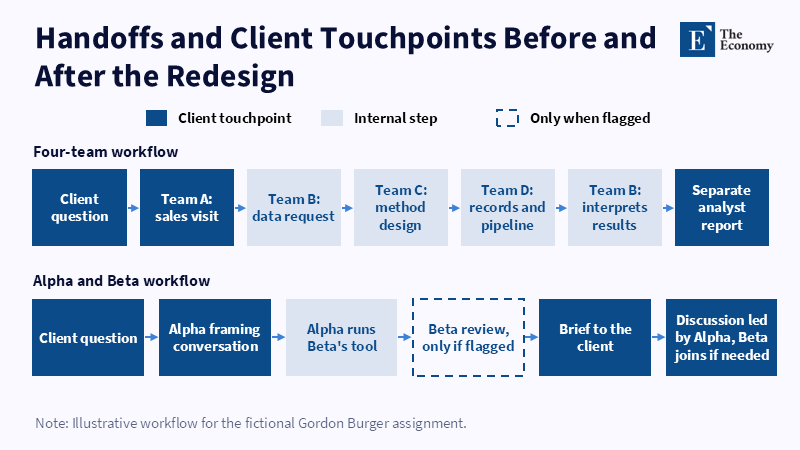
In the previous organisation of the firm, this enquiry would have elicited responses from all four teams. Sales, Team A, would seek details of matters drawing the client's attention to the prices, for example, a regular customer complaining of a price increase, conversations between this and other franchisees, prices charged by another chain's outlet nearby, and so on. Data Analysis, Team B, would define an appropriate request for relevant information on particular items, stores, weeks, means of purchase, and so on, for analysis and comments to be provided to the client. Data Research, Team C, would consider how prices could be isolated from other influences on sales and whether sufficient information was available from normal records, or whether some form of experiment would be worthwhile. Data Backend, Team D, would retrieve, combine, update and maintain appropriate details of purchases from all sources: till, website and other delivery agencies. Analysis would provide the link between the client and technical functions, being the common contact of both Sales and Research. A straightforward request might require only limited information from Data Backend, with the request passing directly from Sales to Analysis. The present enquiry, with two stores only a short distance apart and apparently varying prices irregularly with no obvious explanation, would seem likely to require special study, multiple requests between functions, and probably a sales visit and final report to the client by an analyst.
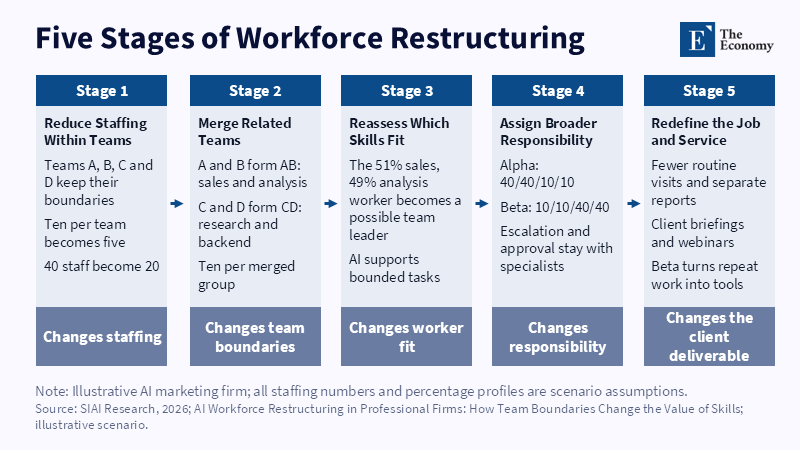
The company has subsequently restructured, following the general principles of the SIAI Framework for AI Workforce Restructuring, set out in SIAI Research's paper.[11] Initially, in this illustrative example, each of the four teams was halved, from 10 to 5, that is, 40 staff in total were reduced to 20. Teams A and B were combined to form AB, and C and D to form CD, placing more value on more wide-ranging combinations of skills, including someone whose previous experience was 51% sales and 49% analysis and who did not fit naturally into either function. Alpha and Beta are set complementary areas of responsibility and there is a new overall definition of job and product to be provided to customers.
3. Alpha Frames the Decision and Beta Owns the Method
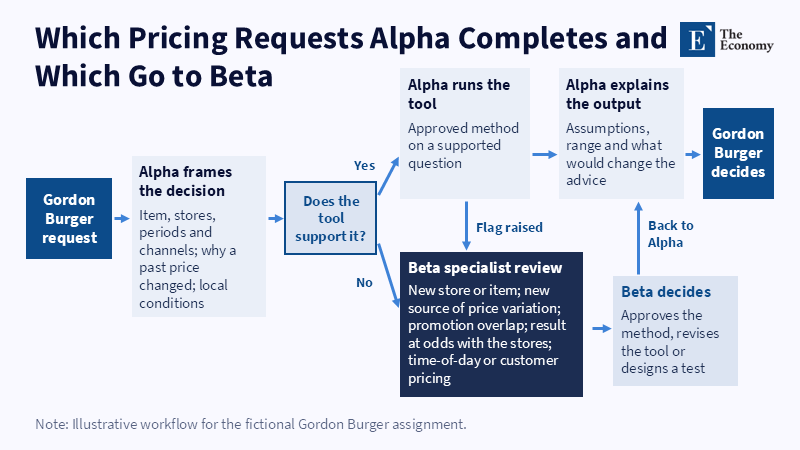
The enquiry will therefore come initially to Alpha. The staff concerned will wish to identify all items, stores, time periods and methods of purchase of interest, noting that prices may differ between, say, the till and delivery services and may have changed at different times. They would ask the reasons for any change in prices in the past, by whom and when introduced, whether intended to affect one store only or both, and so on. They would also seek any relevant information known locally about factors possibly affecting trade in each area, such as level of occupancy of particular offices, road works, competitors' openings or closures. From these they would seek to identify what matters would need to be established or estimated to assist the client's decision. Thus, they would consider different options open to the client, such as continuing with different menu prices, reducing the difference by changing the price at one store only and possibly introducing some local promotional offer in the weaker area, identifying the information and comparisons required for each option and whether the company's standard routines would apply. It would be helpful to indicate at an early stage if any comparison required was outside the scope of current routines.
The relevant routines, and development of new ones where required, are a matter for Beta. In particular, Data Research will consider what information is potentially available to give the required estimates of the effect of price, and what assumptions would be involved and reasonable. Data Backend will provide and update required inputs, with consistent definitions of weeks, stores, offers, menu changes, and so on, on an ongoing basis, and provide to Alpha facilities to determine the comparisons that can be made using the relevant routine or routines, the main assumptions involved, approximate margins of error of estimates produced and features of the particular request or results giving rise to escalation to specialists for consideration. New routines and any unusual cases would also be reviewed by specialists. Data will be interpreted and explained to the client by Alpha, including assumptions and other information which would be relevant to assessing results. Matters giving cause for doubt would be referred to Beta for further investigation. The final decision on price would rest with Gordon Burger, having regard to the information provided and other relevant considerations, for example, knowledge of individual stores and their operators. This would be the most significant decision to be taken by any of the parties concerned.
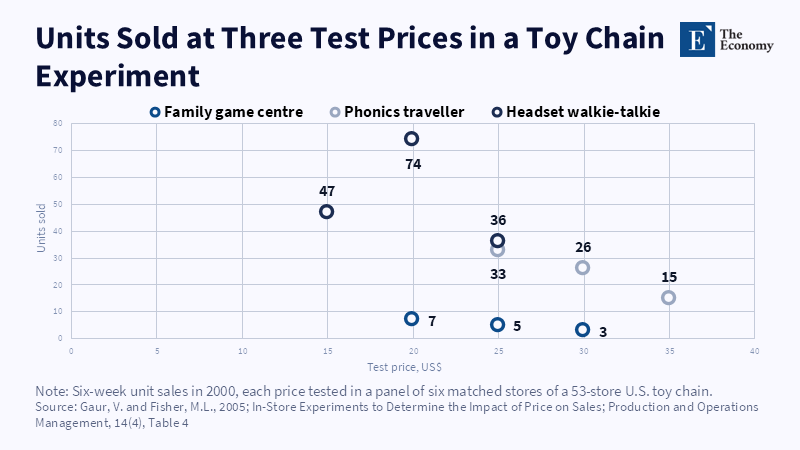
There will generally be a need for specialist intervention to provide an appropriate basis for estimating the effect of price. It may well be that very limited relevant variation in prices has occurred despite a long period of records available for each store. For example, there may have been many occasions when both stores' prices changed simultaneously and so would provide little information about the effect of differences in prices between the stores. Alternatively, prices may typically have been increased only in expectation of higher trade, replicating the general problem outlined at the beginning of this section. There may thus be very few informative observations on prices out of very many weeks' data. It would normally be desirable to devise some appropriate experiment, failing which some instrumental variable technique, described below, could be used if valid instruments could be identified. Even an unqualified randomisation of prices would be informative only about certain limited aspects of response of sales to prices, and of less value for predicting response to other prices.[12] Designing an appropriate experiment would clearly be a specialist task. Considerable ingenuity was required even in the experiment conducted over six weeks in 18 of the 53 stores of one U.S. toy chain, as described by Gaur and Fisher.[13] The test stores were divided into 6 groups according to the overall pattern of sales of a wide range of items. Each of the three prices for each of the three items was imposed randomly on one store in each group, and stores were selected well spaced geographically from others in the chain. Sales were 33, 26 and 15 units over the six weeks at low, medium and high prices respectively for a "phonics traveller", corresponding to an estimated elasticity of about 2. The "family game centre" did not sell sufficiently well, at 7, 5 and 3, to give reliable estimates. The "headset walkie-talkie" gave significantly higher sales at the medium price, 74 units against 47 and 36. Managers plausibly attributed this to uncertainty among customers about the quality of such an item, inferring this from price, and that the medium price was most appropriate for purchase as a present. These comments were, of course, based on managers' knowledge of their customers.[14]
Many other aspects of investigation and estimation could reasonably be expected to be performed routinely, once appropriate methods had been approved by Beta. Data from various sources could be collected and reconciled, for example, to provide total sales for each store-week. All potentially relevant changes in prices could be identified and listed, flagging coincident events, such as offers, bank holidays and menu changes. Various routine tests could be run and routine estimates updated as further data became available. Any factor affecting prices but not directly demand, which could be expected to affect sales only via prices, could be used as an instrumental variable.[15] Increases in costs of various inputs, for example local rates of pay, or prices elsewhere were suggested, the latter being problematic because likely also to reflect demand conditions elsewhere. There would clearly be considerable common influence on demand at the two stores, for example, from weather, local events, and occupancy of offices, so Store South prices would seem a doubtful instrument for prices at Store North. A high correlation of prices would be only one aspect of consideration; a good understanding of reasons for any price change would also be desirable, and judgement of suitability of any proposed instrument would be left to specialists, as would approval of any new candidate.
Knowledge of local circumstances could also be valuable in the hands of Alpha. For example, they may know that a reduced price at Store South coincided with some special offer attracting increased numbers of customers generally in the area over two or three weeks. Such a reduction would appear in the data as a fall in price and an associated substantial increase in sales. This would be brought to the attention of Beta who might conclude that these weeks were inappropriate to assess the effect of price alone, and either exclude them from consideration, attempt to quantify the separate effects and remove them or regard them as relevant to assessing the effect of such offers. Alternatively, Alpha may become aware of increases in suppliers' prices giving rise to changes on known dates, and so provide potentially useful variation in prices independent of demand, which they would be expected to bring to Beta's attention generally if likely to affect the interpretation of comparisons, or to suggest others. The decision would be taken by Beta.
The focus would remain on the likely effect on quantity sold of a change in the posted price. Any quantity estimated in response to some nominated new menu price would be only the conditional expectation, given that price, and should not be regarded as a prediction. Some criterion of desirability of alternative prices would be required to assist the client's decision, which might be profit or margin per customer, number of customers, general policy as to prices throughout its stores, undesirable publicity or complaints from customers shopping at both stores, and so on. Estimating margins would presumably require further information as to costs, not available to and likely to have to be provided by the client. It would be premature, in the absence of data and formal analysis, to seek to indicate probable quantities or profits corresponding to alternative prices. The relevant enquiry is thus as to what information would be helpful in reaching decisions about alternative prices and likely quantities sold. This in turn depends on whether existing data are sufficiently informative, whether a practical experiment is possible in view of the proximity of the two stores and the client's own criteria of desirability. It would be anticipated that some customers would be aware of different prices charged at nearby alternative outlets, biasing results and possibly adversely affecting customer goodwill, and Gaur and Fisher restricted their numbers of test stores accordingly.[16] This consideration would arise immediately for Store North and Store South.
It would be important that each side be aware of the scope and limitations of the other's contribution. The following illustrates matters discussed by each side with the other in one training session on this example. Alpha would emphasise that the client believed that most of lunchtime trade was from local offices, with little attention to prices, compared with Store South where a much higher proportion would be from residents and deliveries, and that the manager was concerned principally whether reducing or eliminating the difference would cause substantial loss of such lunchtime trade. Beta would point out that there had been relatively few changes in the differences in prices between the two stores, of which two coincided approximately with offers. There would be an estimate of elasticity for Store North dependent on all other relevant matters remaining constant in other weeks of change, with a correspondingly large margin of error. Alpha would gain some understanding of what information could reasonably be obtained about elasticities from existing data, how misleading some comparisons could be if changes coincided with other matters, and so on, and of situations where it would be desirable to return the problem to Beta. Beta would appreciate the type of decision of interest to the client, for example, principally concerned with attracting customers at lunchtime to Store North and not overall trade at both stores combined, other relevant matters to be taken into account, such as occupancy of particular offices on particular days, and the form of information likely to be useful and understandable to the store manager, such as range of likely sales given some price or prices and broad conditions applying. Thus each could better understand and explain to the other the reasons for reservations or qualifications to be placed on any results. Beta could indicate in its output features to draw attention to qualifications relevant to particular results, for example, identify weeks relied upon for particular estimates and indicate if offers applied.
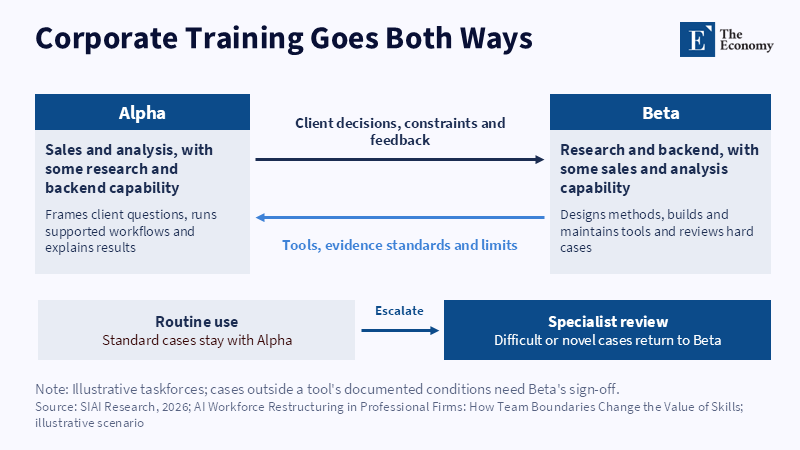
Thus, broadly, Alpha would be expected to apply established methods where the enquiry fell within their scope and to explain the resulting information to the client. Matters outside the scope of current methods would be passed to Beta for consideration and further investigation as appropriate. As illustrated here, each would have some knowledge of, though be less well equipped to deal with, aspects of the other's work, an illustrative 40/40/10/10 sales/analysis/research/backend split for Alpha and the reverse split for Beta, sufficient generally to identify when referral was desirable, but not sufficient to undertake it themselves. For this enquiry, Alpha could be expected to update an accepted set of comparisons with subsequent weeks and to provide an explanation of existing estimates. New stores or items, prices changed concurrently with an offer or other event, proposal to make use of other sources of variation in prices, estimates inconsistent with information known by or reported by the stores, and any enquiry about differential prices, by time of day and so on, or by type of customer, would all be referred to Beta.
4. Interpretation Becomes the Service Gordon Burger Buys
It would be expected that the deliverable or deliverables to the client would also change. Previously, the client would expect at least one visit by a salesperson and a subsequent report by an analyst, probably with no direct contact with the client. Now, the client may expect only a short report identifying the comparisons justified, or not, by available information on Store North relative to Store South, and a webcast, or some other form of discussion, with the lead from Alpha taking queries and inviting Beta to contribute if there were significant matters to discuss. Ideally, the client would be able to tell from the short report what weeks would be used for various comparisons, the likely spread around an answer, other possible causes of the difference in prices and corresponding information that might usefully be gathered to reduce the spread of possible answers. There would be no suggestion of what price or prices to charge. It seems reasonable, although far from certain, that, with this structure, there would be more time spent interpreting results and less time spent on visits and reporting. Some knowledge of the business and relationship with the client would be needed, for example, to raise the question of the importance of lunchtime trade. Also, whoever led the discussion would need considerable familiarity with analytical techniques and their results in order to be clear about the strength of support from available information, and to resist clients wishing a greater degree of certainty.
From the description of the facility available to store managers, McDonald's goes further, giving franchisees recommended prices for each restaurant. Eventually there may be no role for interpreting the output for the client. It is difficult to dispute this conclusion in many circumstances. If an existing approved set of comparisons is simply being extended over further weeks, it seems unnecessary and undesirable to require a webcast; continued insistence on it would probably drive the client elsewhere. However, there are serious situations for which a store manager will want advice. For example, the toy chain study yielded, for one item, sales that rose between the low and middle prices, requiring knowledge on the part of retail managers of their business to be fully informed; prices set at random would give information only on a narrower set of questions than most retailers ask; and it seems likely that a substantial proportion of customers would shop at both of the two Gordon Burger restaurants. There is an obvious value in advising a client of the answer to its question, but it would be seriously inadequate to do so without flagging important qualifications. It can be useful to transfer some decisions to a computerised facility if the questions asked are broadly appropriate to the assumptions and tests applied in constructing the facility, and if exceptions are appropriately flagged and acted on. But if employees fail to note the flags, or if the description of the input information is such that no flag will arise, there will be an overconfidence in unreliable results. The consequence of inadequate training of the Alpha staff would be a confident but inappropriate commentary on very imprecise estimates. This could well be worse for the client than simply waiting longer for a report.
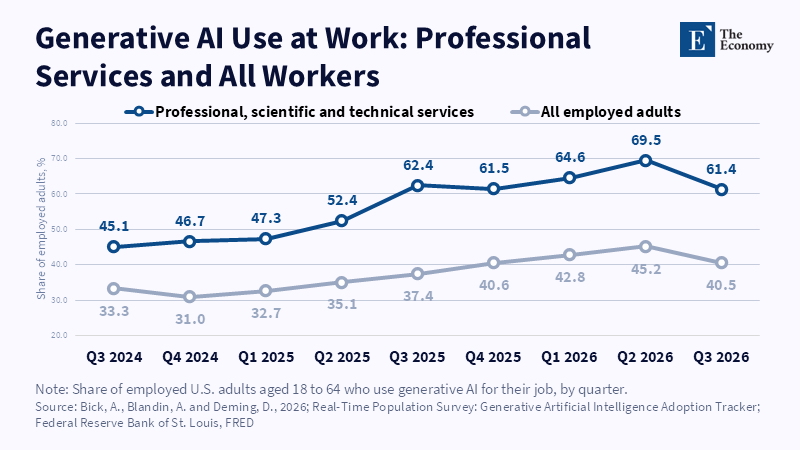
There would also be significant changes to the work of the Beta team. A group of researchers would be responsible for approved methods and would receive exceptional problems, for example, an appropriate experiment involving two restaurants sharing customers. Similarly, some backend staff would be continually providing services to a wide range of users; they would be concerned not only with correct definition and compilation of information but also with identifying difficulties, for example, the nature and frequency of overrides of flags, questions referred back to them, or misinterpretation of results by the client. So they would also want a general understanding of the types of decisions for which results are required. A carefully constructed method and computerised facility would provide an accurate answer to an inappropriate question if they did not reflect the importance of lunchtime trade. Autor and Thompson suggest that automation will tend to increase required skill levels in the remaining tasks if the most routine tasks are automated, and decrease them if the most skilled tasks are automated.[17] Automation of some data processing and simple extensions of approved comparisons would presumably increase the skill level required of the remaining Beta staff. It appears that businesses providing professional and similar services would be relatively early users of this type of technology. Based on responses collected between November 2025 and January 2026 about the previous two weeks, 34% of businesses in "Professional, Scientific and Technical Services" used AI in some business function, compared to 18% of all businesses; of those using AI for any function, 52% used it for Sales and Marketing.[18] These are all weighted averages across businesses. Most users said that they saw it as an aid to existing work, and only about 2% of all businesses reported reductions in numbers employed.[19] From November 2025, the question was extended from production of goods and services to any business function, and Census staff understand the level of usage to have been between 17 and 20% from December 2025 to May 2026.[20] The Federal Reserve has shown both series in an article in April 2026, and calculated an increase in the proportion of firms using AI of 68% over the 12 months to September 2025, on the old definition.[21] The proportion of individual workers using generative AI shows a similar pattern. For all of Q3 2024 to Q3 2026, between 45.1 and 69.5% of employed persons aged 18 to 64 in professional, scientific and technical services used generative AI for their job, rising from 45.1% to 61.4% from Q3 2024 to Q3 2026 via 69.5% in Q2 2026. Over the same period, the figure for all employed persons was 33.3%, 45.2% and 40.5%.[22] These are different questions, in quite different surveys, so the levels of usage should not be directly related; but both indicate very substantial usage by the professional services sector compared to other workers generally.
Presumably various improvements and modifications would be made to the facility following use by clients. For example, following discussions with Gordon Burger store managers, Alpha might conclude that they had assumed the existing field on promotions applied to promotions by the chain generally, and had not therefore reported other promotions and offers locally. Beta would presumably introduce a further field, clarify the existing description, and instruct that any week with a local offer be flagged for Beta review. This would not demand a detailed knowledge of the client's stores and circumstances by Beta staff, or the detail of the method available to Alpha. But it does require frequent communication between them, and someone in Beta responsible for reviewing such communications.
An employee with an illustrative 51/49 mix of sales and analysis experience might be expected to lead the response to this client. Such an individual would be well suited to the task of understanding the question the store manager wishes answered, and determining whether and how it can be answered by the facility. He or she might be an existing member of staff, or one sought for re-employment. Alternatively, an ex-employee, whose profile on leaving at the end of stage 1 might have been inappropriate for any of the new departments, might be re-trained, and plausibly have an illustrative profile of 41% sales, 39% analysis, 10% research and 10% backend. He or she would be able to interpret most flags raised, recognise the difficulty of inferring the effect of price on Store North from variation in price charged by Store South, and know to question the backend group as to the treatment of delivery. These are simply two plausible individuals, not implying any conclusion about total staff retained and re-employed. There would be a wide range of knowledge resulting from such additional training, but it seems unlikely that it would extend to devising an appropriate experiment for two restaurants sharing customers; that would continue to rest with Beta.
It would be appropriate for the business, with its client, to decide the answers it wished the facility to provide. It would be useful for its management to identify these and regard them as part of the range of services offered, extending them as appropriate following approval of new methods by Beta. It would be appropriate to assess Alpha employees at least as much on appropriate referral of matters and client understanding of limitations as on the volume of requests handled. Beta would need to be allowed sufficient time to consider referred matters and update and otherwise maintain methods, without direct billing to clients. Some joint training would be useful, based on actual examples and including at least one requiring referral to Beta. All changes of price in the history would be recorded with an explanation, by the Alpha employee framing the question for the facility. The output of the facility should always be accompanied by assumptions and an indication of the range of possible answers, and questions about the reliability of the comparisons and other possible causes of variation should be referred promptly to Beta. In turn, Beta should seek to describe the assumptions and range of possible answers simply enough for a store manager to repeat, make a record of all overrides of flags and of questions referred back to them, with a view to modifying instructions, definitions and other features, and attend some discussions with clients, to be aware of the nature of the decisions taken based on the tool's output. Clients such as Gordon Burger would assist greatly by maintaining a record of local events, offers, changes in price and so on, being explicit at the outset as to the nature of the desired decision, providing information on costs where relevant to the comparison sought and being prepared to consider what additional information would help reach an answer. Where information is insufficient, an experiment would be worth exploring, bearing in mind the likelihood that many of its customers would be aware of it.
Conclusion: The Price Question Stays With the Client
There will continue to be questions about appropriate prices to charge, given that two restaurants charge different prices. The answer will depend on many judgments, some of which, following the changes, can reasonably be made by the Alpha staff with the client: definition of the relevant decision; application of approved methods and comparisons and description of likely answers and their precision. Clients can provide details of reasons for price changes over time, and describe their desired outcome. However, judgments about the validity of particular changes of prices as an indication of the effect of price on sales, the suitability of other possible sources of variation and methods of experimenting, remain for the Beta group. All parties need sufficient knowledge of the work done by others to identify the limits of their own responsibility. In particular, the Alpha staff would be expected to flag and refer back for consideration many questionable comparisons. And Beta would need to know enough of the decision to be taken to construct appropriate methods and describe their limitations intelligibly to a client. A major part of the service provided would be the quality of the assessment of the reliability of the results provided. It would be dangerous if the level of skill in the Beta group diminished in reliance on the facility for "normal" cases, leaving no one able to judge the reliability of an answer to an unusual request. It would remain for Gordon Burger, therefore, to decide whether to charge different prices at the two stores, and to consider likely levels of sales at each for other prices.
References
[1] National Restaurant Association (2026a) Persistent cost increases and enduring demand will shape the restaurant industry in 2026. Press release, 12 February. Washington, DC: National Restaurant Association.
[2] National Restaurant Association (2026b) Rising food costs + tight supplies = more challenges for industry. Resource library article, 25 March. Washington, DC: National Restaurant Association.
[3] National Restaurant Association (2026c) Elevated costs continue to pressure restaurant profitability. Restaurant Economic Insights analysis, 8 July. Washington, DC: National Restaurant Association.
[4] McDonald's Corporation (2026) Separating fact from fiction: AI does not set prices at McDonald's. Corporate article, 1 October. Chicago, IL: McDonald's Corporation.
[5] Yu, Y.-J. (2024) 'Wendy's addresses "dynamic pricing" comments, says it won't raise menu prices', ABC News, 28 February.
[6] Berry, S.T. and Haile, P.A. (2021) Foundations of demand estimation. Cowles Foundation Discussion Paper 2301, revised May 2022. New Haven, CT: Cowles Foundation for Research in Economics, Yale University.
[7] U.S. Bureau of Labor Statistics (2026) Consumer Price Index for All Urban Consumers: food away from home and food at home in U.S. city average. Series CUUR0000SEFV and CUUR0000SAF11, not seasonally adjusted, data through October 2026, retrieved from FRED, Federal Reserve Bank of St. Louis, November 2026. Washington, DC: U.S. Bureau of Labor Statistics.
[8] Varian, H.R. (1989) 'Price discrimination', in Schmalensee, R. and Willig, R.D. (eds.) Handbook of Industrial Organization, Volume 1. Amsterdam: Elsevier Science Publishers, pp. 597-654.
[9] DellaVigna, S. and Gentzkow, M. (2019) 'Uniform pricing in U.S. retail chains', The Quarterly Journal of Economics, 134(4), pp. 2011-2084.
[10] DellaVigna, S. and Gentzkow, M. (2019) 'Uniform pricing in U.S. retail chains', The Quarterly Journal of Economics, 134(4), pp. 2011-2084.
[11] SIAI Research (2026) AI workforce restructuring in professional firms: how team boundaries change the value of skills. SIAI Research paper. Schindellegi: Swiss Institute of Artificial Intelligence.
[12] Berry, S.T. and Haile, P.A. (2021) Foundations of demand estimation. Cowles Foundation Discussion Paper 2301, revised May 2022. New Haven, CT: Cowles Foundation for Research in Economics, Yale University.
[13] Gaur, V. and Fisher, M.L. (2005) 'In-store experiments to determine the impact of price on sales', Production and Operations Management, 14(4), pp. 377-387.
[14] Gaur, V. and Fisher, M.L. (2005) 'In-store experiments to determine the impact of price on sales', Production and Operations Management, 14(4), pp. 377-387.
[15] Berry, S.T. and Haile, P.A. (2021) Foundations of demand estimation. Cowles Foundation Discussion Paper 2301, revised May 2022. New Haven, CT: Cowles Foundation for Research in Economics, Yale University.
[16] Gaur, V. and Fisher, M.L. (2005) 'In-store experiments to determine the impact of price on sales', Production and Operations Management, 14(4), pp. 377-387.
[17] Autor, D. and Thompson, N. (2025) Expertise. Working paper, 20 June. Cambridge, MA: Massachusetts Institute of Technology.
[18] Bonney, K., Breaux, C., Dinlersoz, E., Foster, L., Haltiwanger, J. and Pande, A. (2026) The microstructure of AI diffusion: evidence from firms, business functions, and worker tasks. CES Working Paper 26-25, April. Washington, DC: U.S. Census Bureau, Center for Economic Studies.ai
[19] Bonney, K., Breaux, C., Dinlersoz, E., Foster, L., Haltiwanger, J. and Pande, A. (2026) The microstructure of AI diffusion: evidence from firms, business functions, and worker tasks. CES Working Paper 26-25, April. Washington, DC: U.S. Census Bureau, Center for Economic Studies.
[20] Grundy, A., Breaux, C. and Khatiwoda, D. (2026) Large firms with at least 20 employees biggest AI users. America Counts story, 26 May. Washington, DC: U.S. Census Bureau.
[21] Allen, J.S. (2026) Monitoring AI adoption in the US economy. FEDS Notes, 3 April. Washington, DC: Board of Governors of the Federal Reserve System.
[22] Bick, A., Blandin, A. and Deming, D. (2026) Real-Time Population Survey: Generative Artificial Intelligence Adoption Tracker. Series RPSGENAIUSAGESHAREIND12 and RPSGENAIUSAGESHAREWORK, quarterly, updated 20 October. St. Louis, MO: Federal Reserve Bank of St. Louis, FRED.