Teacher AI Literacy Is the Real Test of AI in Education

Working across research, policy, and data-driven analysis, the Editorial Board ensures that published pieces reflect a consistent institutional perspective grounded in quantitative reasoning and long-term structural assessment.
Authored On
Modified
AI access does not guarantee real learning
Teacher AI literacy determines whether AI supports or replaces thought
Schools need stronger training, clearer rules and better assessment

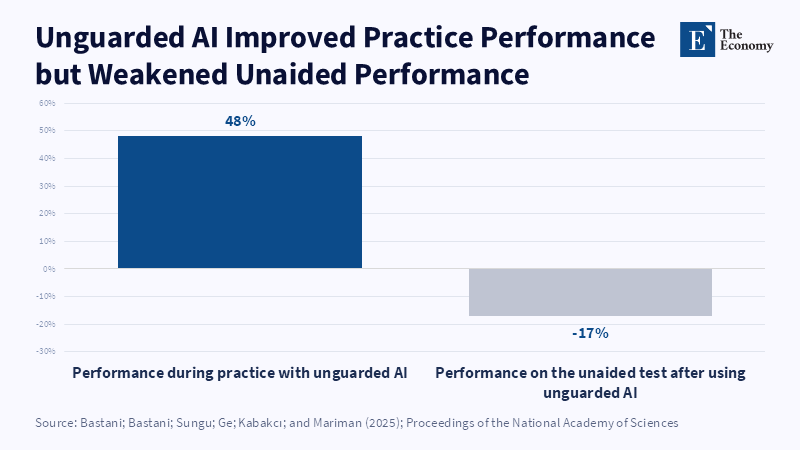
An AI tutor raised high school students’ mathematics practice scores by 48 percent. But then the tool was withdrawn. When they were tested without AI, students who had practiced with the open-ended chatbot scored 17 percent lower than their peers who practiced without one. It illustrates the real problem with AI in education. That performance improved in the presence of a tool does not mean the person learned something. That an AI can produce a fluent, seemingly knowledgeable answer does not mean that it understands. An AI cannot, unaided, observe a student’s reasoning or judge how much support preserves independent thought. But most of all, it cannot independently determine what constitutes “help,” rather than a “shortcut.” The crucial issue for the AI in education policy agenda, therefore, should not be about how advanced the technology becomes, but how strong teacher AI literacy grows in order to keep human learning at the center of the process.
Teacher AI Literacy Is the Missing Infrastructure
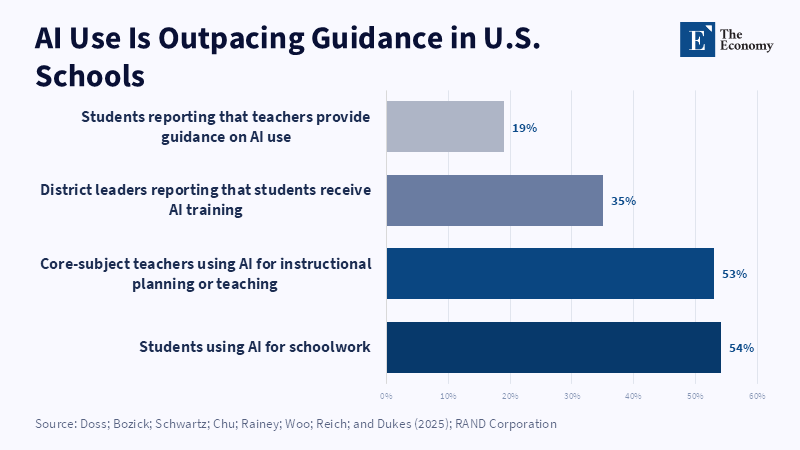
For the most part, student access is no longer the key policy challenge. As of February 2025, 92 percent of undergraduates in the United Kingdom reported using at least one AI tool in some form, while 88 percent had used generative AI for assessed work, according to a HEPI survey. For K-12, a RAND analysis found that in core subjects, 54 percent of students and 53 percent of teachers reported using AI in their school during the 2024-25 school year. The adoption curve is faster than any standard curriculum development cycle. No school can assume students will await their permission to use an emerging tool; they are already experimenting with applications, sharing effective prompts and figuring out what work the machine can accomplish in mere seconds.
The more urgent questions should be: Are teachers equipping their students to think with AI instead of submitting to it? Are teachers prepared to shape AI use to facilitate thought, practice and constructive feedback? This requires more than licensing technology; teacher AI literacy has become a core form of instructional infrastructure. It combines pedagogical knowledge, professional ethics, technical competence and an understanding of the limits of AI tools. A school might have plentiful licenses, state-of-the-art computing devices and speedy internet connections; yet still be caught unprepared if teachers cannot correctly judge AI output, rewrite a weak or poorly conceived activity, or advise their students on when AI has exceeded its supportive function and begun to replace a cognitive task.
This disparity is apparent in students’ learning experiences, too. Of the students RAND surveyed, Over 80 percent stated their teachers had not taught them how to use AI for school tasks and only 35 percent of district leaders indicated that their districts provide AI training for students. Higher education students identified AI skills as important-two-thirds said that they were essential in today's world -yet just 36 percent have received instructional support to learn them. What these numbers illustrate is why student experience is not the same as proficient use: young people can readily navigate the interface of the newest AI, but can they effectively test an AI-generated claim, diagnose bias in a response, protect their personal data, disclose the use of the tool appropriately in the body of their work and in footnotes and detect when slick text is hiding weak arguments? Being able to produce text quickly is not synonymous with having robust judgment. And in the process of developing such capacity, teachers play a crucial role-they set the ground rules for students to learn how to query AI rather than merely defer to it.
None of this means that the older a teacher is, the more likely they are to struggle with the tools. The age target in much discourse is easy to pick out, making a systems failure appear as an individual one, but it masks the real causes: uneven professional development, weak leadership, limited time and unclear guidance. A confident user could still create shallow work if their tools enable poor design choices, just as a wary one could learn to become remarkably adept with sufficient training. As UNESCO’s AI competency framework for teachers outlines, AI competence should be understood broadly as a constellation of professional skills rather than merely tech proficiency: This framework combines human-centered values, ethics, technical knowledge, AI pedagogy and continuing professional learning. Learning effective prompts, a sliver of these competences, is important. But the central task of teacher literacy is learning to recognize what a key learning objective for the human student should be, when an AI tool may be a helpful appendage rather than an undue substitute and how to verify that a student has attained a given understanding.
Teacher AI Literacy Must Mean More Than Prompting
The sharpest evidence for this case comes from the design of the AI tools themselves. In the mathematics trial for high school students, the participating AI tools included a simple, open-ended generative model and a “guarded” AI tutor designed to scaffold, or help students work through, the problem-solving process. Both tools improved performance when students practiced with an AI in the room; in contrast, the students using the open model did 17 percent worse on the final test taken without AI support. The takeaway from this study is not that AI is harmful for students’ learning-instead, design matters. An AI that acts as a true scaffold to thought has very different effects than one that functions more like a crutch, as evidenced by students’ eventual performance without any support. A teacher who understands the distinction will strategically deploy an AI that offers hints, probes students’ thinking, prompts comparison of methods and points out a specific error, whereas a teacher who lacks such literacy might become a passively accepting recipient of slick responses produced by an AI, conflating completed output with student mastery.
As Nigeria’s experiences illustrate, how AI is introduced into a system is crucial for how it impacts students. A six-week program where secondary students used Microsoft’s Copilot in after-school English lessons in Nigeria demonstrated a 0.31 standard-deviation gain in a composite assessment, along with a 0.23 standard-deviation gain in English. In essence, according to the economic measure used, students gained the cost-effectiveness equivalent of approximately 1.5 to two years of business-as-usual schooling, not because a smarter model was deployed, but because an intervention was “designed,” connecting AI with teachers already trained in pedagogical techniques. Teaching students AI skills and having access to AI are distinct and the trial shows why: the tool supported trained teachers, who guided students through structured tasks.
This conclusion is mirrored in AI tools designed to support adults instead of replacing them. In the context of online mathematics lessons aimed at underserved communities, a program known as Tutor CoPilot supplied AI guidance to human instructors by giving real-time prompts and suggestions on where they could offer intervention, as found in a randomized study involving 900 tutors and 1,800 students. Students taught by AI-equipped instructors were four percentage points more likely to master the assessed topics and those working with lower-rated tutors gained nine percentage points. Rather than the AI giving directions or answers away immediately to students, the AI helped the instructors guide students through the task and prevent the pattern of teachers simply explaining the problem in response to student questions or requests for immediate answers. This kind of design process appears more constructive as a blueprint for AI in education. In this model, an AI system provides possible interventions and the human instructor has the discretion to decide whether and when to deploy that intervention based on how it serves the needs of each unique student and fits the subject at hand. In this structure, human authority prevails. And this structure would not be viable if it were not bolstered by teacher AI literacy.
Assessment Is the Real Stress Test for Teacher AI Literacy
While there are concerns that teachers lack control over what students and faculty use when it comes to the latest generation of tools, the reality is that AI has not made honest academic work impossible. But it has revealed how many of the academic assignments have been designed to celebrate finished output, rather than demonstrate process, progress, or the construction of an idea. Any common worksheet or prompt can often be completed using one of the powerful generative AI models and treating every such use as cheating avoids the real question. How was that task intended to demonstrate the student’s thinking? Assignments now need a series of stages to allow students to demonstrate learning: writing a first draft; explaining a prompt; justifying a choice of sources; analyzing an AI response against a human one; or demonstrating growth after receiving feedback, or conducting some part of the work in class.
To understand what is learned, students’ work should allow teachers to assess observable thinking with in-class or in-person work or explanations, or an oral discussion of their reasoning, while also incorporating other modes of assessment-perhaps in using a recent, local example instead of generic one; in a written process log; or in explicitly noting when the use of an AI has been integrated into a task and when it has not.
As for guidelines, teacher AI literacy is crucial to developing consistent levels of permitted AI use for each assignment. What might be suitable when learning code, testing ideas or developing practice questions may be unsuitable for basic skill development, clinical judgment or closed assessments. Clear communication between the teacher, students and institution with regard to policy needs to extend and include expectations of prompting, disclosure and use, rather than being a guessing game that is an exercise in inequity.
A frequent objection to the more detailed consideration is that such an effort requires additional work. Those who already juggle these demands could find adding even more responsibility unsustainable. However, using these AI tools carefully could help ease the burden. A June 2025 Gallup report on U.S. public-school teachers found that 60% had used at least one AI tool for their jobs, with 32 percent using one or more once a week. Those teachers reported an average of 5.9 saved hours per week, a figure derived from teachers estimating the total hours they saved across multiple uses and may not reflect a true measurement of productivity, but is nevertheless indicative of usage trends. Much of the use reported by teachers occurred in the preparation and customization of instructional materials, suggesting that with mindful integration, those savings in time could be shifted to more impactful and less routine pedagogical tasks.
Build Teacher AI Literacy as a System, Not a Workshop
In its current state, the dominant model for teacher training, typically a brief one-hour session on prompts, is simply not enough. Although learning about how to open and initiate work with AI tools certainly plays a role in ensuring faculty engagement with the technology, that will not adequately prepare teachers to re-evaluate the tasks and assessments they assign; to analyze how the AI tool works, identifying where and how errors are produced; to safeguard the privacy of students; nor to critically decide when use of the tools should be prohibited entirely.
An effective strategy for teacher AI literacy will require a learning process over time that extends from establishing a baseline for AI competence (both conceptual knowledge and application in practice), to providing context and examples based on curriculum-specific areas of need, dedicated time for trying and revising assignments in small professional learning communities, peer coaching and reflective reviews of how AI use in student assignments is affecting what and how students learn. Instead of showcasing brilliant demonstrations of AI, training should include failure cases-how a hallucinated citation works, for instance, or why feedback, while delivered fluidly and efficiently by an AI, is superficial and needs to be replaced, improved, or rejected. The goal is not to transform every educator into a computer programmer, but rather to enable all educators to make pedagogically informed choices about the use of this new technology.
School leaders must revise what they measure. Purchasing licenses for tools to then build capability is the wrong order of operations. AI procurement policies should include assessments of vendor privacy practices, age suitability of use, accessibility, capabilities for detecting erroneous information and the ability of educators to direct or prevent use. Pilot projects should contrast student performance and learning on assignments performed before and after an intervention, with and without AI support. In addition to metrics of hours saved or usage numbers, evaluations of AI use in schools ought to focus on students' abilities to explain concepts, transfer skills and detect false information or limitations of an AI, without an AI assisting, as well as equity in guidance offered to students or across disciplines. Unequal development of teacher AI literacy is a particular risk; unless all students’ teachers are equipped, some will have access to high-quality human guidance, but others may face either bans or mediocre automated assistance.
Policymakers should view the development of AI literacy for teachers as a core dimension of their professional expertise. While national or state standards will certainly benefit from UNESCO’s five-part framework for teacher AI competency, any standards must be undergirded by real funding, not merely by proclamations. The professionalization of AI in education entails revising teacher training courses to incorporate design for AI, along with assessment strategies for its use. Teachers must have paid, dedicated time to study new approaches and materials and be offered credentials recognized on a school or system level. National and regional inspectorates must evaluate schools on how they support the development of teachers’ professional knowledge of AI, not simply on whether a school has published an official AI policy. Public communication regarding acceptable use should differentiate between the administrative support that an AI offers, the use of which poses minimal direct risk to student cognition and direct instruction that can alter student thinking and therefore should be accompanied by clear safeguards, regular public assessment and additional oversight.
One argument may be raised: teacher development is too slow for rapidly changing AI tools. However, speed without professional control is not innovation; it is unmanaged exposure. Students do not need a teacher who has mastered the latest generation of technology faster than their students; they need a teacher who has set pedagogical goals, guarded progress in “productive struggle”, challenged assumptions, evaluated evidence and required the machine to remain silent. The initial experiment showed the cost of confusing high school student-assisted work (a 48 percent gain in practice) with learning (a 17 percent loss when work moved to an unaided context) and delivered a clear policy warning. Success will depend less on model capability than on whether institutions equip educators to use the technology to pose better questions, protect productive struggle and use AI judiciously - even if it means keeping the machine at bay.
The views expressed in this article are those of the author(s) and do not necessarily reflect the official position of The Economy or its affiliates.
References
Ash, A.M. (2025) ‘Three in 10 teachers use AI weekly, saving six weeks a year’, Gallup, 25 June.
Bastani, H., Bastani, O., Sungu, A., Ge, H., Kabakcı, Ö. and Mariman, R. (2025) ‘Generative AI without guardrails can harm learning: Evidence from high school mathematics’, Proceedings of the National Academy of Sciences, 122(26), e2422633122.
De Simone, M., Tiberti, F., Barron Rodriguez, M., Manolio, F., Mosuro, W. and Dikoru, E.J. (2025) From Chalkboards to Chatbots: Evaluating the Impact of Generative AI on Learning Outcomes in Nigeria. Policy Research Working Paper 11125. Washington, DC: World Bank.
Doss, C.J., Bozick, R., Schwartz, H.L., Chu, L., Rainey, L.R., Woo, A., Reich, J. and Dukes, J. (2025) AI Use in Schools Is Quickly Increasing but Guidance Lags Behind: Findings from the RAND Survey Panels. Research Report RRA4180-1. Santa Monica, CA: RAND Corporation.
Freeman, J. (2025) Student Generative AI Survey 2025. HEPI Policy Note 61. Oxford: Higher Education Policy Institute. (Accessed: 23 June 2026).
Miao, F. and Cukurova, M. (2024) AI Competency Framework for Teachers. Paris: UNESCO.
Olsen, B. and Thomas, J. (2026) ‘Will AI in education succeed?’, Brookings Institution, 9 June.
Ransome, E. (2026) ‘What generative AI reveals about staff capability and institutional risk in higher education’, Higher Education Policy Institute, 1 April.
Turner, C. (2026) ‘The risks of AI in schools outweigh the benefits, report says’, NPR, 14 January.
Wang, R.E., Ribeiro, A.T., Robinson, C.D., Loeb, S. and Demszky, D. (2024) ‘Tutor CoPilot: A human-AI approach for scaling real-time expertise’, EdWorkingPaper, No. 24-1054. Providence, RI: Annenberg Institute at Brown University.
Working across research, policy, and data-driven analysis, the Editorial Board ensures that published pieces reflect a consistent institutional perspective grounded in quantitative reasoning and long-term structural assessment.