China Transshipment and the Southeast Asian Weak Link in Chip Controls

Working across research, policy, and data-driven analysis, the Editorial Board ensures that published pieces reflect a consistent institutional perspective grounded in quantitative reasoning and long-term structural assessment.
Authored On
Modified
China transshipment now extends beyond tariff avoidance
Southeast Asia is both a chip hub and a diversion risk
Export controls should track ownership and final use

In less than a month in 2025, at least $510m worth of high-end US-designed servers were allegedly diverted to China via a South-East Asian company. The case, uncovered by US prosecutors in March 2026, was not about a secret port or a clandestine chip design. It was about simple tools: falsified end-user declarations, repacked servers, pass-through companies and dummy servers, all designed to fool the inspectors. That total reveals the real vulnerability of today’s technology controls. Their flaw is not simply transshipment by China. Their weakness, rather, lies in the fact that sanction rules continue to trust the buyer's legal definition more than the tangible origin, ownership, or final utilization of a product. South-East Asia is now the world's new border, hoovering up real investment, employment and expertise while also providing a route to pass products through the back door concealed in the veil of legal commerce. Yet it is a policy challenge that must be addressed.
China Transshipment Has Moved Beyond Relabelled Goods
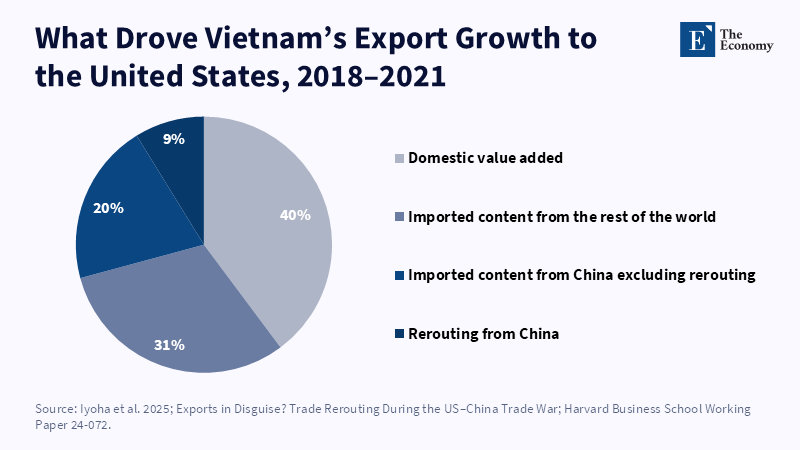
China transshipment became a new policy concern only after the broad tariffs imposed on Chinese products in 2018. Exporters showed remarkable agility. Some goods were exported through Vietnam, Malaysia, Thailand, or Mexico. Others underwent minor processing before being labeled as originating elsewhere and sent to the US. However, there were findings revealing that not all the increased exports from SEA were a mere facade. A firm-level investigation of Vietnam revealed that about 8.8 percent of the post-tariff export increase to the US was from Vietnamese re-exported Chinese goods. Meanwhile, almost 40% were derived from added Vietnamese value and 20.4% from added Chinese inputs. Chinese and Hong Kong-owned companies made up more than half of the tariff-driven rerouting. Both evasion and genuine production growth could coincide for a period of time and a customs label does not tell which segment created the end product.
That pattern is now shifting from finished goods to strategic components. Whereas the old form of China transshipment was designed to beat a tariff, the new form may be designed to allow access to technology that cannot be legally sold to a Chinese end user. This distinction is important. A tariff creates a price differential; a control on an export creates a legal block to the buyer/destination/use. The profit incentive to conceal the true customer is therefore much greater. A shell company, a warehouse rental and a local director can make a prohibited deal look like a normal regional sale. The goods may never cross the border and never go into true Chinese production; they can just be repacked, split and shipped through the freight forwarder and all the documentation appears to be in order, but the actual business story is false.
Recent cases demonstrate how effective this can be in practice. In August 2025, US authorities charged that an American firm had redirected important AI chips via freight forwarders in Singapore and Malaysia. Prosecutors claimed that a minimum of 20 shipments traveled along these routes. The larger case announced in March 2026 went further. It claimed that a producer in Southeast Asia had purchased some $2.5 billion of high-performance servers during 2024 and 2025, then helped funnel many of these to clients in China. Thousands of placeholder servers were apparently arranged to abide by inspections after the real machines had already departed. These are still just claims, rather than definitive legal rulings. Nonetheless, they reveal one fundamental weakness. Screening systems tend to check for the presence of documents. They do not tend to check whether the claimed enterprise could make use of whatever they purchased.
The Semiconductor Corridor Is Real, but Its Risks Are Also Real
The argument over China transshipment needs to assume a simple fact first: Southeast Asia is a different but large semiconductor region in its own right. Singapore has world-class wafer fabs, equipment, materials and research capacity; Malaysia has forty years of experience in assembly, testing, packaging and now intends to expand into design and advanced packaging; Vietnam is establishing a larger back-end industry and training thousands of engineers; while Thailand and the Philippines have important electronics, automotive and chip-making activities along with testing. The economies have compelling reasons to welcome new plants. Semiconductor investment provides skilled jobs, cash flows from taxes, suppliers and a pathway into the more profitable manufacturing stages. To treat any China-related project as suspicious undermines genuine growth, undermines regional government trust and blights progress.
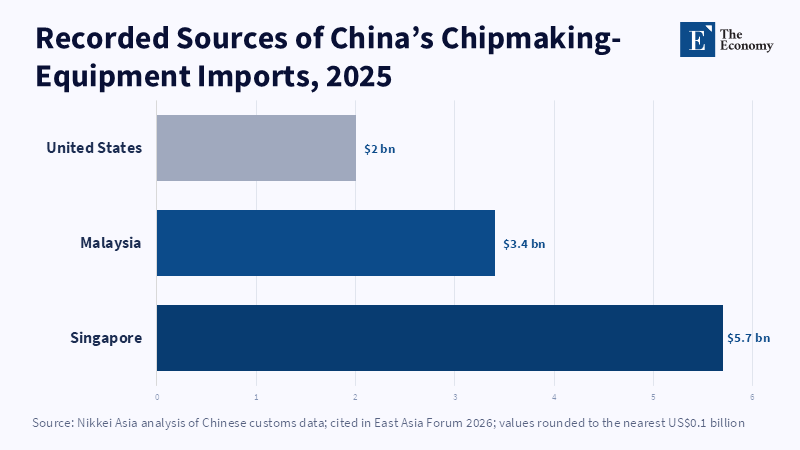
Trade data, however, demonstrates where simple faith falls short. China imported a record $51.1 billion worth of semiconductor manufacturing equipment in 2025. Imports directly reported from the United States plummeted, while reported imports from Singapore alone totaled about $5.7 billion and from Malaysia, $3.4 billion. The increase does not necessarily mean illegal diversion of the equipment. Much may have been built, installed, maintained, or legitimately re-exported within the region. Some equipment enables mature-node processes not subject to the most restrictive controls. Though Singapore and Malaysia are home to genuine facilities of leading equipment manufacturers, a swing in trade alone is just a warning, not a conclusion and must be interpreted together with information at the firm level.
That should be the basis of policy. Washington has too often relied on the country of shipment as a speculative proxy for risk. It should instead inquire whether the buyer has the engineers, power supplies, clean-room space, service contracts and production records to operate the equipment. A start-up corporate buyer placing an order for hundreds of advanced servers should not pass review merely because it has an office and a local registration number. The same is true with chip manufacturing equipment. Its serial numbers, installation records, service archives and software access history can be repeatedly verified. Exporters already compile most of this information for warranty repair, calibration and service work and regulators should use it to establish a common means of end-user verification rather than a one-time form completion requirement. That would effectively "bake in" a check on actual use over time rather than judging on fleeting intentions.
Critics will say that such oversight would discourage trade and encourage Southeast Asian governments to lean towards Beijing. That's a genuine danger. Imposing blanket tariffs and arbitrary regulations has already damaged the US's appeal as a trading partner. To treat ASEAN as a suspicious grouping would only make this worse. Conversely, soft monitoring would impose higher costs on the region. If diversion grows, the US may retaliate with nationwide import caps and steeper tariffs, or require tighter licensing. Genuine regional companies would then be penalized for the behaviors of a handful of affected intermediaries. Strong local enforcement of controls is therefore not an American luxury. It helps preserve Southeast Asia's role as a reliable source of semiconductors, not a stopover for someone else's measures.
Organized Crime Exposes the Cost of Weak Corporate Verification
Though this time, the facts do not justify such a wide allegation against China-related companies or citizens. There is no overwhelming evidence to suggest that triad-related organizations control the entire semiconductor industry in China, or that they are responsible for all the cases of reported chip diversion. It would be unwise to lump together the legitimate Chinese investment activities, national policy, private companies' illicit smuggling activities and transnational crime - four distinct actors pursuing various objectives.
However, the more serious implications of the organized-crime evidence relate to institutions. Large organized criminal networks have demonstrated that they can conceive, establish and concurrently operate multiple companies, transfer money, rent lab sites, corrupt officials, acquire partial ownership of other companies and smuggle workers across national borders for decades. This means that weak company records and light-touch audits are dangerous for any high-profile sector and even more so in the absence of direct proven criminal associations.
The scam-center industry provides the clearest warnings. INTERPOL reported victims trafficked into online scam centers from 66 nations by March 2025. Around 74% were taken into compounds across Southeast Asia. The US authorities said that Americans alone had been defrauded of at least $10 billion by regionally based scams in 2024. They were not a small, subterranean phenomenon. Many used hotels, casinos, business parks, payment companies, data service providers and local protection. UN investigators linked these operations with human trafficking, the underground economy, malware, bribery and money laundering. A raid often uncovered just one element of a network of three or four other sites. With industry pressure mounting, the firms swap locations, change names, relocate employees, or set up shop elsewhere. The shell premises may be abandoned, while the merchants remain.
Implementation has involved co-operation between governments, police agencies, financial institutions and tech companies. By December 2025, nearly 60 nations had linked into an international alliance against fraudsters in Bangkok. INTERPOL, UN agencies, China, the United States, the United Kingdom, as well as a range of agents across Southeast Asia, have taken steps. Thousands of employees have been extracted from sites, major networks have been targeted and assets have been frozen. Nonetheless, UN sources explained in March 2026 that the illicit infrastructure persisted. The reality is not that all regional trade is illicit. It is that a registration at a business bureau, the clearance through customs and even office premises do not establish the organization's purpose or those benefiting from it. An office, after all, can be used for a fraudulent transaction.
That matters at all to the controls on semiconductors, because those same vulnerabilities are common to every market. A nominee director conceals the true owner. A freight forwarder covers a final destination. A storage emplacement is prepped for inspection. A chain of payments distances the buyer from the beneficiary. That doesn't establish a direct relationship between scam syndicates and the procurement of chips. What it clearly illustrates, however, is why compliance can't stop after a company search and a signed declaration. High-risk technology requires the same checks on assets, finances, equipment and use. The test should be against deceptive behavior, not nationality. That rule protects bona fide Chinese companies every bit as much as it would safeguard US technology and Southeast Asian enterprise. This is what also keeps the standard reasonable and unbiased.
China Transshipment Policy Must Follow Control, Not Labels
A robust China transshipment strategy would start with beneficial ownership. Regional states, including Singapore, Malaysia and Vietnam, should require uncertain sellers and end buyers to disclose their ownership to customs, financial intelligence units and export-control partners. Sudden ownership changes, weak capitalization, repeated addresses and shared directors should trigger enhanced inspection. The point is not to disfavor new firms: it is to see into a new company’s industrial intentions, required manpower and suitable premises for the commercial size of the purchase. Paper companies will not be trusted to the same extent as mature manufacturers: inspections should intensify as the sum and danger of the purchase increase.
Verification should then monitor the goods following shipment. Customers might log serial numbers, installation locations, remote software access, service calls and parts replacements. Any server cluster appearing to leave its specified location should trigger an alarm. Any chip tool that never arrives at installation or maintenance support may likewise be suspect. Post-shipment checks should be so numerous that a rented warehouse can't be staged for a proper inventory checkup. Exporters and buyers of the highest-risk items could be forced to maintain secure, time-stamped inventories. These steps aren't as noticeable as a new tariff, but perhaps more directly relevant to the place of failure and easier to isolate at probable transactions. They also avoid interrupting most genuine commerce. That's a reasonable price.
Regional authorities will also need incentives to implement controls. Enforcing semiconductor restrictions costs money. It calls for experienced customs officers, technical inspectors, data systems and legal authority to seize suspect shipments. The United States, Japan, the Netherlands and leading equipment suppliers could help underwrite that capacity. Trusted firms would be given faster licensing privileges and eased customs procedures. Countries that establish effective controls should be rewarded with greater access to investment, human capital and technology cooperation. Willful diversion should target the companies, middlemen and officials who enable it. Yet export restrictions should be kept targeted. China is investing heavily in homegrown equipment supplies and broad restrictions risk accelerating that shift, killing profitable trade. The most effective restrictions would target the most sensitive equipment and high-end computers, not the whole chip ecosystem.
The alleged diversion of $510m did not happen because there was no other tariff schedule in the world. It happened because false firms, false records and false machines could be accepted as proof. China transshipment has become the litmus test of policy: does it see through the legal form to the economic fact? South East Asia should not be cast as a passive victim or a willing conduit. It is a burgeoning semiconductor hub with a direct interest in proper trade. The correct policy is mutual verification, targeted interdiction and genuine rewards for trusted production. Rules based on ownership, serial numbers, cash flow and ultimate user will be more difficult to dodge than rules that end at the consignment note. Without that move, the next dummy warehouse is already in place. The next breach will not be a surprise; it will be a consequence of rules that prefer labels to proof.
The views expressed in this article are those of the author(s) and do not necessarily reflect the official position of The Economy or its affiliates.
References
BBC News (2025) ‘Thousands of Chinese lured abroad and forced to be scammers—now Beijing is cracking down’, BBC News.
Delaney, S. (2025) ‘China reshapes global shipping order, secures stakes in 129 ports worldwide’, The Economy, 22 July.
East Asia Forum (2026) ‘China’s chipmaking supply chain runs through Southeast Asia’, East Asia Forum, 20 June.
INTERPOL (2025) ‘INTERPOL releases new information on globalization of scam centres’, 30 June.
Iyoha, E., Malesky, E.J., Wen, J. and Wu, S.-J. (2025) ‘Exports in disguise? Trade rerouting during the US–China trade war’, Harvard Business School Working Paper, No. 24-072.
Lee, K. (2025) ‘China tariff transshipment and the illusion of decoupling’, The Economy, 22 November.
MEDIAWORLD (2026) ‘The chip reshoring wave and Asia’s new semiconductor hubs’, Industry Asia-Pacific, 2 June.
O’Leary, N. (2025) ‘Transshipment and label switching: U.S. circumvents China’s rare earth export ban’, The Economy, 10 July.
Reuters (2025) ‘What are Southeast Asia’s scam centres, and why are they being dismantled?’, 4 March.
Silverado Policy Accelerator (2026) ‘China’s semiconductor manufacturing equipment imports hit record levels in 2025’, 17 February.
South China Morning Post (2025) ‘Trump’s chip tariffs may drive South-East Asia into China’s arms, analysts warn’, republished by The Star, 9 August.
United Nations Office on Drugs and Crime (2025) Inflection Point: Global Implications of Scam Centres, Underground Banking and Illicit Online Marketplaces in Southeast Asia. Bangkok: UNODC Regional Office for Southeast Asia and the Pacific.
Working across research, policy, and data-driven analysis, the Editorial Board ensures that published pieces reflect a consistent institutional perspective grounded in quantitative reasoning and long-term structural assessment.