"Territory or Security?" EU Opens Ukraine Accession Talks, Nation’s Future Hinges on the Fate of Donbas and Crimea

Siobhán Delaney is a Dublin-based writer for The Economy, focusing on culture, education, and international affairs. With a background in media and communication from University College Dublin, she contributes to cross-regional coverage and translation-based commentary. Her work emphasizes clarity and balance, especially in contexts shaped by cultural difference and policy translation.
Authored On
Modified
Launch of discussions on the first accession chapter
Breakthrough enabled by Hungary’s change in government
Potential reshaping of Europe’s postwar security architecture
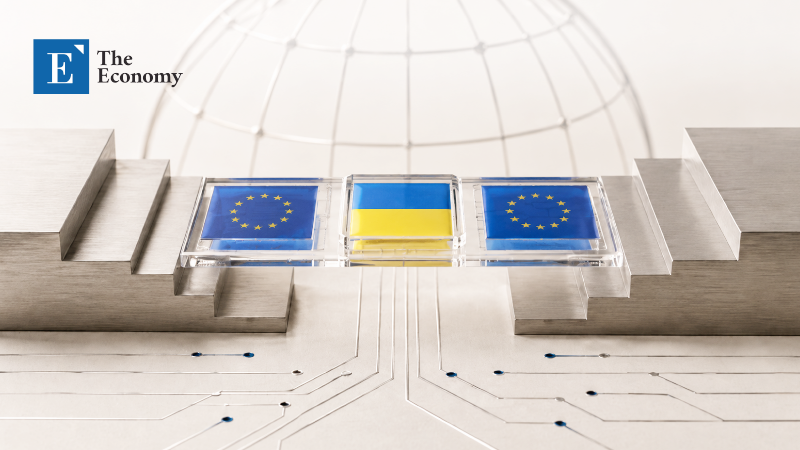
The European Union (EU) has formally launched the accession process for Ukraine, which has been fighting Russia’s invasion for a fifth consecutive year. On the surface, the process is aimed at assessing Ukraine’s adherence to the rule of law and institutional reforms. Beneath that, however, discussions over the future postwar order surrounding the fate of Donbas and Crimea are advancing in parallel. As Ukraine’s path toward EU membership becomes increasingly tangible, debate over a new equilibrium acceptable to both Russia and the West is also expected to gain momentum.
First Step After Four Years as a Candidate
On June 15 (local time), the EU began discussions on the first cluster of accession negotiations with Ukraine during a meeting of foreign ministers from the bloc’s 27 member states in Luxembourg. The initial stage focuses on core institutions underpinning EU membership, including the rule of law, judicial reform, and public administration standards. Taras Kachka, Ukraine’s deputy prime minister, who attended the meeting, said, “For us, this is a true crossing of the Rubicon and a historic milestone,” adding that “Ukrainian society as a whole regards EU membership as a national aspiration.”
Ukrainian President Volodymyr Zelenskyy has pursued EU accession as a central foreign policy objective, viewing membership as essential for guaranteeing national security against Russian threats and securing long-term prosperity. Shortly after Russia’s invasion in February 2022, Ukraine applied for EU membership alongside neighboring Moldova, which also faced concerns over Russian security threats. Both countries obtained EU candidate status in June of that year. The EU had planned to open accession negotiations with Ukraine and Moldova in June 2024, but substantive talks failed to begin due to opposition from Hungary under the leadership of the pro-Russian Viktor Orbán.
Negotiations that had remained deadlocked gained new momentum after Orbán lost power for the first time in 16 years in Hungary’s general election last April. Prime Minister Péter Magyar recently reached an agreement with President Zelenskyy on strengthening the rights of Hungary’s ethnic minority in Ukraine, a key condition for Budapest’s support of Ukraine’s EU membership bid. The breakthrough allowed Ukraine to take the first step in accession negotiations that had been stalled for two years. Nevertheless, actual membership remains a lengthy process. Candidate countries must align their laws and institutions with EU standards across six broad areas and 35 detailed chapters covering issues such as the rule of law, security, the environment, and agriculture. Final accession also requires unanimous approval from all 27 existing member states.

Donbas and Crimea: The Biggest Variables
Renewed momentum in Ukraine’s EU accession talks is drawing attention because it is directly linked to the issues of Donbas and Crimea. The territorial disputes surrounding areas occupied or effectively controlled by Russia have long been regarded as the most complex geopolitical challenge in Ukraine’s integration with the West. Russia annexed Crimea in 2014 and has politically and militarily supported pro-Russian separatist forces in Donbas. Since the outbreak of full-scale war in 2022, the region has become the central justification underpinning Moscow’s war objectives.
For Ukraine, Crimea and Donbas symbolize the restoration of sovereignty and serve as a foundation of domestic political legitimacy. However, as the war drags on and human and financial costs continue to mount, some voices in the West have again advanced a more pragmatic approach linking territorial issues to security guarantees. Recent U.S.-backed peace initiatives have also discussed a framework combining concessions in Donbas with long-term security guarantees, narrowing Ukraine’s strategic options.
Russia’s calculations are also more nuanced than they may appear. Moscow has consistently described NATO expansion as a direct security threat, yet it has taken a comparatively flexible stance regarding Ukraine’s potential EU membership. The Kremlin has characterized EU accession as a sovereign choice for Ukraine while treating NATO membership as a separate security matter. Analysts believe this distinction leaves room for a future compromise in which EU membership is accepted in exchange for excluding military alliance membership.
For Russia, Donbas and Crimea represent both a military buffer zone and a political trophy. Control of Donbas provides justification through the protection of Russian-speaking populations while securing an important industrial region. Crimea, meanwhile, guarantees access to the Black Sea Fleet and southern maritime routes. Another reason Russia seeks Donbas lies in its geographic significance. Having annexed Crimea and secured a warm-water port that remains ice-free year-round, Moscow requires a land corridor linking the peninsula to the Russian mainland.
At present, Crimea remains largely isolated from mainland Russia and is connected primarily through the Kerch Strait Bridge, which opened in 2018. If Russia were to secure all of Donbas, however, it would gain a new access route linking Crimea and the Mediterranean through the port of Mariupol. Should Moscow secure both strategic axes while tacitly accepting Ukraine’s EU accession, it could achieve the minimum objectives of the war while simultaneously easing long-term confrontation with the West.
An EU Shield Against Future Russian Aggression
Ukraine faces a fundamentally different calculation. The loss of Donbas would be a major setback. Since the outbreak of conflict in 2014, Ukraine has invested heavily in transforming the region into a critical defensive stronghold. If this line collapses, Kyiv would need to establish new defenses farther west across the plains of Kharkiv and Dnipropetrovsk. Donbas is also a key transportation hub, with rail lines connecting Kyiv to eastern Kharkiv and routes leading to Mariupol passing through the region. Russian control of Donbas would significantly increase the vulnerability of the Ukrainian capital itself.
Even so, if EU integration becomes guaranteed despite the loss of some territory, Ukraine would simultaneously secure economic reconstruction, institutional stability, and long-term security backing. Any future Russian pressure on Ukraine would effectively become an issue directly affecting the EU’s political and economic sphere. While EU membership differs from NATO’s collective defense commitments, it would nevertheless function as a powerful deterrent for Ukraine. Ukraine’s accession would also shift Europe’s security frontier eastward. Whereas the EU’s practical defensive line has largely centered on Poland and the Baltic states, Ukraine’s membership would extend that frontier toward Donbas and the northern Black Sea region. Such a development would cement Russia’s position outside the European security order while committing the EU to long-term responsibility for Ukraine’s reconstruction, defense, and institutional reforms.
The burden on the EU, however, is substantial. Ukraine is a major agricultural producer and faces enormous reconstruction needs resulting from the war. This year, the EU approved a financial package worth approximately $105.3 billion for Ukraine while also supporting energy infrastructure restoration and expanded defense production. If accession becomes reality, the bloc will face adjustment pressures across the Common Agricultural Policy, regional development funds, labor markets, energy networks, and defense procurement systems. Resistance from member states with significant agricultural interests, including France and Poland, is also likely to intensify during the later stages of negotiations.
Nevertheless, the EU’s decision to launch accession talks reflects a broader calculation regarding long-term security costs. Leaving Ukraine in a geopolitical gray zone would increase the likelihood of renewed Russian invasions, refugee flows, energy disruptions, cyberattacks, and arms races. The EU is therefore seeking to bring Ukraine into its institutional framework, transforming external instability costs into internally managed security expenditures. Some advocates of a hardline Western position have warned that any peace settlement involving territorial concessions could amount to a replay of the 1938 Munich Agreement. Yet Europe’s current security environment differs fundamentally from that era. Following the cession of the Sudetenland, Czechoslovakia remained outside any external security guarantee system. Ukraine, by contrast, is being integrated into Europe’s political and economic framework.
Siobhán Delaney is a Dublin-based writer for The Economy, focusing on culture, education, and international affairs. With a background in media and communication from University College Dublin, she contributes to cross-regional coverage and translation-based commentary. Her work emphasizes clarity and balance, especially in contexts shaped by cultural difference and policy translation.
Similar Post