“Pocket Six-Figure Bonuses, Reject Burden-Sharing”: SK Hynix Precedent Fuels a Summer of Bonus Battles

Matthew Reuter is a senior economic correspondent at The Economy, where he covers global financial markets, emerging technologies, and cross-border trade dynamics. With over a decade of experience reporting from major financial hubs—including London, New York, and Hong Kong—Matthew has developed a reputation for breaking complex economic stories into sharp, accessible narratives. Before joining The Economy, he worked at a leading European financial daily, where his investigative reporting on post-crisis banking reforms earned him recognition from the European Press Association. A graduate of the London School of Economics, Matthew holds dual degrees in economics and international relations. He is particularly interested in how data science and AI are reshaping market analysis and policymaking, often blending quantitative insights into his articles. Outside journalism, Matthew frequently moderates panels at global finance summits and guest lectures on financial journalism at top universities.
Authored On
Modified
Management Proposes “Industry-Cycle Response,” Labor Decries “De Facto Pay Cut”
Labor and Management Deadlocked Over Mechanism to Adjust Labor Costs During Downturns
Bonus Bargaining Benchmark Spreads to Auto, Shipbuilding and IT Industries
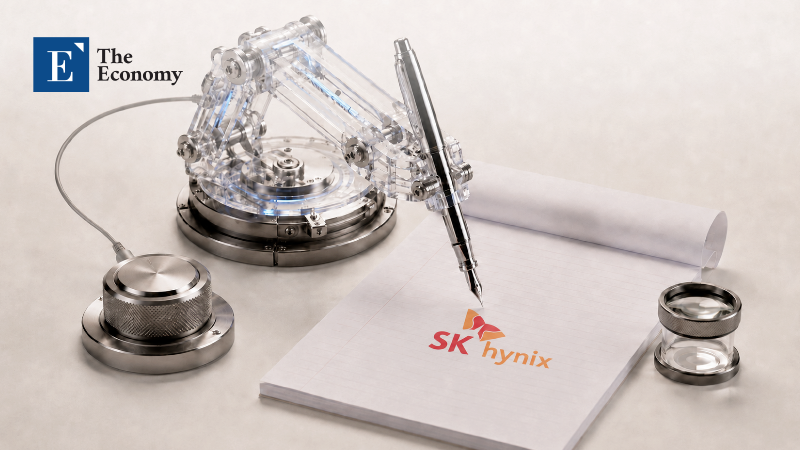
SK Hynix management and labor remain at loggerheads over a proposal to pay bonuses in company stock and adjust wages when the company posts a loss. With the artificial intelligence (AI) memory boom expected to generate bonuses worth several hundred thousand dollars per employee, the union is holding firm to the existing principle of cash compensation, while management is pushing to reform the wage structure in preparation for an industry downturn. The problem is that the dispute extends well beyond SK Hynix. If its bonus formula becomes the benchmark for labor negotiations at other major companies, foreign investors will inevitably have to reassess the case for investing in Korean businesses.
SK Hynix Union Rejects Pay Adjustments in Loss-Making Years
According to semiconductor industry sources on Aug. 3, management and labor again failed to find common ground on the core issues during their recent fourth formal bargaining session. Minutes released by the union show that the company maintained its proposal to pay more than half of the bonus in treasury shares and restrict their sale for a specified period. It also proposed reforming the wage structure to allow temporary pay adjustments when an industry downturn pushes the company into the red.
Management reportedly maintains that the cyclical nature of the memory industry, in which booms and downturns repeatedly alternate, makes it necessary to secure greater long-term flexibility in the wage system. The union, however, argues that adjusting wages during loss-making periods would amount to a de facto pay cut and that paying bonuses in shares would overturn the hard-won labor-management agreement reached last year. It has therefore maintained that neither proposal is acceptable.
In last year’s wage and collective bargaining agreement, the two sides agreed to abolish the cap on the profit-sharing bonus, or PS, funded by 10% of operating profit, and to retain the system for 10 years. They also agreed that 80% of the bonus would be paid in cash in the year it was earned, with the remaining 20% distributed over the following two years. The bonus structure resurfaced as a central issue this year, however, after the company introduced a new proposal to pay part of the award in shares.
Union opposition has intensified further because SK Hynix is expected to deliver record earnings this year amid the AI memory boom. Brokerage analysts forecast that the company’s annual operating profit could reach roughly $175 billion. Dividing 10% of that figure among its approximately 35,000 employees would yield an average bonus of about $490,000 per employee before taxes. Management’s proposal to pay part of the bonus in shares has consequently emerged as a new point of contention in this year’s negotiations. During the third formal bargaining session, the union said, “The company’s bonus proposal undermines the intent and fundamental direction of the agreement that the two sides worked so hard to reach last year, and is therefore unacceptable.”
Profit Sharing Presupposes Responsibility Sharing
A performance bonus is a system for sharing a company’s excess profits with its employees. Labor’s contribution cannot be discounted, since corporate performance materializes only when management strategy, the technical capabilities of research and development personnel, yield management on production lines and customer acquisition by sales teams work in concert. The accumulated expertise of production workers and technological know-how of development personnel were also central to SK Hynix’s emergence as a leader in the high-bandwidth memory (HBM) market and its expansion into higher-value-added memory products.
A profit-sharing system gains institutional legitimacy, however, when it is designed in tandem with a mechanism for sharing risk. Shareholders and creditors expect returns during boom periods, but in exchange accept the risk of falling share prices, reduced dividends, principal losses and bankruptcy. Executives can likewise suffer damage to their positions, reputations and long-term careers when investments fail or earnings deteriorate. Wages under an employment contract, by contrast, are paid in return for labor, while performance bonuses are generally additional compensation layered on top.
No Appetite for Burden-Sharing
Against this backdrop, a position that excludes burden-sharing during loss-making periods from discussion altogether is difficult to defend. Semiconductors are a quintessentially cyclical industry. SK Hynix generated record operating profit of more than $42 billion in the second quarter, but only three years earlier, in 2023, it posted an operating loss of $5.4 billion. Even then, the union demanded a 6.5% increase in base pay and an incentive equivalent to 15% of annual operating profit. At the time, the union sought an additional 4.5% increase, exceeding the 5.5% raise plus a fixed monthly increase of about $70 agreed upon by management and labor in 2022. SK Hynix’s average annual salary in 2022 was approximately $93,700.
On incentives, the union demanded that the PS pool, then funded with 10% of the previous year’s operating profit, be expanded to 15%. It also proposed narrowing the eligibility criteria for the semiannual productivity incentive, or PI, which was paid when production targets were achieved and the company posted an operating profit, so that meeting production targets alone would trigger payment. Other demands included abolishing the wage-peak system, removing the 1,000% cap on PS payments, paying PS bonuses to retirees and incorporating fixed overtime allowances into base salaries.
Management navigated the crisis by deferring payment of the wage increase instead of restructuring its workforce. In an industry characterized by recurring cycles of boom and bust, it is reasonable to design compensation systems from a long-term perspective. The PS system agreed upon last year directly links compensation to operating profit. Sharing more of the gains when business is strong, while also accepting part of the risk when conditions deteriorate, will ultimately determine the company’s future competitiveness.
SK Hynix’s stock-payment proposal should be evaluated in the same context. Converting part of the cash award into shares would align employees’ interests with the company’s long-term value and reduce the sharp cash outflows that accompany short-term earnings surges. Admittedly, excessively long lockup periods or the absence of protection against declines in the share price could place employees at a disadvantage. Even so, defining equity compensation solely as a transfer of risk overlooks the purpose of the long-term incentive programs widely used by global technology companies.
Table 1. Bonus Demands and Agreements at Major Companies
| Company | Demands | Bargaining and Labor Action |
|---|---|---|
| Samsung Electronics Device Solutions Division | Farmark 10.5% of business performance to fund a special management performance bonus. Abolish the payment cap and pay the full after-tax amount in treasury shares | Approved with 73.7% support in a union vote on the wage and collective bargaining agreement in May |
| Hyundai Motor | Pay 30% of the previous year’s net profit as bonuses | Three rounds of partial strikes on July 13–15, July 20–22 and July 29–31 |
| Kia | Pay 30% of the previous year’s operating profit as bonuses | Included in the union’s demands for the 2026 wage and collective bargaining agreement |
| HD Hyundai Heavy Industries | Allocate 30% of operating profit to the performance-sharing pool | Wage and collective bargaining negotiations under way |
| Kakao | Pay approximately $7,000 per employee, equivalent to 13–14% of the previous year’s operating profit. Exclude restricted stock units from bonus calculations | First partial strike at headquarters since the company’s founding on June 10 |
| LG Uplus | Pay 30% of operating profit as bonuses | Included in the union’s wage and collective bargaining demands alongside an 8% increase in total wages |
| Shinsegae | Increase the bonus payout ratio from 10% to 15% | Demanded disclosure of the calculation criteria and creation of a joint labor-management task force |
| Hanwha Aerospace | Abolish the bonus cap and pay 50% of the bonus in advance upon conclusion of the wage and collective bargaining agreement | Negotiations under way alongside a proposed 11.14% increase in base pay |
| HD Hyundai Electric | Abolish the 1,000% cap on bonus payments | Union sent management an official letter protesting application of the cap |
“N% Bonus” Demands Spread to Other Companies
The greater concern is that the SK Hynix labor dispute will not remain an internal distribution issue at a single company. Unions at major Korean businesses are increasingly adopting the compensation formula of a market leader as a new bargaining benchmark without examining the profitability or investment burden of their respective industries. Indeed, once SK Hynix fixed its bonus pool at 10% of operating profit, unions at other companies followed with demands for a specified percentage of earnings. Samsung Electronics, which reached a labor-management agreement in May, decided to pay 10.5% of operating profit as a special management performance bonus to employees in its semiconductor, or Device Solutions, division. Although the entire amount will be paid in treasury shares, the controversy continues.
The demand for “N% bonuses,” which began in the semiconductor industry, has now spread across virtually every sector, including automobiles, shipbuilding, information technology and retail. The union at Hyundai Motor, Korea’s leading automaker, demanded that 30% of net profit be paid as bonuses. It completed a four-hour partial strike on each of July 13–15, followed by a second three-day partial strike involving eight hours per day from July 20–22. The Kia union is demanding that 30% of operating profit be paid as bonuses.
The union at HD Hyundai Heavy Industries, Korea’s largest shipbuilder, is also demanding bonuses equivalent to 30% of operating profit and is moving toward strike action. In the IT industry, the Kakao union demanded bonuses worth about $7,000 per employee, equivalent to approximately 13–14% of operating profit, and staged the first strike in the company’s history last month. The LG Uplus union is demanding that at least 30% of operating profit be distributed as bonuses, while the Shinsegae union is seeking bonuses equivalent to 15% of operating profit. Unions at Hanwha Aerospace and HD Hyundai Electric are calling for the abolition of bonus caps.
Rising Investment Risk in Korea
Bloomberg assessed that the movement was another reminder of the risks confronting investors in the Korean market, where militant unions wield considerable influence. Bum Ki Son, an economist at Barclays, said, “Rigid labor markets and strong employment protections make it difficult for companies to dismiss workers. From the employees’ perspective, the recent bonus agreement resembles a ‘free option’ that protects their jobs during downturns while granting additional compensation during boom periods.”
Foreign capital is particularly wary of unpredictability. High wages and performance-based compensation can be incorporated into investment models when supported by productivity and profitability. If the profit-sharing ratio rises during every boom, adjustment mechanisms are blocked during loss-making periods and failed negotiations repeatedly threaten production disruptions, however, estimating future cash flows becomes increasingly difficult. Investors reflect that uncertainty in discount rates and risk premiums. Financing costs rise, and decisions on new investment in Korean operations inevitably become more conservative.
Moreover, SK Hynix has begun facing direct scrutiny from global institutional investors after raising $26.5 billion through the listing of American depositary receipts on Nasdaq. Global capital markets incorporate not only record earnings into corporate valuations, but also the efficiency of cash allocation, the sustainability of capital expenditure and the stability of labor relations. If the SK Hynix union secures uncapped profit sharing as a right while refusing to discuss adjustments during downturns, the burden will inevitably be transferred to shareholders, suppliers, new hiring and next-generation investment.
Matthew Reuter is a senior economic correspondent at The Economy, where he covers global financial markets, emerging technologies, and cross-border trade dynamics. With over a decade of experience reporting from major financial hubs—including London, New York, and Hong Kong—Matthew has developed a reputation for breaking complex economic stories into sharp, accessible narratives. Before joining The Economy, he worked at a leading European financial daily, where his investigative reporting on post-crisis banking reforms earned him recognition from the European Press Association. A graduate of the London School of Economics, Matthew holds dual degrees in economics and international relations. He is particularly interested in how data science and AI are reshaping market analysis and policymaking, often blending quantitative insights into his articles. Outside journalism, Matthew frequently moderates panels at global finance summits and guest lectures on financial journalism at top universities.
Similar Post