U.S. Poised to Launch ‘Economic Isolation Campaign’ Against Iran, With Ultimate Aim of Cutting Off China’s Energy Supplies on All Fronts

Anne-Marie Nicholson is a fearless reporter covering international markets and global economic shifts. With a background in international relations, she provides a nuanced perspective on trade policies, foreign investments, and macroeconomic developments. Quick-witted and always on the move, she delivers hard-hitting stories that connect the dots in an ever-changing global economy.
Authored On
Modified
Washington Threatens Cascading Sanctions Against Third Countries to Choke Off Iran’s Funding
Measures to Target Sanctions-Evasion Tactics, Including Ship-to-Ship Oil Transfers
Rising Energy Procurement Costs and Supply Disruptions Converge on Chinese Industry
The Donald Trump administration has signaled an “economic D-Day” targeting even third countries that conduct business with Iran. The plan is to ensnare companies, banks and vessels in countries trading with Iran in a sweeping sanctions regime while guaranteeing passage for non-Iranian crude, thereby precisely severing Iran’s financial lifelines while limiting disruption to global energy markets. Although ostensibly aimed at cutting off funding to Iran, the strategy is ultimately seen as an attempt to deprive China of the cheap energy supplies on which it has long relied, simultaneously weakening cost competitiveness across industries ranging from refining to petrochemicals and eroding Beijing’s leverage in negotiations with Washington.
Economic Sanctions Threatened Against Third-Country Governments, Companies and Financial Institutions Supporting Iran
According to Reuters and other major international media outlets on the 23rd local time, U.S. Treasury Secretary Scott Bessent is scheduled to hold a press conference on the 24th local time, or early tomorrow morning in South Korea. In an op-ed titled “Economic D-Day Is Coming for Iran,” Bessent described the economic offensive being prepared by the United States as “the largest single financial attack ever deployed against an adversary.” Trump had previously threatened cascading sanctions against third countries, warning that any country providing Iran with a lifeline through financial institutions, companies or government agencies would pay an enormous economic price. Having concluded that military operations alone are unlikely to end the Iran war as it enters its sixth month, Washington appears intent on worsening Iran’s economic distress to compel Tehran to reopen the Strait of Hormuz.
The United States’ principal objective is to comprehensively sever the flow of funds to the Iranian regime. Bessent defined as “complicity” with the Iranian regime not only the purchase or transportation of Iranian oil, but also the maintenance of financial and commercial ties with Iran, permission for Iranian aircraft to land, acquiescence to ship-to-ship transfers of Iranian petroleum products at sea and failure to prevent related illicit financial transactions. In effect, the United States intends to force countries into a binary choice by imposing secondary sanctions not only on Iran but also on third countries that do business with it.
“Countries calculating that appeasing the Iranian regime is the safer course would do well to consider the price they will pay if they continue,” Bessent warned. Addressing countries that maintain financial and commercial links with Iran in particular, he said that “every avenue to sustainable prosperity will be closed,” stressing that serving as a haven for terrorism means becoming a “global pariah” in the eyes of the United States. He even invoked “Pascal’s wager,” formulated by the 17th-century French philosopher Blaise Pascal (1623–1662), applying to sanctions the logic that decisions made under uncertainty should account for the worst possible outcome.
Selective U.S. Blockade Reverses Iran’s Transit-Fee Pressure
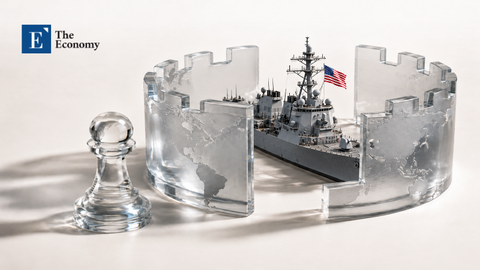
What distinguishes the current plan from previous maximum-pressure policies is that a maritime blockade will reinforce the enforcement power of financial sanctions. The United States plans to combine financial sanctions with a naval blockade to compel third countries to choose sides. Countries and companies trading with Iran would be expelled from the financial system, while the U.S. military would block the movement of associated vessels. This is also why U.S. Central Command resumed its blockade of ships entering and leaving Iranian ports on the 14th of last month.
At the same time, Washington has separately preserved export routes for crude from Gulf oil producers by facilitating passage for regional vessels unrelated to Iranian ports. According to the U.S. digital news outlet Axios, the U.S. Army has established a dedicated unit at Fort Bragg, North Carolina, that coordinates each day the sailing order of empty tankers entering the Persian Gulf from the Arabian Sea and vessels departing with crude cargoes. Over the past two weeks, 15 to 20 tankers each night have used a southern route off Oman’s coast, while U.S. Air Force fighter aircraft and Navy warships have protected the shipping corridor against potential Iranian cruise-missile and drone attacks.
Such covert shipments have become possible after U.S. Central Command weakened Iran’s maritime radar and surveillance networks during two weeks of military operations. According to the United Kingdom Maritime Trade Operations, 103 vessels entered the strait and 89 exited over the past week, lifting traffic by 27% from the previous week. Although this remains only 20% of prewar levels, commodity intelligence firm Kpler estimated that more than 80% of the liquid cargoes passing through over the past two weeks either used the Omani route or sailed with their Automatic Identification Systems switched off. Whereas Iran initially pressured energy-importing countries by closing the strait and imposing transit fees in the early stages of the war, the United States is now guaranteeing passage for non-Iranian crude while confining only vessels linked to Iranian ports within its blockade.
China’s Energy Vulnerabilities in the Crosshairs
This selective transit regime is focused on severing the energy supply chain to China, the largest buyer of Iranian crude. If the U.S. military controls the airspace above the strait and the surrounding waters, Iran’s room to exercise sea control will be sharply diminished. With naval vessels escorting ships and air power deterring cruise-missile and drone attacks, any Iranian attempt to use land-based installations to strike the shipping corridor could also place those facilities on the U.S. target list. Oman’s plan to share transit-fee revenue with Iran will likewise inevitably face disruption. If the United States selectively blocks only vessels linked to Iranian ports, Iran will lose both oil-export and transit-fee revenue, while sanctions-evasion networks operating through neighboring countries will rapidly contract.
China is the country facing the greatest pressure. If Iranian crude is cut off, Beijing can fill the shortfall with supplies from Russia, Iraq and Brazil, but securing the same discounted prices and reliable supply terms it has long enjoyed will not be easy. The longer the blockade persists, the more severe procurement difficulties will become for Chinese refiners, while rising feedstock prices are likely to erode profitability across the petrochemical industry. Iran initially controlled the Strait of Hormuz and pressured energy-importing countries, including China, during the early stages of the war, but the United States has now regained the initiative by blocking transport routes for Iranian crude. For the Trump administration, the strategy offers a means of both severing Iran’s foreign-currency income and exploiting China’s energy vulnerabilities.
Table 1. Changes in China’s Crude-Oil Procurement Conditions Under the U.S. Blockade of Iran
| Category | Previous Figure | Latest Figure | Change and Impact |
|---|---|---|---|
| China’s imports of Iranian crude | 785,000 barrels per day in June 2026; 823,000 barrels per day in July | 534,000 barrels per day in August | Down 35.1% from July |
| Floating inventories outside the U.S. blockade zone | 105 million barrels | 80 million barrels | Down 25 million barrels; difficulty securing new supplies |
| Offer prices for Iranian crude | Discount of approximately $3 per barrel to Brent crude futures | Premium of approximately $2 per barrel to Brent crude futures | Price terms deteriorated by $5 within days |
| Impact on Chinese industry | Refining margins supported by inexpensive Iranian crude | Need to substitute Russian, Iraqi and Brazilian crude | Higher procurement costs and deteriorating profitability for independent refiners and petrochemical companies in Shandong Province |
Chinese Procurement Costs Surge as Cheap Iranian Crude Dries Up
The fallout from the pressure campaign has first penetrated China’s independent refiners in Shandong Province. According to commodity intelligence firm Kpler, China purchased more than 80% of the crude Iran exported by sea last year, with average purchases reaching 1.4 million barrels per day. However, imports declined further after the United States resumed its blockade last month while wartime conditions were already reducing shipment volumes. China’s imports of Iranian crude stood at 785,000 barrels per day in June and 823,000 barrels per day in July before falling to 534,000 barrels per day in August. Floating inventories remaining outside the U.S. blockade zone also declined from 105 million barrels to 80 million barrels, making it more difficult to secure new supplies.
As supplies tightened, Iranian crude offered in the Chinese market this week carried a premium of approximately $2 per barrel to Brent crude futures. This marked a dramatic reversal from just days earlier, when offers had been made at a discount of $3 per barrel. China can offset the shortfall with crude from Russia, Iraq and Brazil, but matching the price competitiveness offered by Iranian supplies will be difficult. This is why independent refiners and petrochemical companies in Shandong Province, which have relied on cheap feedstock to preserve refining margins, are being forced to absorb both higher procurement costs and deteriorating profitability. The U.S. blockade intended to cut off Iran’s foreign-currency income is thus translating into heavier cost burdens for Chinese industry.
China Grows Anxious Ahead of ‘D-Day’
The Chinese government’s recent public opposition reflects the fact that the U.S. blockade has begun to directly destabilize its energy supply chain. Since the war erupted in late February, China has avoided military involvement while urging the belligerents to exercise restraint and pursue a diplomatic resolution. However, it immediately escalated its response after the United States announced that it would sanction buyers of Iranian crude and the banks handling their transactions. Chinese Foreign Ministry spokesperson Lin Jian said on the 20th that “sanctions and pressure do not help solve problems,” calling instead for a political and diplomatic solution. The following day, Beijing also declared its opposition to unilateral sanctions imposed without the approval of the United Nations Security Council. Growing concern that America’s economic D-Day could target Chinese companies and financial institutions has made it increasingly difficult for the Chinese government to remain silent.
The Chinese government has repeatedly pressed for the swift resumption of negotiations between the United States and Iran whenever passage through the Strait of Hormuz has come under threat. According to Reuters, China asked Pakistani Deputy Prime Minister and Foreign Minister Ishaq Dar to mediate between the two countries when he visited Shanghai on the 16th of last month. A Pakistani official said at the time that China had expressed considerable frustration, noting that “Iran’s blockade of Hormuz and attacks on Gulf countries are also damaging Chinese interests.” China and Pakistan subsequently issued a joint statement calling for an immediate ceasefire and the resumption of negotiations. Wang Yi, director of the Office of the Central Commission for Foreign Affairs of the Communist Party of China and foreign minister, also met Iranian Foreign Minister Abbas Araghchi and demanded the implementation of an earlier memorandum of understanding. In effect, disruption to crude-shipping routes has driven the Chinese government to directly pressure its ally Iran.
Tightening Oil-Trading Networks Pressures China and Iran Simultaneously
China’s anxious response has also been shaped by its heavy dependence on imported crude. According to the U.S. Energy Information Administration, 37.7% of the crude supplied to global markets through the Strait of Hormuz is destined for China. Beijing amassed large volumes of cheap Russian and Iranian crude even before the war, but a prolonged blockade would force it to contend simultaneously with dwindling stockpiles and rising import costs. The Wall Street Journal estimated that China has drawn down approximately 56 million barrels from commercial crude inventories and 15 million barrels from refiner-held stocks since May. The country is believed to retain substantial strategic petroleum reserves, but continued depletion of commercial inventories would inevitably increase refiners’ purchasing burdens and intensify upward pressure on domestic oil prices.
Crude-supply disruptions are already spreading rapidly into China’s petrochemical market. According to S&P Global data, approximately 1.2 million barrels of naphtha per day passed through the Strait of Hormuz before the war, accounting for 60% to 70% of Asia’s total imports. In March, however, Middle Eastern naphtha shipments plunged to 692,000 metric tons, less than one-fifth of the previous month’s level, while Asian ethylene prices surged to $1,500 per metric ton in the same month. China’s domestic production capacity and coal-chemical industry are absorbing part of the shock, but another rise in naphtha and ethylene prices would likely intensify cost pressures throughout manufacturing, including plastics, synthetic fibers, packaging materials and automotive components.
The U.S. pressure on China’s energy procurement network is also seen as an attempt to mobilize Beijing to weaken Iran’s negotiating leverage. If China continues purchasing Iranian crude, its refiners, banks and shipping companies will be exposed to secondary sanctions; if it reduces imports, Iran’s principal source of foreign-currency income will dry up. Whichever path it chooses, China will inevitably shoulder a substantial economic burden. Yet any attempt to directly neutralize the U.S. naval blockade would risk military confrontation with the United States, making an armed response an equally unrealistic option.
Anne-Marie Nicholson is a fearless reporter covering international markets and global economic shifts. With a background in international relations, she provides a nuanced perspective on trade policies, foreign investments, and macroeconomic developments. Quick-witted and always on the move, she delivers hard-hitting stories that connect the dots in an ever-changing global economy.
Similar Post