“Launch Is Imminent, but Technological Readiness Remains in Doubt” — Tesla’s Cybercab Risks Becoming a ‘Second Cybertruck’ Amid Robotaxi Troubles and Exodus of Key Personnel

Oliver Griffin is a policy and tech reporter at The Economy, focusing on the intersection of artificial intelligence, government regulation, and macroeconomic strategy. Based in Dublin, Oliver has reported extensively on European Union policy shifts and their ripple effects across global markets. Prior to joining The Economy, he covered technology policy for an international think tank, producing research cited by major institutions, including the OECD and IMF. Oliver studied political economy at Trinity College Dublin and later completed a master’s in data journalism at Columbia University. His reporting blends field interviews with rigorous statistical analysis, offering readers a nuanced understanding of how policy decisions shape industries and everyday lives. Beyond his newsroom work, Oliver contributes op-eds on ethics in AI and has been a guest commentator on BBC World and CNBC Europe.
Authored On
Modified
Tesla’s Fully Autonomous Purpose-Built Vehicle ‘Cybercab’ Nears Launch
Persistent Technology Concerns as Robotaxi Malfunctions and Accidents Mount
Key Cybercab Personnel Depart in Droves, Raising Fears of a Repeat of the ‘Cybertruck’ Debacle
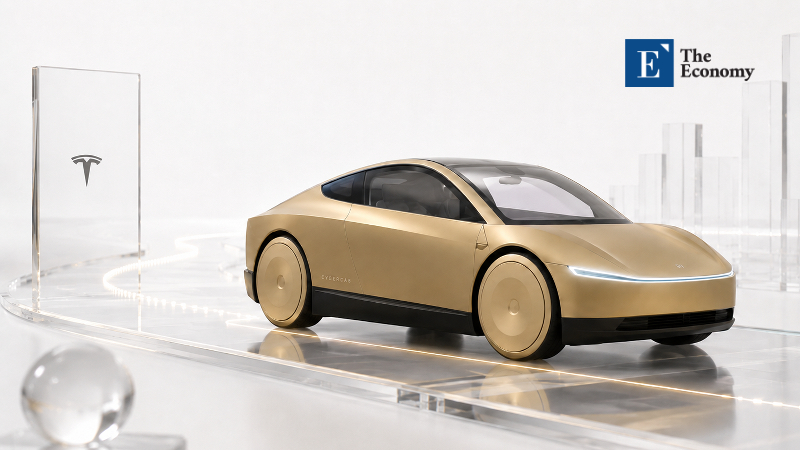
As Tesla prepares to launch the Cybercab, a fully autonomous vehicle without a steering wheel or pedals, market skepticism shows little sign of abating. Concerns over its technological readiness are mounting as the company’s existing robotaxi service continues to experience ride-hailing and routing errors, collisions, and other problems. Some market observers warn that unless these concerns are resolved, the Cybercab could follow in the footsteps of the Cybertruck, which has struggled with quality defects and lackluster sales.
Cybercab on the Verge of Commercial Deployment
According to electric-vehicle news outlet Teslarati on September 1, Tesla recently registered 45 Cybercab vehicles with the Texas Motor Carrier Credentialing System, or TxMCCS. The Cybercab is a two-seat, fully autonomous electric vehicle developed by Tesla. First unveiled at the company’s “We, Robot” event in October 2024, it is distinguished by being a purpose-built autonomous vehicle designed from the outset for driverless operation, rather than a conventional passenger car converted into a self-driving taxi. The production model likewise dispenses with a steering wheel and accelerator and brake pedals, while vehicle control relies on Tesla’s camera-based autonomous-driving system and Full Self-Driving technology.
Launch preparations are already well advanced. Tesla initially said Cybercab mass production would begin in the second quarter of this year, after which Chief Executive Elon Musk provided a more specific timetable, saying production would commence at the company’s Texas Gigafactory in April. Tesla began pilot production in the first quarter and formally announced the start of production in the second quarter, subsequently conducting on-road engineering tests with production vehicles. Commercial deployment is expected to begin in earnest with a Cybercab launch event scheduled to take place in Austin, Texas.
“Is the Technology Ready?” Market Skepticism Persists
The market, however, remains unconvinced about the autonomous-driving technology that will underpin Cybercab operations. The FSD system Tesla currently offers to consumers is not a fully driverless autonomous-driving system. Drivers must continuously monitor the road ahead and be prepared to intervene immediately through steering or braking when necessary. Cybercab passengers, by contrast, will be unable to take direct control of the vehicle when problems arise, meaning the system itself must effectively demonstrate sufficient reliability to handle every driving scenario. In other words, the driving data accumulated through the existing FSD system cannot conclusively establish the Cybercab’s safety.
Tesla’s distinctive camera-centric approach to autonomous driving has also intensified the technological debate. Tesla maintains that full autonomy can be achieved solely through vehicle-mounted cameras and artificial intelligence neural networks, without light detection and ranging, or LiDAR, sensors. Its rationale is that humans likewise perceive their entire surroundings through their eyes. One market expert said, “Because cameras fundamentally perceive the surrounding environment through visible light, they can be vulnerable in situations where visibility itself is impaired,” adding, “If strong sunlight shines directly into the cameras or visual data become obscured by fog, torrential rain, or dust, the system may struggle to accurately distinguish lanes, vehicles, pedestrians, and obstacles.”
Troubles Surrounding Tesla’s Robotaxi Service
Tesla’s existing robotaxis have already exposed numerous technological shortcomings during real-world operations. Bloomberg reported that after taking multiple Tesla robotaxi rides in Austin in June, it encountered waiting times of up to approximately 30 minutes and instances in which ride requests were restricted on the grounds of high demand. One vehicle reached a Tesla store but then displayed an error message and failed to depart, while other vehicles stopped at incorrect locations, including across the street from their intended destinations. One vehicle traveling to a coffee shop dropped its passenger off in an alley rather than on the road, temporarily obstructing the passage of a delivery truck.
On August 24, electric-vehicle news outlet Electrek also detailed the difficulties experienced by Reggie Overton, a known Tesla supporter, while using the robotaxi service. On August 22, Overton requested a robotaxi in Austin for a destination just 2.3 miles away, but the app displayed an estimated travel time of one hour and six minutes. After he contacted customer support, the estimate temporarily fell to 16 minutes before quickly rising again to 57 minutes, with no change to the actual route. Even after recognizing the problem, the customer-service representative was unable to search for another vehicle or switch to an alternative route. Overton ultimately exited the vehicle midway through the journey and took an Uber instead. Tesla subsequently refunded the trip. In the same report, Electrek said another customer, who had purchased four Tesla vehicles, used a robotaxi on August 17 and was dropped off approximately three miles from the location of his own vehicle. Two days later, the robotaxi again passed the designated drop-off point, and the customer reached his destination only after receiving assistance from a remote-support employee.
Table 1. Problems Identified During Tesla Robotaxi Operations
| Category | Major Cases |
|---|---|
| Dispatch and waiting | Ride-request restrictions, prolonged waits, and excessively long estimated travel times even for short distances |
| Routing | Selection of unnecessary detours and customer support’s failure to correct routes |
| Pick-up and drop-off locations | Passengers dropped off across the street from their destination, in alleys, or far from designated locations |
| Driving judgment | Vehicle observed recognizing bollards in a restricted-access area but pushing through them |
| Accident frequency | 14 accidents over approximately 800,000 miles, an accident frequency roughly four times that of human drivers |
| Cumulative accidents | 22 accidents from June last year through June this year, with injuries reported in two cases |
Accident Risks Cannot Be Ruled Out
Cases have also been reported in which robotaxis made flawed driving decisions on public roads. On August 18, for example, footage captured an unstaffed Tesla robotaxi pushing through plastic bollards blocking a restricted-access area in Austin. Electrek concluded that the vehicle had likely recognized the obstacles because it repeatedly stopped and reversed in front of the bollards, but failed to select an appropriate route after detecting them.
These safety concerns are also borne out by the data. According to analyses by Fortune and Electrek based on information released in February, Tesla’s Austin robotaxis had reported a total of 14 accidents to the National Highway Traffic Safety Administration after traveling approximately 800,000 miles. That equated to roughly one accident every 57,000 miles, about four times the minor-collision frequency among human drivers cited in Tesla’s own vehicle safety report, which stood at approximately one incident every 229,000 miles. The number of accidents has continued to rise since then. NHTSA data show that Tesla robotaxis were involved in 22 accidents from June last year through June this year. Two of those incidents resulted in injuries, while no fatalities were reported.
Cracks Emerge in the Internal Personnel Structure
With the autonomous-driving technology needed to support the Cybercab still not fully secured, key Tesla personnel who spearheaded the project have also been leaving in succession. In February, vehicle program manager Victor Nechita resigned shortly after the first production vehicle was delivered. In early April, director Thomas Dimitruk, who built the vehicle’s over-the-air software-update system and robotaxi ride-hailing infrastructure, also left the company. That same month, Mark Rupkey, who oversaw Cybercab assembly and the initial stages of mass production at the Texas Gigafactory, departed Tesla as well. Rupkey was a key figure who had worked at Tesla for approximately eight years and led the construction of its production lines.
Industry observers warn that if this trend persists, the Cybercab could effectively become a “second Cybertruck.” Tesla first unveiled the Cybertruck, an electric pickup truck, in 2019 and began customer deliveries in the United States in November 2023. Tesla initially positioned it as a mass-market electric pickup, announcing a starting price of $39,900, but the least expensive model actually sold approached $74,990.
The problem was that the vehicle’s quality failed to match its price. In April 2024, NHTSA recalled 3,878 Cybertrucks over concerns that the accelerator pedal pad could dislodge and become trapped in the interior trim, potentially causing unintended acceleration. Additional problems subsequently emerged involving the windshield wiper, rearview camera, drivetrain, and other components. In March last year, virtually every Cybertruck then operating in the United States—approximately 46,000 vehicles—was recalled because exterior panels could detach while the vehicle was in motion. The persistent problems ultimately translated into sluggish sales. According to automotive market-research and data-analytics firm Cox Automotive, Cybertruck sales plunged 48.1%, from 38,965 units in 2024 to 20,237 units last year. In the fourth quarter of last year, 1,279 of the 7,071 Cybertrucks registered in the United States were reportedly supplied to SpaceX, the space company led by Musk.
Oliver Griffin is a policy and tech reporter at The Economy, focusing on the intersection of artificial intelligence, government regulation, and macroeconomic strategy. Based in Dublin, Oliver has reported extensively on European Union policy shifts and their ripple effects across global markets. Prior to joining The Economy, he covered technology policy for an international think tank, producing research cited by major institutions, including the OECD and IMF. Oliver studied political economy at Trinity College Dublin and later completed a master’s in data journalism at Columbia University. His reporting blends field interviews with rigorous statistical analysis, offering readers a nuanced understanding of how policy decisions shape industries and everyday lives. Beyond his newsroom work, Oliver contributes op-eds on ethics in AI and has been a guest commentator on BBC World and CNBC Europe.
Similar Post