Wages, Generational Wealth and AI Investment Reshape the US Economy, Shifting It From a ‘K-Shape’ to ‘C- and G-Shapes’

Anne-Marie Nicholson is a fearless reporter covering international markets and global economic shifts. With a background in international relations, she provides a nuanced perspective on trade policies, foreign investments, and macroeconomic developments. Quick-witted and always on the move, she delivers hard-hitting stories that connect the dots in an ever-changing global economy.
Authored On
Modified
Lower-Income Spending Accelerates as Affluent Consumption Holds Steady
Wage Recovery, Family Support and AI Employment Effects Converge
‘C-Shaped’ and ‘G-Shaped’ Diagnoses Gain Traction as the ‘K-Shaped’ Divide Narrows
The K-shaped polarization of the U.S. economy, long sustained by affluent consumers, is beginning to shift. As wages and consumption recover among lower-income households, some analysts argue that the “K-shaped economy” is converging into a “C-shaped” one, while others have advanced the concept of a “G-shaped economy,” in which the first and second baby-boom generations—those born between 1955 and 1974—use their accumulated wealth to support spending by their children’s generation. At the same time, Big Tech’s investment in artificial intelligence (AI) data centers is lifting employment and wages in construction and manufacturing, injecting fresh momentum into the U.S. economy.
Affluent Consumption Holds Steady as Lower-Income Spending Accelerates
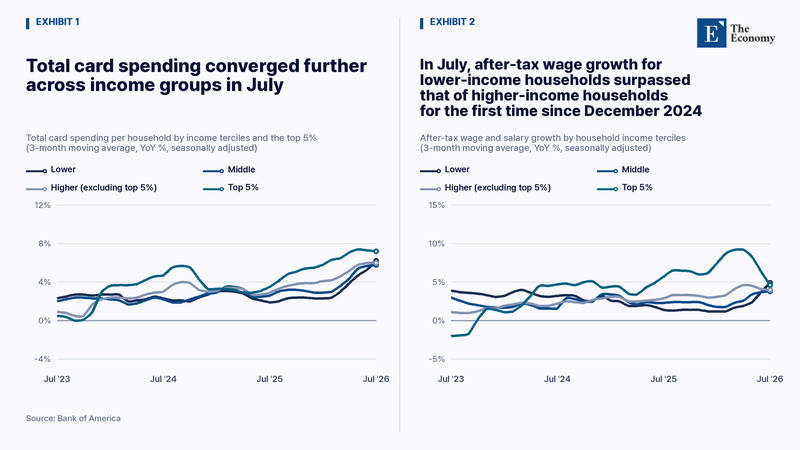
According to U.S. news outlet Axios on September 8 (local time), the divide between affluent Americans, who have maintained their pace of spending, and other income groups that have struggled to consume has recently narrowed sharply. Economists have long warned that the growing dependence of U.S. consumption growth on affluent households was leaving the economy vulnerable to stock-market declines and other shocks. More recently, however, the lower arm of the “K” has begun moving upward. This does not mean wealthy households are cutting spending; rather, low- and middle-income Americans are beginning to catch up with affluent consumers.
Bank of America (BofA) has dubbed this trend “The Great Convergence.” According to the BofA Institute, card spending by households in the lowest income tercile increased 5.4% year on year in July, outpacing growth among middle-income households. After-tax wages among low-income earners rose 5.2% over the same period, exceeding the 4.2% increase recorded by high-income earners. This marked the first reversal in wage-growth rates between the two groups since December 2024. The shift appears to reflect comparatively stronger employment growth among lower-income workers, wage gains from job changes and reduced tax withholding, all of which have lifted disposable income. BofA concluded that as those income gains translated into consumption, the spending gap between income groups also narrowed.
Wages for Bottom 25% Rise 5.5%, Triple the Pace for Top Earners
The White House had already declared the end of the K-shaped economy, citing the recovery in wages among lower-income workers. U.S. Treasury Secretary Scott Bessent told CNBC on August 9, “I can say unequivocally that the K-shaped economy is over,” emphasizing that lower-income workers were finally beginning to catch up. “I am tired of hearing about the K-shaped economy,” he said. “We are now moving closer to a C-shaped economy, in which low-wage workers are once again closing the gap.” His argument was that, as during President Donald Trump’s first term, wages for lower-income workers were rising at a comparatively faster pace.
Citing U.S. labor statistics, Bessent said wages for workers in the bottom 25% of the income distribution had risen 5.5% year on year. He described the increase as roughly three times the wage-growth rate for workers in the top 25%. Bessent also argued that real wages, adjusted for inflation, had improved. He said real wages for workers in the bottom quartile had increased 2%, predicting that workers would gradually begin to feel their purchasing power recover.

Consumption Underpinned by the Baby-Boom Generation
Some observers argue that the recent recovery in consumption should instead be viewed through the lens of intergenerational wealth disparities. Ed Yardeni, president of Yardeni Research and one of Wall Street’s most prominent bulls, has characterized the U.S. economy as a “G-shaped economy,” taking the letter from “generation.” His diagnosis is that baby boomers who have accumulated enormous wealth are sustaining their own consumption while also supporting overall spending by covering living expenses for their adult children and grandchildren. In effect, he suggests that financial support from parents may have contributed to the increase in lower-income spending alongside the recovery in wages.
This analysis rests on the concentration of real estate and financial assets among baby boomers. Yardeni Research’s analysis of data from the U.S. Federal Reserve (Fed) found that baby boomers held $85.4 trillion in net worth, equivalent to roughly half of all U.S. household wealth. Moody’s Analytics has likewise estimated that Americans aged 55 and older own more than 70% of total wealth, while their share of consumption increased from 27.1% in 2010 to 45.3% by the middle of last year. Even as employment income declines after retirement, a growing segment of the population can maintain its spending levels by drawing on housing wealth, pensions and returns from equity investments.
The Link Sustaining the ‘G-Shaped Economy’
Baby-boomer wealth also flows into consumption among younger generations through intrafamily transfers. A BofA survey of Americans aged 18 to 27 found that 46% of respondents received financial assistance from parents or other family members. In particular, 54% of all respondents did not pay their own housing costs, while 64% of young adults who did pay for housing spent more than 30% of their salaries on rent or other housing-related expenses. A Pew Research Center survey similarly found that 44% of adults aged 18 to 34 with at least one living parent had received financial assistance during the previous year. Living expenses, telecommunications bills and rent paid by parents effectively preserve younger adults’ capacity for other forms of consumption.
The generational divide in homeownership is closely connected to the concentration of wealth underpinning the G-shaped economy. According to the Fed’s “Report on the Economic Well-Being of U.S. Households in 2025,” the homeownership rate stood at 83% among Americans aged 60 and older but just 24% among those aged 18 to 29. Older households that already owned homes during periods of rising property prices benefited from asset appreciation, while younger adults had to contend simultaneously with elevated home prices, borrowing costs and rents. Indeed, 23% of U.S. renters reported falling behind on rent at some point during the previous year, with the proportion exceeding 30% among renters earning less than $50,000 annually.
Data Center Boom Drives Up Pay for Electrical and Facilities Workers
Another pillar of the U.S. economy’s resilience is investment in AI infrastructure. According to the U.S. Bureau of Economic Analysis (BEA), real gross domestic product (GDP) expanded at an annualized rate of 1.5% in the second quarter, while private domestic final demand—the combined total of consumption and private fixed investment—grew 3.9%. Corporate investment in industrial equipment, information-processing equipment and software substantially offset declining government expenditure and weakness in residential and factory construction. The four largest technology companies—Amazon, Microsoft (MS), Alphabet and Meta—have collectively planned $725 billion in capital expenditure this year, an increase of 77% from last year.
Investment momentum has been particularly pronounced at data center construction sites. Based on U.S. Census Bureau data, annualized data center construction spending reached $75.2 billion in July, surging 57.2% from a year earlier. Total U.S. construction spending declined 3.8% over the same period, while residential construction and manufacturing-facility construction contracted 7.3% and 21.2%, respectively. Data centers accounted for more than 60% of private office-construction expenditure, effectively dominating the commercial real estate development market. Excluding data centers, the decline in overall construction spending was estimated to widen to approximately 5.1%.
Data center investment has boosted demand not only for building construction but also for transformers, switchboards, backup generators, cooling systems and fiber-optic networks, transmitting its effects into manufacturing and the power industry. In its September Beige Book, the Fed found that nonresidential construction across several of its 12 districts was concentrated in data center projects, while rising orders among manufacturers in the Cleveland district were led by data centers and the defense industry. Competition has consequently intensified for electricians, plumbers, welders and heating, ventilation and air-conditioning technicians. Data compiled by recruitment platform Indeed showed that data center-related job postings had more than doubled over the past two years, while advertised hourly wages for installation and maintenance positions were 42% higher than at conventional workplaces. As AI reduces white-collar hiring while lifting employment and wages for skilled tradespeople, it is also beginning to influence disparities in consumption across income groups.
Anne-Marie Nicholson is a fearless reporter covering international markets and global economic shifts. With a background in international relations, she provides a nuanced perspective on trade policies, foreign investments, and macroeconomic developments. Quick-witted and always on the move, she delivers hard-hitting stories that connect the dots in an ever-changing global economy.
- Previous “Agricultural and Energy Prices Sound Alarm” Rate-Hike Case Gains Ground Across U.S., Europe and Japan as Extreme Weather and Wars Fuel Inflation
- Next “First the Money Pipeline, Now the Air Routes”: U.S. Accelerates ‘Operation Economic Outcast’ Against Iran, Targets Third-Country Firms Trading With Tehran
Similar Post