Hanwha Closes In on Germany’s Rheinmetall, With European and US Supply-Chain Integration Key to Its Next Leap

Siobhán Delaney is a Dublin-based writer for The Economy, focusing on culture, education, and international affairs. With a background in media and communication from University College Dublin, she contributes to cross-regional coverage and translation-based commentary. Her work emphasizes clarity and balance, especially in contexts shaped by cultural difference and policy translation.
Authored On
Modified
Poland deliveries feed through in earnest, sending Hanwha’s defense revenue soaring
Production footholds in Europe and the US overcome the limits of finished-system exports
Preserving manufacturing efficiency and completing localization key to further growth
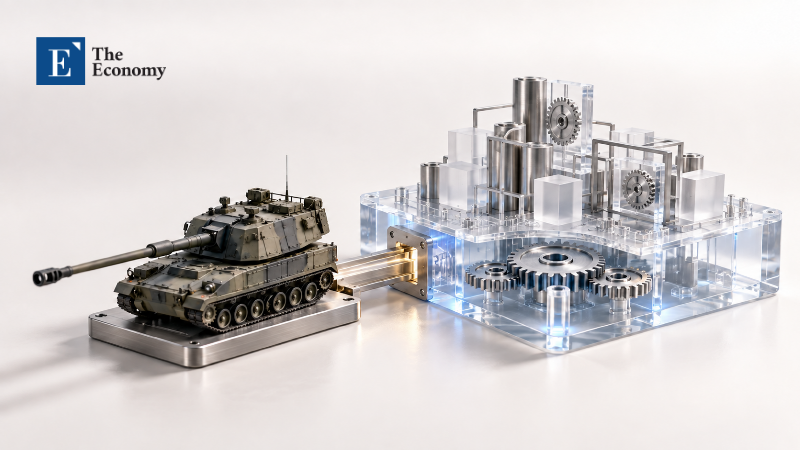
Hanwha has climbed to 16th place among the world’s defense companies, closing in on Europe’s traditional industry heavyweights. Exports of K9 self-propelled howitzers and Chunmoo multiple-launch rocket systems have driven its top-line growth, while local production facilities, supplier networks and operators’ forums have emerged as central pillars of its long-term business foundation. The next phase of the contest will hinge on how securely Hanwha can embed those foundations within local industries. As Europe and the United States prioritize domestic production, employment and component sourcing, sustained long-term orders will likely depend on building procurement and workforce-development systems around local plants and supplier networks.
Hanwha Rises to 16th in Global Defense Rankings
According to Defense News’ “Top 100 Defense Companies 2026,” released on the 6th (all dates local time), Hanwha ranked 16th worldwide after posting $10.43763 billion in defense revenue last year. The result marked a six-place rise from its previous ranking of 22nd. Hanwha’s defense revenue surged by approximately $4 billion in one year from $6.81734 billion in 2024, with defense operations accounting for 20% of the company’s total revenue.
Hanwha finished immediately behind Germany’s Rheinmetall, which ranked 15th with revenue of $11.21318 billion. It overtook China’s state-owned shipbuilder CSSC, which placed 17th with $10.20679 billion. The result narrowed Hanwha’s gap with traditional European defense heavyweights, including 12th-ranked France’s Thales. Hanwha’s defense revenue notably recorded double-digit growth amid fierce competition among the industry’s largest companies.
Ground-Defense Exports Combine With Affiliate Synergies
Exports of the K9 self-propelled howitzer and Chunmoo multiple-launch rocket system have been among the principal engines of Hanwha’s defense-revenue growth. Deliveries under K9 and Chunmoo implementation contracts signed with Poland since 2022 were carried out sequentially in 2024 and 2025, expanding the company’s ground-defense business. Hanwha Aerospace’s ground-defense revenue rose 16.1% from approximately $5.12 billion in 2024 to $5.94 billion in 2025, while the share generated by exports increased from 68% to 71%. Continued deliveries of K9 and Chunmoo systems to Poland, accompanied by supplies of ammunition and ancillary equipment, further broadened the company’s overseas revenue base.
Alongside robust exports, a business reorganization combining the defense capabilities of Hanwha’s affiliates has become another major growth pillar. Hanwha Systems supplies radar and command-and-control systems, while Hanwha Ocean adds naval defense capabilities encompassing surface vessels and submarines, enabling the group to assemble a portfolio spanning land-based firepower, surveillance and reconnaissance, and naval platforms. As countries expand the scope of arms procurement to include local production, ammunition supply, and maintenance, repair and overhaul (MRO), this collaboration among affiliates is regarded as a competitive advantage that strengthens Hanwha’s bargaining power in major contract tenders.
Local Production Network Targets Europe’s Defense Ecosystem
Diversification across geographic markets has provided another foundation for Hanwha’s growing scale. Having expanded through exports, Hanwha is accelerating a localization strategy designed to establish production capacity within Europe’s defense ecosystem. Securing long-term contracts through finished-system deliveries alone has become increasingly difficult as European governments raise defense spending while imposing domestic production, employment and technology-transfer requirements on procurement programs. The European Union’s (EU) approximately $171 billion Security Action for Europe (SAFE) defense-financing instrument requires at least 65% of the cost of eligible equipment components to be sourced from the EU, Ukraine, or qualifying European Economic Area and European Free Trade Association countries. Establishing local plants and supplier networks is therefore essential to accessing EU policy support and securing follow-on orders.
Romania is the first European production base that Hanwha has brought into concrete form. On February 12, Hanwha Aerospace broke ground on “H-ACE Europe,” a 181,055-square-meter ground-weapons production facility in Petrești, Dâmbovița County, Romania. The plant will handle local production of the 54 K9 self-propelled howitzers and 36 K10 ammunition resupply vehicles that Romania decided to acquire in 2024, while also developing assembly, integration, testing and full-lifecycle logistics-support capabilities. Hanwha aims to manufacture most of the contracted systems in Romania and raise the local-content ratio to as much as 80%. It plans to integrate more than 30 Romanian companies already working with Hanwha into its global supply chain and establish research and development (R&D) functions at the site, positioning it as a core hub for the company’s European ground-weapons business.
Hanwha Accelerates German Production-Hub Plans
Hanwha is targeting Germany as its principal Western European hub. Hanwha Aerospace held its first “Hanwha Industry Day” in Berlin last May, where it discussed local production, joint R&D and long-term investment plans with German government and corporate officials. At the time, Hanwha also unveiled plans to establish a production facility in eastern Germany. The company currently works with approximately 60 German suppliers, with annual procurement exceeding $114 million. As Germany embarks on a sweeping rearmament program, Hanwha is seeking to establish a foundation for long-term cooperation by emphasizing local production and participation in domestic supply chains.
The expanding scale of the German market has added further impetus to Hanwha’s localization strategy. The German government plans to set its core defense budget at approximately $124.2 billion in 2027 and allocate another $13.2 billion for military assistance to Ukraine. The defense budget is projected to rise to approximately $209.3 billion by 2030. Germany, however, has a formidable domestic defense-industrial base led by Rheinmetall and KNDS, while calls to prioritize national industry remain strong. These conditions explain Hanwha’s focus on establishing production facilities, creating local jobs and expanding component procurement in Germany.
Hanwha’s efforts to raise local brand recognition can also be seen in its previous European ventures. In 2011, as Hanwha Group pursued the European expansion of its solar business, it signed a sponsorship agreement with German professional football club Hamburger SV and launched the “Hanwha Solar Cup.” The company placed the Hanwha Solar logo on tickets, posters and the club’s website, while organizing fan meetings to broaden its engagement with local consumers. Defense businesses operate at the intersection of government policy decisions, regional industrial interests and decades-long follow-on logistics support. Hanwha’s current construction of production facilities and local supply chains can likewise be understood as an extension of its market-establishment strategy into the sphere of industrial cooperation.
Table 1. Expansion of Hanwha Aerospace’s K9 and Chunmoo Operator Cooperation Networks
| Category | Participating Countries and Scale | Key Areas of Cooperation | Future Plans |
|---|---|---|---|
| K9 User Club | Seven operator countries: South Korea, Estonia, Poland, Norway, Finland, Romania and Australia Observer delegations from Spain and Sweden Approximately 200 military and industry officials | Incorporating operational and maintenance experience into capability upgrades and logistics-support systems Presenting an operational concept linking fire-direction drones with the K9 for target detection, precision strikes and battle-damage assessment Building a digital logistics-support system integrating parts quotations, orders and delivery information | Linking the digital logistics-support system with the parts warehouse in Poland Holding the next K9 User Club in Australia Building a long-term cooperation network centered on operator countries |
| Chunmoo Users Workshop | Approximately 40 officials from South Korea, Poland, Estonia and Norway | Sharing experience in fielding, operations and maintenance, education and training, and parts management Poland proceeding with the acquisition of the localized “Homar-K” variant of Chunmoo and local production of guided missiles Estonia, Norway and Croatia also adopting Chunmoo | Holding the first official Chunmoo User Club in South Korea next year Expanding cooperation in joint parts procurement, education and training, and logistics support |
K9 Operator Alliance Expands Its Reach to Chunmoo
These initiatives have been reinforced by efforts to bring K9 operator countries together within a single cooperation network. Hanwha Aerospace held the fifth “K9 User Club” in Tartu, Estonia, from the 2nd through the 4th, bringing together approximately 200 military and industry officials from seven operator countries—South Korea, Estonia, Poland, Norway, Finland, Romania and Australia—as well as observer delegations from Spain and Sweden. At the event, Hanwha presented a next-generation operational concept in which a vertical-takeoff-and-landing fire-direction drone detects and tracks a target before transmitting its coordinates to a K9 for a precision strike, after which the drone assesses the resulting damage. A digital logistics-support system integrating parts quotations, orders and delivery information is scheduled to be linked with the parts warehouse in Poland. The initiative is intended to create an enduring framework of cooperation by incorporating each country’s operational experience into capability upgrades and maintenance systems.
The operator forum established around the K9 has also expanded its reach to Chunmoo. Hanwha organized a “Chunmoo Users Workshop” during the K9 User Club. Approximately 40 officials from South Korea, Poland, Estonia and Norway shared their experience in fielding, operations and maintenance, education and training, and parts management. Poland is pursuing local production of guided missiles following its acquisition of the localized “Homar-K” variant of Chunmoo, while Estonia, Norway and Croatia have also joined the ranks of Chunmoo operators. Building on this foundation, Hanwha plans to hold the first official Chunmoo User Club in South Korea next year, while the K9 User Club will continue in Australia. As more North Atlantic Treaty Organization (NATO) member states adopt both the K9 and Chunmoo, the scope for joint parts procurement, education and training, and logistics-support cooperation will also expand.
This operator network also represents an advance positioning strategy aimed at Western Europe’s high-barrier markets. Hanwha initially expanded sales in Eastern and Southern Europe, where procurement capacity was relatively constrained, by leveraging fast delivery and price competitiveness. The operational and maintenance records accumulated through operators’ forums can serve as important evidence when Germany and the United Kingdom assess performance, NATO interoperability and long-term logistics-support capabilities. Ongoing discussions with both countries include not only weapons-system procurement but also the placement of production facilities and the use of local personnel. The strategy is intended to spread recognition of Hanwha’s systems as “proven NATO firepower platforms” across Western European markets by regularly sharing the performance and requirements of existing operators.
Hanwha Breaks Into US Army Market, but Fast Delivery and Manufacturing Efficiency Remain Crucial
Hanwha is also accelerating its push into the US defense market by leveraging the local-production experience it accumulated in Europe. On the 18th of last month, Hanwha Defense USA was selected to develop prototypes for the US Army’s Mobile Tactical Cannon (MTC) program. The contract covers six K9MH wheeled self-propelled howitzers based on the K9 platform, with options for another 12 guns, bringing its maximum cumulative value to $262.9 million. The US Army will conduct approximately four years of operational testing before deciding whether to replace the M777 towed howitzers used by some units with the MTC. Bloomberg Opinion estimated that a follow-on production program could be worth as much as $7 billion. The greater significance lies not in the contract’s face value, but in the foothold Hanwha has secured within the US Army’s long-term procurement system.
Hanwha secured a US production base even before entering the competition. In April, Hanwha Defense USA signed a three-year lease for a site in Opelika, Alabama, and began investing more than $2 million to establish a K9-series integration and testing facility. The six K9MH prototypes covered by the contract will also be assembled and integrated at the facility before delivery to the US Army. Hanwha plans to hire approximately 40 employees by drawing on engineering talent from nearby Auburn University and a vocational-training program affiliated with Fort Benning. As the US government seeks to link defense procurement with domestic manufacturing and job creation, the Opelika investment aligns the interests of the K9MH program with local employment and the regional economy.
Embedding this local foothold within a genuinely American supply chain will nevertheless require a long-term effort. Local production capacity and supply chains, military performance validation, MRO systems and US job creation are all intertwined with the program’s competitiveness. Bloomberg Opinion estimated that US-made components currently account for approximately 40% of the K9 supply chain, arguing that Hanwha would need to raise the share to at least 50% to become a major US Department of Defense supplier while reducing exposure to Buy American requirements and tariff risks. The supply-chain transition will take considerable time, however, because Hanwha must secure local parts suppliers and skilled workers while preserving the delivery speed and manufacturing efficiency of its Korean production system. Bloomberg columnist Juliana Liu advised, “Hanwha must develop its US supply chain and workforce while preserving the efficiency that is the hallmark of South Korean defense companies,” adding, “It should not rush, because America’s domestic industrial capacity will need time to mature.”
Siobhán Delaney is a Dublin-based writer for The Economy, focusing on culture, education, and international affairs. With a background in media and communication from University College Dublin, she contributes to cross-regional coverage and translation-based commentary. Her work emphasizes clarity and balance, especially in contexts shaped by cultural difference and policy translation.
Similar Post