The New Labour Bargain: Youth, Jobs, And Ageing Economies

Working across research, policy, and data-driven analysis, the Editorial Board ensures that published pieces reflect a consistent institutional perspective grounded in quantitative reasoning and long-term structural assessment.
Authored On
Modified
Young populations can lift growth only if jobs expand
Ageing economies need labour, but extraction is not a strategy
Investment decides whether youth becomes a dividend or a trap

Between 2025 and 2035, 1.2 billion young people in emerging and developing economies will enter the workforce. This is a matter of concern not just for development aid agencies -it is the coming labor market- and it will test the capacity of states. But meanwhile, some rich countries are heading in the opposite direction: birth rates are low. Workforces are aging. Costs for pensions and care are growing. The easy story claims that one side has too many workers and the other too few. This is clear, but it is mistaken. People are not spare parts. A proper demographic dividend policy will require posing a more difficult question: Will young workers in emerging economies go on to own wealth at home or be exploited for their cheap labor as an aging population reserves in foreign economies?
Demographic Dividend Policy Should Focus on Jobs, Not Headcounts
That is not the real concern: it is whether they have a job machine that can accommodate them. Having a large youth cohort can boost growth if it is put to work in firms that invest, train, export, and generate wages to support household saving; it can widen stress if young people find themselves in informal work, idle time, or low-value-add activity with no upward path. The latest labor market data make this a clear-cut story. Global youth unemployment declined to 64.9 million in 2023, the lowest number this century and the youth jobless rate sank to 13 percent. But this headline figure masks a weak foundation: one third of young people are in countries that are off track on youth not in employment, education or training. In lower-income nations, a young individual who attained a tertiary level education can have worse overall unemployment than a similarly aged person with only basic literacy. This is not just a skills deficit; it is a demand shortfall.
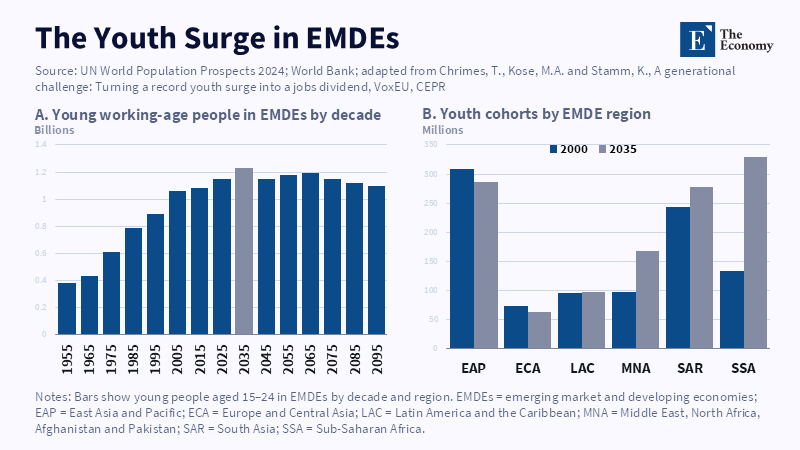
That is why policy on the demographic dividend cannot merely be measured by the number of seats filled on an ever-expanding pyramid of skills training. A wrong sequencing of policy choices is all too familiar, however: expanding university courses while donors support short courses, while private providers offer certification services. Meanwhile, neither school-to-work transitions nor young people's expectations get better. Firms remain small, financial systems are parched, governance is costly, and domestic demand is thin. Training may turn into frustration. Better sequencing happens in so-called 'real' sectors, like food production, logistics, health, housing, repair and maintenance, renewable energy, tourism, digital public services, and light manufacturing. These sectors may not be as glamorous as frontiers of innovation, but they also employ at scale. They also create links between villages, secondary towns, and export markets, which matter because young workers cannot wait for a startup boom that benefits but a small urban elite.
The clearest way to reframe the debate is to shift attention from a youth bulge to a jobs dividend. A youth bulge is a demographic fact. A jobs dividend is a policy consequence. Roads, power, ports, credit, rules over land, taxes, courts, care, and work norms are the 'infrastructure' in which the dividend emerges. So are trust, clear rules, and large markets to invest in. Firms will choose to invest in workers if they can see a clear line from investment in skills to higher income. Investors will put capital into plants if they can reliably move their goods and get paid. No reform will be a silver bullet. But the question is transparent: if a country produces enormous numbers of young workers and 20 million must leave within five years, the dividend will drain through migration, underemployment, and downward earnings pressure.
Advanced Economies Need Partners, Not Talent Mines
Aging countries will require labor. That truth should not be prettified. Throughout the OECD- -where fertility has, on average, dropped well below replacement level, and where, between 2023 and 2060, the working age population is expected to decline by 8 percent, more than a quarter of the countries (see OECD Business and Labour Outlook 2025, a 30% drop. Korea is an extreme case where the decline is expected to reach 46%). Likewise, the European Union has a long downhill slope ahead of it- between 2025 and 2100, 20-64year-olds will decrease in the EU from 263.2 million to 198.4 million. To put the figures into perspective, these are not only numbers but would translate into declining supplies of nurses, builders, drivers, engineers, technicians, and care workers. They also imply declining growth unless productivity rises rapidly.
This is why it is so tempting for rich countries to view developing country talent as a solution. Narrowly, this is understandable. The nurse trained in Kenya can work in Germany. The programmer in Nigeria can be a coder in London. An engineer in India will support a factory in Japan. But a labor strategy based on ruthless pragmatism is unstable. It transfers the cost of training to the poor economies, then extracts those people central to building firms, hospitals, grids, and schools. It can also stigmatize the process. It leaves source nations with brain drain and destination countries with a migration backlash. Workers face blocked mobility, softened rights, and divided families. A more honest population dividend approach treats labor mobility as a social contract, not a talent hunt.
That compact could have three elements. First, training partnerships should finance capacity in source countries, not just flows. A rich country that recruits nurses should help finance their origin country's nursing colleges, teachers, labs, and rural placements. Second, visas should favor skill use and return spans. Circular migration only makes sense if migrants are going back with savings, credentials, and links to markets at home. Third, recognition rules should be equitable and flexible. So many skilled migrants are stuck in low-skilled jobs because licensing systems and teacher registrations are slow. That is a waste of skills and generates hostility. The broad objective should be clear. Mobility can lighten aging burdens in rich countries, while boosting skills and capital stocks in younger economies.
The Outsourcing Trap Is a Policy Choice
The warning is not of migration alone. It is from the previous outsourcing approach. India has demonstrated both the potential and pitfalls of the previous path. Its services boom demonstrated that a developing country can sell high-value activities to the world and (by then) to familiar advanced economies. It created large firms, a global diaspora, and a leading digital profile. It did not, however, create enough jobs. Services can generate foreign exchange, or market a new face to the world, without generating many formal jobs. They can concentrate gains in a few metro cities and markets, serviced by Anglophone graduates. The data from India itself shows the squeeze. Youth unemployment has been much higher among educated workers than among those with little or no education, and graduate unemployment hit 29.1 percent in 2022, according to one major employment survey. That's a lesson for any 'young' economy that aims to skip the 'middle' stage to go straight to global services.
Offshoring is not necessarily bad. It can be an element of upgrading. What is dangerous is when a country is selling labor time without developing domestic product, depth of management, and capital. A call center can teach discipline and language skills. A software house can develop export connections. A back-office operation can boost wages for some. But at the low-margin end, where the country remains, it is easy to displace that activity. Newer automation technology is increasing that danger. The World Economic Forum predicts widespread turnover for 2030, with 170 million jobs being created across the economies surveyed, against 92 million being eliminated. The message is not to fear technology. The message is to move away from a growth mode where young workers simply compete on cost.
A more expansive demographic dividend policy would also use outsourcing income as a pipeline to local capabilities. Governments can also insist on increased training of strategic management in large service provision contracts. They can bolster supplier networks around export firms. They can leverage public procurement to enable local software, maintenance, health-technology, and logistics companies to scale up. They can tie tax incentives to apprenticeship quality and regional sales. They can also put pressure on companies to move from task delivery to product ownership. This is how a wider labor base is transformed into a wider corporate base. Failing that, the 'young' countries risk turning into remote-work colonies. Wages shoot up for a small few, but the overall productivity of the nation stagnates. It exports effort, while it imports strategy, leaving the brightest young managers simply serving clients rather than generating new markets.
This has implications for educators and training providers too, but not in the same narrow way. More generic courses won't do it. What is needed is greater alignment of training provision with sector strategy. Technical training colleges should be funded to pursue real projects, e.g., solar mini-grids, cold chains, hospital systems, water repairs, housing upgrades, port logistics, or digital tax administration. Universities should follow up on graduation employment status by field and geography, not just registration. Short courses should only be funded if they lead to employment, wage growth or firm expansion. Policy makers should develop institutional procedures to end the "softer" externally funded approach to employability: it may be the only demonstration that a country's human capital plan has been successful in achieving the industrial policy objectives. It is also the only obvious point where the demographic dividend policy translates directly into everyday life.
Jobs Dividends Require Firms, Cities and Rural Value Chains
Urban bias in youth policy is a big mistake. Rural youth still constitute more than 50% of the youth in many developing countries, and many work in poor, insecure jobs. But the next job dividend will not only be urban. It can also be from food processing, storage, packing, repairing, transporting, irrigating, shopping, servicing, and other rural activities close to land and family. Changing urban incomes are changing food consumption. It creates a market for safer, processed, and more varied food. If countries develop local value chains, rural youth could move from raw production into better-paid work close to home. It's no fantasy of a romantic retreat to the land. It is rural industrial policy, and it belongs squarely at the center of demographic dividend policy, because nearly every new worker will need to work near land, family, and food.
Africa shows the magnitude of the decision. In 2024, Africa's population exceeded 1.5 billion, and by 2050, it is forecast to climb to 2.5 billion. In 2024, Africa's working age population is also expected to increase from 883 million in 2050 to nearly 1.6 billion. Around this period, one in four of the world's working-age population could be African. This holds incredible global potential. It may equally bring about grave pressure if jobs tend to be informal and poorly remunerated. A viable demographic dividend policy should create infrastructure first. Such is the basis for electricity, broadband, feeder roads, land records, payment infrastructure and court systems are job policy in the same way as day care, safe transport for women and healthcare are systems that allow labor to be productive!
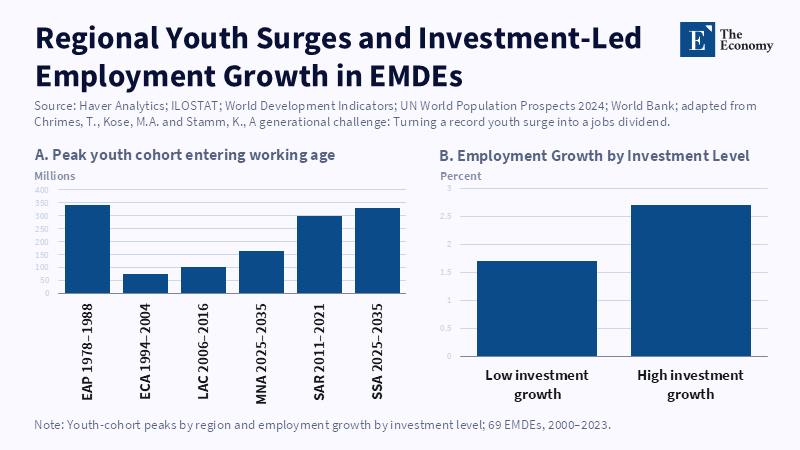
A more expansive demographic dividend policy that poor states cannot bear is such an ambitious agenda. The answer is that they cannot afford not to. An expensive training scheme that does nothing is not frugal. A tax holiday that avoids jobs is not pro-growth. The export deal that supplies health workers elsewhere is not efficient. The limits to public expenditure are real, but they sharpen the options. Public money should unlock private jobs where there is demand. Development finance should crowd in local banks rather than just foreign contractors. Pension funds and life assurance should sit happily investing in bankable infrastructure with visible safeguards. Employment laws should protect workers without inviting a paradox of impossible formal employment. The objective is not to replicate a particular model. The objective is to give each reform the task of determining whether it will generate productive work at scale for the young.
The political risk is equally clear. Young people are making direct comparisons with the world in real time. They look around the clock and see jobs and homes and status elsewhere. They call it a lie when they hear a promise. When millions of young adults are trained but trapped, patience does not follow. Something else does. Exit, protest, withdrawal. That is why the demographic dividend policy is also a stability policy. It holds down young people to the state. It gives firms a reason to invest. It promotes healthy aging economies to better supply the urbanizing world. The opening number, 1.2 billion, should not be read as a pool of workers waiting to be allocated. It should be read as a deadline. The nations that can create jobs and firms and just mobility now will be the authors of the next economy. The nations that treat youth as cheap labor will let the dividend slip.
The views expressed in this article are those of the author(s) and do not necessarily reflect the official position of The Economy or its affiliates.
References
Advisory Ranking (2026) ‘Top 20 Workforce Strategy Advisory 2026’, Advisory Ranking, 1 April.
Chrimes, T., Kose, M.A. and Stamm, K. (2026) ‘A generational challenge: Turning a record youth surge into a jobs dividend’, VoxEU, 3 July.
Eurostat (2026) ‘Population projections in the EU’, Statistics Explained. Luxembourg: European Commission.
Healthcare Ranking (2026) ‘Top 20 Rehabilitation & Long-Term Care Providers 2026’, Healthcare Ranking, 15 May.
Institute for Human Development and International Labour Organization (2024) India Employment Report 2024: Youth Employment, Education and Skills. New Delhi: Institute for Human Development and International Labour Organization.
International Labour Office (2024) Global Employment Trends for Youth 2024. Geneva: International Labour Office.
Muhammed, J. (2025) ‘Why Africa’s Youth Surge Will Reshape the Global Order’, African Leadership Magazine, 1 July.
OECD (2018) The Future of Rural Youth in Developing Countries: Tapping the Potential of Local Value Chains. Paris: OECD Publishing.
OECD (2024) Society at a Glance 2024: OECD Social Indicators. Paris: OECD Publishing.
OECD (2025) OECD Employment Outlook 2025. Paris: OECD Publishing.
Ranking News (2026) ‘National Competitiveness Indices and Their Role in Economic Policy Reform’, The Ranking News, 16 March.
United Nations Department of Economic and Social Affairs, Population Division (2024) World Population Prospects 2024. New York: United Nations.
World Bank (2026) Global Economic Prospects, June 2026. Washington, DC: World Bank.
World Economic Forum (2025) The Future of Jobs Report 2025. Geneva: World Economic Forum.
Working across research, policy, and data-driven analysis, the Editorial Board ensures that published pieces reflect a consistent institutional perspective grounded in quantitative reasoning and long-term structural assessment.