Chinese K-Beauty Counterfeits Spread to Europe, Underscoring Urgent Need for Premium Strategy to End War of Attrition

Matthew Reuter is a senior economic correspondent at The Economy, where he covers global financial markets, emerging technologies, and cross-border trade dynamics. With over a decade of experience reporting from major financial hubs—including London, New York, and Hong Kong—Matthew has developed a reputation for breaking complex economic stories into sharp, accessible narratives. Before joining The Economy, he worked at a leading European financial daily, where his investigative reporting on post-crisis banking reforms earned him recognition from the European Press Association. A graduate of the London School of Economics, Matthew holds dual degrees in economics and international relations. He is particularly interested in how data science and AI are reshaping market analysis and policymaking, often blending quantitative insights into his articles. Outside journalism, Matthew frequently moderates panels at global finance summits and guest lectures on financial journalism at top universities.
Authored On
Modified
Surging K-beauty exports become new target for China’s copycat industry
Eastern European distribution network exposed by Romanian customs seizure
Shift toward premium branding imperative to end war of attrition

As K-beauty expands rapidly across the United States and Europe, Chinese-made counterfeits are also spreading through Western markets. Romanian customs authorities have seized imitation Medicube products originating in China, while 97.7% of the counterfeit K-brand goods confiscated by the Korea Customs Service last year were shipped from China. Chinese companies are copying products and packaging as well as store signs, interiors and K-pop marketing, monetizing the trust built by the Korean Wave. The government has launched overseas reporting and enforcement networks, but Korean companies now face an urgent need to establish sufficient brand authority to curb the cost of pursuing counterfeiters and steer consumers toward authentic products.
Counterfeit Medicube Products Seized in Romania
According to cosmetics industry sources on Aug. 10, beauty company APR confirmed that roughly 100 suspected counterfeit units of its Medicube PDRN Pink Collagen Capsule Cream were confiscated last month by customs authorities at Timișoara Airport in Romania. The appearance and container design of the seized products were reportedly so similar to the genuine articles that ordinary consumers would struggle to distinguish them with the naked eye.
The expansion of the counterfeit industry has coincided with K-beauty’s rapid growth. South Korean cosmetics exports reached $7 billion in the first half of this year, up 27.3% from the same period a year earlier and marking a record high for any first-half period. The United States became the largest export market at $1.45 billion, while sales in Europe also climbed sharply. As the main growth engine for authentic products shifted from China to the United States and Europe, counterfeit distribution networks extended their reach into Western markets.
K-beauty counterfeits had previously circulated mainly across Asian markets, including China, Hong Kong, Taiwan, Vietnam and Japan. The Romanian seizure is regarded as evidence that the distribution of counterfeit K-beauty products has reached Eastern Europe. Timișoara is a major transportation hub in western Romania bordering Hungary and Serbia. Since Romania fully joined the Schengen Area, including its land borders, in January last year, goods cleared through local customs can move across European countries without separate border inspections.
China Accounts for 97.7% of Originating Shipments
China remains the principal production and distribution hub. In a joint crackdown conducted early last month by the public security bureau and market regulation authority in Baiyun District, Guangzhou, authorities seized more than 6,000 imitations of six Medicube products. Counterfeit products bearing the names of other internationally recognized South Korean brands, including Skin1004 and Arencia, were also reportedly discovered during the operation.
According to industry sources, production facilities for counterfeit K-beauty products are concentrated in China’s Guangdong Province, prompting some South Korean companies to conduct regular on-site raids with assistance from local legal representatives and public security authorities. The Korea Customs Service detected 117,005 counterfeit K-brand items last year. China accounted for 97.7% of shipments by country of origin, followed by Vietnam at 2.2%. Cosmetics comprised the largest category, with 41,903 items representing 35.9% of the total, followed by toys and stationery at 33%. Industry officials say, however, that companies face considerable practical constraints in sustaining cooperation with overseas investigative and enforcement agencies on their own.
Table 1. Reporting System and Response Measures for the Counterfeit K-Brand Reporting Center
| Category | Key Details |
|---|---|
| Policy rationale | Prevent export losses for South Korean companies and deterioration in confidence and quality assessments of the national “K-” brand amid the spread of counterfeit and lookalike products overseas |
| Reportable cases | Products and marketing that invoke “K-” branding and cause consumer misperception or confusion despite having no connection to production in South Korea or the intellectual property rights of South Korean companies |
| Operating institution | Korea Intellectual Property Protection Agency |
| Reporting channel | Counterfeit K-Brand Reporting Center within the K-Brand Protection Portal |
| Reporting method | Online reports using a dedicated QR code and image- and location-based functions |
| Primary reporting channels | Overseas brick-and-mortar stores, online platforms and social media |
| Review criteria | Similarity to South Korean trademarks, likelihood of consumer misperception or confusion, and probability of intellectual property infringement |
| Classification | Misappropriation of business names or store signs, distribution of counterfeit goods, and damage to Korean Wave identity |
| Follow-up measures | Prompt notification of valid reports to K-brand administrators and support for evidence collection and administrative or criminal enforcement |
| Cases involving unclear rights | Review of response measures based on potential violations of unfair competition and consumer protection laws |
| Stronger enforcement | Expanded legal action and customs enforcement against manufacturers and distributors through cooperation with intellectual property enforcement agencies and diplomatic channels |
South Korean Government Opens Counterfeit K-Brand Reporting Center
The government has responded by establishing a Counterfeit K-Brand Reporting Center to eradicate products that mislead consumers. The center is tasked with blocking deceptive marketing practices that invoke “K-” branding to exploit the Korean Wave’s strong credibility and recognition, despite the products having no connection to manufacturing in South Korea or the intellectual property rights of South Korean companies.
The reporting center is an online system that allows South Korean nationals to easily report suspected counterfeit K-brand cases encountered at overseas stores, on online platforms or through social media. It will operate within the K-Brand Protection Portal run by the Korea Intellectual Property Protection Agency, allowing the public to file reports overseas through a dedicated QR code and image- and location-based functions.
Submitted reports will be reviewed for similarity to South Korean trademarks, the likelihood of misperception or confusion and the probability of infringement. The data will then be classified into categories such as misappropriation of business names or store signs, distribution of counterfeit goods and damage to Korean Wave identity. Reports deemed valid will be promptly forwarded to K-brand administrators, with support extending to subsequent response measures. When local trademark rights exist, cases will be referred for trademark infringement action, including evidence collection and administrative or criminal enforcement. When no local rights exist or ownership is unclear, authorities plan to pursue remedies under laws and regulations governing unfair competition and consumer protection.
The government determined that the proliferation of counterfeit and lookalike products could damage South Korean companies’ export performance and erode confidence in and quality assessments of the national “K-” brand over the long term. It therefore plans to substantially strengthen legal action and customs enforcement against counterfeit K-brand manufacturers and distributors through cooperation with intellectual property enforcement agencies and diplomatic channels.
Price Competition Ends, Battle for Value Must Begin
Experts say that repeatedly tracking sellers and seizing inventory whenever counterfeits surface will make a war of attrition difficult to avoid. When enforcement closes in, counterfeiters shut down their accounts, switch corporate entities and resume production elsewhere. South Korean companies consequently face recurring costs for retaining overseas legal representatives, gathering evidence and pursuing local litigation. Regaining control of this pursuit requires raising brand value to a level that compels consumers to insist on authentic products while increasing the cost of imitation.
The defenses built by European luxury companies over several decades originated from the same approach. Europe’s luxury industry created an enormous value gap between counterfeits and authentic goods by combining accumulated craftsmanship, scarcity and rigorous distribution controls. Companies registered trademarks and designs preemptively in major markets and controlled distribution through directly operated stores and authorized retailers. They gave consumers sustained reasons to purchase authentic products by integrating distinctive design, consistent quality, repair and warranty services with their brand heritage.
K-beauty has reached a point where its growth formula, long reliant on fast-moving trends and price competition, requires recalibration. Companies must combine research and development capabilities, ingredient safety, clinical data and manufacturing quality with brand narratives, building proprietary assets recognized by global consumers. Authentication technology, distribution traceability and official sales networks in individual countries must also be strengthened. Securing brand authority commensurate with the speed of product launches holds the key to breaking the cycle in which every successful new product triggers an influx of imitations.
China Targets the Illusion of Korean Origin, Replicating Entire Store Concepts
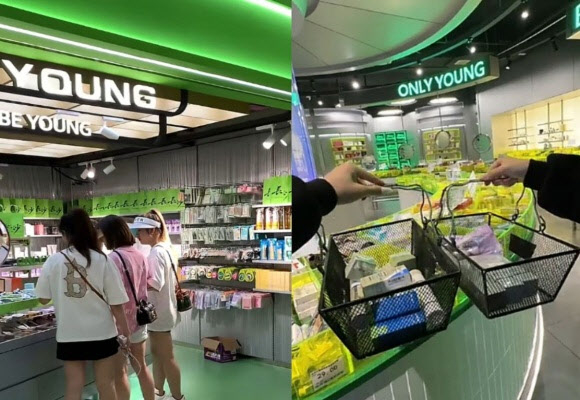
China’s persistent pursuit of the growth trajectory established by South Korean brands further heightens the need for a long-term strategy. Following product imitation, cases of copied store names, logos and interiors are proliferating across China. A beauty retailer called Only Young, which evokes Olive Young, reportedly opened recently in Changsha, Hunan Province, and is expanding its footprint. The retailer has extended its sales network to nearby Liuyang and promotes free nationwide delivery. Its store name, logo design, signature colors and product display methods have all drawn comparisons with South Korea’s Olive Young. Similarities in shopping bag design have also raised concerns that consumers without precise brand information could mistake it for a South Korean brand.
The use of a “Korean image” is also conspicuous in its marketing. Only Young has opened an official account on the Chinese short-form video platform Douyin and posts promotional clips featuring K-pop as background music. Its stores reportedly sell products from global beauty brands including Nars, Dior and Kiehl’s. Distribution industry officials regard the business as a case of “deliberate imitation” premised on consumer confusion.
Such imitation businesses can generate revenue only when consumers mistake them for South Korean brands. As awareness of authentication systems and official sales networks increases and local trademark enforcement accelerates, the space available for disguised sales will contract accordingly. China’s vast manufacturing base fuels the mass production of imitations, but the concentration of production facilities, seller accounts and shipping routes in certain regions and platforms also exposes targets for enforcement. This dynamic explains why Chinese companies, despite their advantage in replication speed, remain vulnerable in the long-term battle for brand trust.
Matthew Reuter is a senior economic correspondent at The Economy, where he covers global financial markets, emerging technologies, and cross-border trade dynamics. With over a decade of experience reporting from major financial hubs—including London, New York, and Hong Kong—Matthew has developed a reputation for breaking complex economic stories into sharp, accessible narratives. Before joining The Economy, he worked at a leading European financial daily, where his investigative reporting on post-crisis banking reforms earned him recognition from the European Press Association. A graduate of the London School of Economics, Matthew holds dual degrees in economics and international relations. He is particularly interested in how data science and AI are reshaping market analysis and policymaking, often blending quantitative insights into his articles. Outside journalism, Matthew frequently moderates panels at global finance summits and guest lectures on financial journalism at top universities.
Similar Post