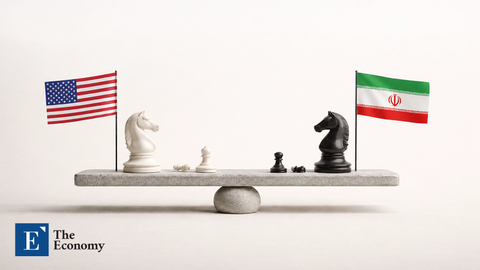
“Hardline Rhetoric, Then the Negotiating Table”: U.S. and Iran Reopen Talks at UN General Assembly as Prolonged War Strains Both Economies

Aoife Brennan is a contributing writer for The Economy, with a focus on education, youth, and societal change. Based in Limerick, she holds a degree in political communication from Queen’s University Belfast. Aoife’s work draws connections between cultural narratives and public discourse in Europe and Asia.
Authored On
Modified
U.S. and Iran meet at UN General Assembly after exchanging extreme rhetoric
Mounting war costs weigh on U.S. as businesses struggle
Iran’s economic crisis deepens, exposing limits of sanctions-evasion strategy
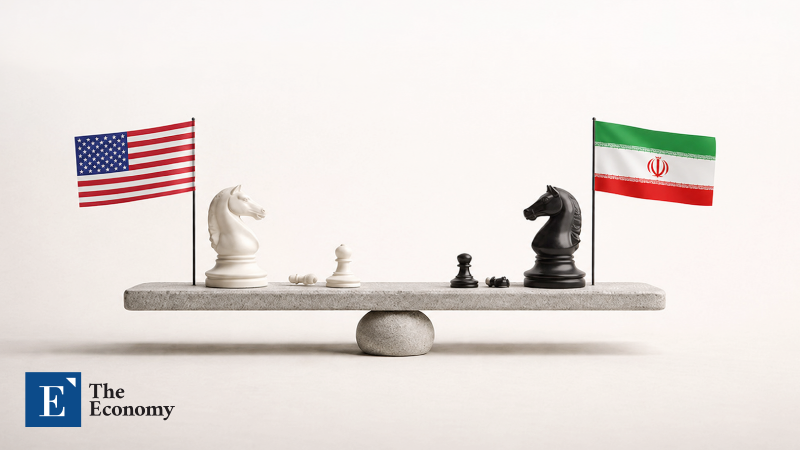
The United States and Iran held talks in New York on the sidelines of the United Nations (UN) General Assembly. A working-level meeting followed sharply worded denunciations and threats by both countries’ leaders at the UN, reopening a diplomatic channel that had long been deadlocked. The move appears to reflect the economic pressures accumulating on both sides as the war drags on.
Trump Renews Pressure on Iran
On the 22nd (local time; all subsequent dates are local), President Donald Trump took the floor as the second speaker at the 81st UN General Assembly in New York. “I have a decision left to make: whether to strike a deal that allows Iran to develop further and rebuild as a far greater nation than ever before, or to swiftly annihilate the Islamic Republic and send them to hell,” he said. “But I believe we will reach an agreement right after the election, because it makes no sense for them not to,” he added. “They are waiting to see how I do in the midterm elections, but what they fail to realize is that I am not running.”
Trump continued his denunciation of Iran and called on other countries to respond. “The foremost example of a threat we allowed to grow powerful enough to endanger the world is the Islamic Republic of Iran, the world’s leading state sponsor of terrorism,” he said. “They were the bully of the Middle East, but they are no longer.” “From my first day in politics, my position has never wavered,” he added. “I will never allow Iran to possess a nuclear weapon.” Trump also said, “Even after agreeing to a ceasefire for nuclear discussions, Iran immediately violated it by committing brazen acts of terrorism against other countries’ civilian vessels.” He thanked the UN Security Council for passing a resolution condemning what he called Iran’s “vile terrorist attacks on merchant ships” by an overwhelming vote, and urged countries to show the same unity in maintaining pressure.
Iran Vows to Defend Its Position
Iran responded with equally confrontational remarks. In a speech before departing on the 22nd, Iranian President Masoud Pezeshkian said he was going to New York “to convey the position of the Islamic Republic of Iran.” “We have prevailed with dignity, and we will firmly defend our position on the international stage,” he said. “At the UN General Assembly, I will set out the harm suffered by the Iranian people, the crimes of the United States and Israel, and the distrust that has accumulated,” he added. “They prevented Iranian journalists from accompanying us because they fear exposure of their crimes, but we can make Iran’s voice heard through the international press at the venue.”
“We have sat at the negotiating table many times and drafted agreements, but unfortunately the whole world has witnessed promises go unfulfilled and written agreements violated,” Pezeshkian said. He also accused Iran’s adversaries of closing off every possible avenue to force the Iranian people into submission. In his account, the United States and Israel were seeking other ways to pressure Iran after failing to achieve their objectives by military means. “They are blocking land and air routes, fomenting internal divisions, exploiting the media and ethnic minorities, and taking maximum advantage of our weaknesses to undermine us from within and force us to yield,” he said.
Talks Resume After War of Words
Despite those declarations, the two sides reportedly found an opportunity to negotiate at the UN General Assembly. Iranian state broadcaster IRIB reported on the 22nd that Foreign Minister Abbas Araghchi, who was visiting New York for the assembly, had met Steve Witkoff, the Trump administration’s Middle East envoy. The meeting took place after Araghchi accepted Witkoff’s request, and Iran reportedly reiterated its conditions for reopening the Strait of Hormuz. Those conditions included the immediate lifting of the maritime blockade, the immediate release of all frozen Iranian assets, and an end to the war on all fronts, including Lebanon.
Asked about the discussions during a bilateral meeting with Ukrainian President Volodymyr Zelenskyy, Trump told reporters that the talks with Iran “lasted three hours and were very good.” “It was a very productive meeting, and another meeting is scheduled for the very near future,” he said. “A lot of good ideas came out of it, and a lot of things are going very well,” he added, describing the momentum toward an agreement as substantial. “There are two choices, and as I said in my speech today, one of them is very bad,” Trump said. “The other could lead their country to greatness.”
U.S. Economic Burden Mounts
The economic burden of a prolonged war appears to explain why both countries returned to the negotiating table despite their extreme rhetoric. The United States has already incurred substantial costs from the Iran war. According to a report released on the 15th by the Congressional Budget Office (CBO), Congress’s nonpartisan budget agency, U.S. Department of Defense spending associated with the conflict had reached an estimated $38 billion as of the first of last month. The estimate includes the cost of replacing munitions expended and equipment lost in combat, increased flight hours, other operational expenses, and fuel. If fighting continues at the lower intensity seen in May and June, the CBO projects another $2 billion in costs each month; if it intensifies to July’s level, the monthly cost would rise to $3 billion.
Private companies are also facing growing disruption from war-driven oil prices. CNN reported on the 20th that U.S. businesses were being pushed to their limits as diesel prices had doubled since March, global shipping capacity had fallen 15% this year, and supply-chain disruption had intensified. In a monthly survey released earlier this month by the Institute for Supply Management (ISM), several business executives said conditions had been better during the COVID-19 pandemic. One market specialist attributed the comparison to the scale of today’s uncertainty: during the pandemic, supply chains seized up and then gradually restarted along a relatively linear path, whereas conditions have repeatedly improved and deteriorated since the Iran war began.
Table 1. Economic Costs of a Prolonged War for the United States and Iran
| Country | Sector | Key developments |
|---|---|---|
| United States | War costs | Department of Defense spending approaches $38 billion; an additional $2 billion–$3 billion a month projected, depending on the course of the war |
| United States | Businesses and supply chains | High oil prices, reduced shipping capacity, and recurring supply-chain disruptions increase costs and uncertainty for businesses |
| Iran | Exchange rate and prices | Collapse in the rial and high inflation sharply erode household purchasing power |
| Iran | Employment and living standards | Employment falls and unemployment rises while average wages remain far below basic living costs |
| Iran | Oil exports | U.S. sanctions and the maritime blockade sharply reduce crude shipments, a vital source of foreign currency |
| Iran | Overland logistics | Large-scale diversion of seaborne trade to land routes causes customs bottlenecks and a surge in transportation costs |
Iran’s Economy Pushed to the Brink
Iran has likewise suffered a severe economic shock. The rial has plunged from around 1 million per dollar a year ago to more than 2.2 million per dollar recently, while the official average inflation rate over the past 12 months has climbed to 69.9%. Price increases for food, beverages, and tobacco have approached twice the overall average. The strain on households has become acute: Iranian workers earn an average of just $125 a month, while the cost of meeting a household’s basic needs has risen to about $450 a month. The spring unemployment rate rose to 9.1%, and employment fell by roughly 450,000 from a year earlier. Oil exports, a principal source of revenue, have also been curtailed by U.S. restrictions. According to commodity analytics firm Kpler, shipments of Iranian crude stood at roughly 260,000 barrels a day early this month, down about 85% from 1.7 million barrels a day a year earlier.
Iran’s attempt to expand overland trade to circumvent the U.S. maritime blockade has also run up against logistical limits. Large volumes previously moved by sea have converged on land borders with comparatively little capacity, creating bottlenecks across the logistics network. According to The Wall Street Journal, hundreds to thousands of Iranian trucks are stranded awaiting customs clearance at Iran’s borders with Türkiye, Pakistan, Afghanistan, and Turkmenistan. Overland transport also struggles to replace shipping on cost. Majidreza Hariri, chairman of the Iran-China Chamber of Commerce, said moving one container from China to Iran costs about $3,000 by sea and $12,000 by land. With roughly 2 million containers entering Iran’s southern ports each year, Hariri estimates that a sustained maritime blockade could add $18 billion annually in transportation costs alone. The bottlenecks and higher freight costs could intensify inflationary pressure on an Iranian economy already burdened by soaring prices.
Aoife Brennan is a contributing writer for The Economy, with a focus on education, youth, and societal change. Based in Limerick, she holds a degree in political communication from Queen’s University Belfast. Aoife’s work draws connections between cultural narratives and public discourse in Europe and Asia.
Similar Post