"Advancing Chips Instead of Stockpiling External GPUs": Apple Proves Its Competitive Edge With A20 Pro, Harnessing In-House Design to Build an On-Device AI Ecosystem

Aoife Brennan is a contributing writer for The Economy, with a focus on education, youth, and societal change. Based in Limerick, she holds a degree in political communication from Queen’s University Belfast. Aoife’s work draws connections between cultural narratives and public discourse in Europe and Asia.
Authored On
Modified
Apple Equips iPhone 18 Pro With In-House A20 Pro Processor
Strong Benchmark Performance Outpaces Mac and Mainstream Desktop Processors
Focus on Chip Design and On-Device AI Competitiveness Over Data Center Spending
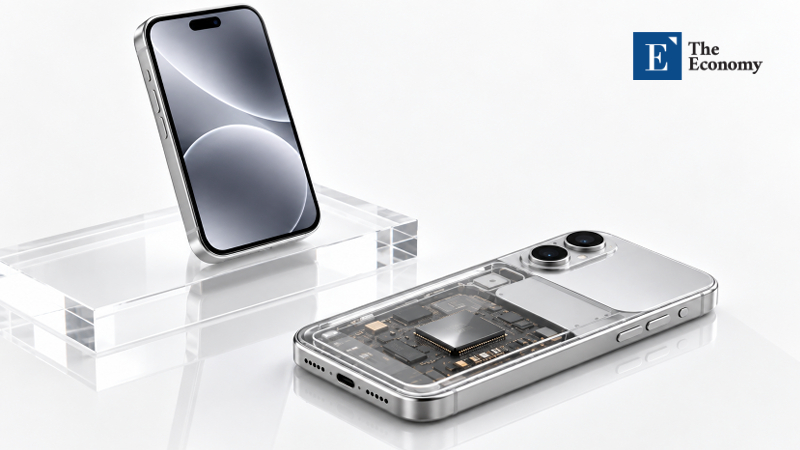
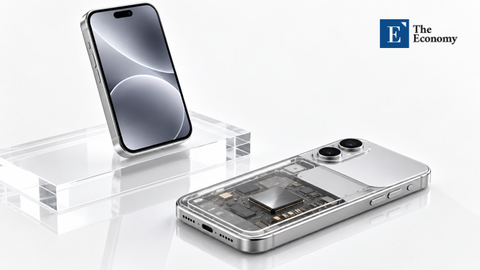
Apple’s efforts to internalize semiconductor design are beginning to bear fruit. Its new 2-nanometer-class A20 Pro processor has outperformed several high-end PC processors in benchmark tests, bringing the design capabilities Apple has accumulated over many years into sharper focus. Apple has long prioritized improving the computing performance of the iPhone and Mac to deliver on-device artificial intelligence (AI) rather than investing heavily in large-scale infrastructure. More recently, the company has also been exploring the construction of AI servers powered by its own chips, seeking to extend its hardware-internalization strategy from devices into the data center.
Apple’s A20 Pro Unveiled
According to foreign media reports compiled on the 18th (local time), Apple unveiled the A20 Pro, which powers the iPhone 18 Pro, for the first time at its product launch event on the 9th. The A20 Pro is the first 2-nanometer-class system-on-chip (SoC) Apple has designed for the iPhone. By packing miniaturized transistors at a higher density, the chip simultaneously improves central processing unit (CPU), graphics processing unit (GPU) and AI computing performance. Its CPU comprises six cores in total: two high-performance super cores and four power-efficient cores. Super-core performance has improved by as much as 20% from the previous generation, while the four efficiency cores integrate neural-network accelerators separately from the Neural Engine. Apple explained, “Integrating neural accelerators into the efficiency cores reduces latency not only for ordinary applications but also for on-device AI workloads that run AI models directly on the device.”
The GPU has seven cores, the highest count of any iPhone SoC released to date. Conventional graphics performance has improved by as much as 40% from the previous generation, while integrated neural accelerators have approximately doubled FP8, or 8-bit floating-point, computing performance. The Neural Engine, which handles various AI workloads at low power, features as many as 32 cores. Its computing performance has doubled from the previous generation, while memory bandwidth has increased by 50%. Apple has also overhauled its thermal-management architecture. The silicon die is connected directly to a vapor chamber, whose surface area is as much as three times larger than that of the iPhone 17 Pro, minimizing performance degradation.
Solid Benchmark Results
These performance improvements are also evident in benchmark results. On the 11th, a device identified as “iPhone19,3” appeared in the database of cross-platform benchmarking program Geekbench. The device recorded a single-core score of 4,042 and a multi-core score of 11,691 in the Geekbench 7 CPU test. The single-core score measures processing performance when only one CPU core is in use, while the multi-core score represents aggregate performance when multiple cores operate simultaneously. Foreign media reports subsequently identified iPhone19,3 as the iPhone 18 Pro Max equipped with the A20 Pro.
The market has focused on the A20 Pro’s ability to outperform high-end processors used in products such as the Mac. Apple’s premium PC-class M5 Max SoC, deployed in high-performance products including the MacBook Pro, generally records Geekbench 7 single-core scores ranging from the high 3,600s to the mid-3,700s, approximately 8% below the A20 Pro’s score of 4,042. AMD’s Ryzen 9 9950X3D, one of the highest-end processors for conventional desktop PCs, also posts an average single-core score of approximately 3,059 in Geekbench’s processor database, while Intel’s Core i9-14900KS manages only 2,769.
Big Tech’s AI Investment Frenzy
Underlying this performance edge is a technological capability Apple has cultivated along a different path from its rivals. Since the generative AI boom took hold, leading Big Tech companies have poured vast amounts of capital into securing large-scale data centers and GPUs. Amazon expects annual capital expenditures of $200 billion this year, and Amazon Chief Executive Officer (CEO) Andy Jassy has said that a substantial share will be allocated to Amazon Web Services (AWS) and AI infrastructure investment. Microsoft (MS) is likewise forecasting annual capital expenditures of $175 billion this year and invested approximately two-thirds of its most recent quarterly capital expenditures in shorter-lived assets such as GPUs and CPUs.
Alphabet expects capital expenditures of $175 billion to $185 billion this year and has said that most of the spending will go toward technology infrastructure, including servers, data centers and networks. Meta has also raised its capital expenditure forecast for this year to $125 billion to $145 billion, citing the expansion of AI development and supporting infrastructure, including Meta Superintelligence Labs, as the rationale for the revision.
Table 1. Big Tech Companies’ AI Investment Strategies
| Company | Capital Expenditure Forecast for This Year | Primary Investment Focus |
|---|---|---|
| Amazon | $200 billion | Expansion of AWS data centers and AI infrastructure |
| Microsoft | $175 billion | Acquisition of AI computing equipment, including GPUs and CPUs |
| Alphabet | $175 billion–$185 billion | Development of servers, data centers and networks |
| Meta | $125 billion–$145 billion | Expansion of AI research organizations and related infrastructure |
| Apple | $14 billion | Development of proprietary chips and neural engines, and optimization of on-device AI |
Apple’s Distinctive AI Strategy
Apple, by contrast, has maintained a strategy of designing the processors used in its iPhones and Macs and improving the computing power of the devices themselves, rather than acquiring large-scale data centers and general-purpose AI accelerators from external suppliers. A prominent example is the A11 Bionic, introduced in the iPhone X in 2017. Apple incorporated its first proprietary Neural Engine dedicated to machine-learning computations into the chip. At the time, the Neural Engine was designed to process as many as 600 billion operations per second, allowing machine-learning features such as Face ID to run directly on the device. The Neural Engine’s computing capacity subsequently expanded steadily, and the 16-core Neural Engine in the A15 Bionic released in 2021 was capable of processing 15.8 trillion operations per second.
This proprietary-chip strategy eventually expanded into the Mac ecosystem. In 2020, Apple replaced Intel CPUs in the Mac with its internally designed M1, integrating the CPU, GPU, Neural Engine and memory system into a single SoC. The M series has since improved its dedicated machine-learning performance with each successive generation. The proprietary-silicon capabilities accumulated through this process now underpin Apple’s core strategy in the generative AI era. One example is Apple Intelligence, unveiled in 2024. The generative AI system is integrated into the operating systems of the iPhone, iPad and Mac, with a substantial number of its AI models designed to run directly on-device rather than in the cloud. An industry source said, “Because Apple has spent years building its proprietary chip-design capabilities, its strength in the generative AI race lies in its ability to optimize hardware and operating systems together,” adding, “If Apple can implement AI that understands users’ needs and context within its own ecosystem without relying on external cloud services, it could become the most quintessentially ‘Apple-like’ approach to AI.”
Potential Partnership With Nvidia
More recently, Apple has also been working to overcome the limitations of on-device AI. A notable example is its discussions with Nvidia on developing enterprise servers powered by Apple’s own chips. On the 16th, technology publication The Information reported, “Apple has been exploring the construction of an AI server cluster combining its internally developed ‘M8 Ultra’ chips with Nvidia’s server-interconnect technology.” Apple’s proposed server would link two or four M8 Ultra chips to process AI inference workloads. The target launch date is as early as 2029, although the plans could reportedly be modified or abandoned because discussions remain at an early stage.
Apple’s decision to revisit the server market after 18 years is widely interpreted as an attempt to secure in-house the infrastructure required to expand its AI services. With on-device technology alone insufficient to meet the market’s large-scale computing demand, the company appears to be widening the scope of hardware and software integration through proprietary servers. Nvidia is expected to support Apple’s server connectivity through its open interconnect technology, NVLink Fusion. NVLink Fusion is designed to connect CPUs and accelerators made by companies other than Nvidia to Nvidia’s NVLink-based high-speed network.
Aoife Brennan is a contributing writer for The Economy, with a focus on education, youth, and societal change. Based in Limerick, she holds a degree in political communication from Queen’s University Belfast. Aoife’s work draws connections between cultural narratives and public discourse in Europe and Asia.
Similar Post