"Cutting Manufacturing Costs": Hyundai Scales Up Atlas Production and Deployment to Counter Chinese EV Price Pressure

As one of the youngest members of the team, Tyler Hansbrough is a rising star in financial journalism. His fresh perspective and analytical approach bring a modern edge to business reporting. Whether he’s covering stock market trends or dissecting corporate earnings, his sharp insights resonate with the new generation of investors.
Authored On
Modified
Boston Dynamics opens RMAC to train and validate Hyundai’s Atlas
Hyundai plans to deploy 25,000 Atlas robots and expand production capacity
Can lower manufacturing costs help Hyundai catch up with Chinese EV makers?
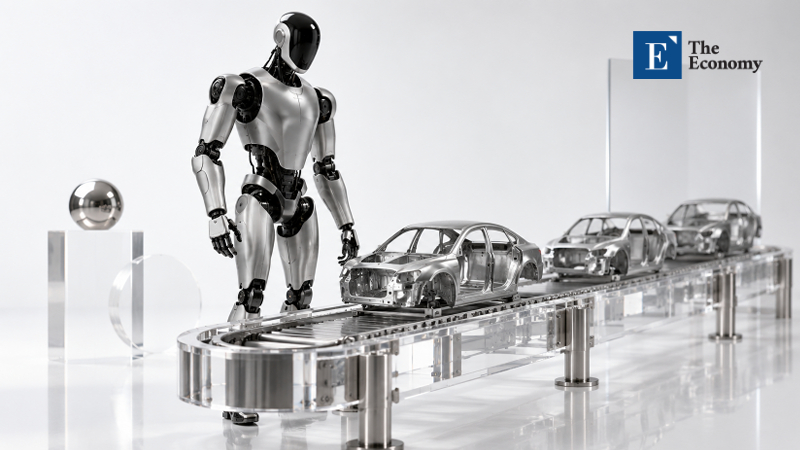
Hyundai Motor Group is preparing to put its Atlas humanoid robot to work on automotive production lines. As Chinese automakers expand their global presence through extensive automation and inexpensive components and batteries, Hyundai is accelerating efforts to improve its cost structure through robotics. The group plans to increase Atlas production and gradually broaden its use across manufacturing processes, reducing both the robot’s unit cost and overall vehicle production costs.
Atlas Begins Full-Scale Training
On September 21 (local time), Boston Dynamics announced that it had opened the Robotics Metaplant Application Center (RMAC) at Hyundai Motor Group Metaplant America (HMGMA) near Savannah, Georgia, and begun operations. RMAC is a test bed where Atlas learns and validates tasks in an automotive manufacturing environment before entering production lines. Atlas is reportedly performing logistics preparation and parts sequencing—arranging automotive components in assembly order—while its precision and safety are assessed against production-floor requirements.
The RMAC facility now operating is its first phase. Boston Dynamics plans to move it into a separate building on the HMGMA campus in 2027 and expand it to roughly 10 times its current size. Training will also broaden in stages. Atlas will first establish its suitability for parts sequencing and logistics before moving into processes involving repetitive motions and heavy loads that place greater physical strain on workers. RMAC will go beyond teaching the robot to repeat preset movements: it plans to continually refine Atlas’s behavioral models using real manufacturing data. The approach combines motion-training data collected at RMAC with production data from a software-defined factory (SDF) to retrain the robot.
Hyundai’s Production-Automation Plans
Hyundai Motor Group plans to deploy more than 25,000 Atlas robots across its production facilities in phases after they complete this training. It intends to identify 16 core manufacturing processes and assess the effects of Atlas deployment on safety, productivity and quality. The first deployment on a production line is expected in 2028, beginning with parts sequencing. Hyundai plans to extend the program to the nearby Kia Georgia plant in the second half of 2029, followed by other production sites worldwide. An earlier analysis of humanoid deployment in auto plants examined both the group’s plans and the technical requirements for wider adoption.
Hyundai is also revamping its production system to support deployment at scale. The group aims to secure capacity to manufacture 30,000 robots annually by 2028 and plans to build a new robot production facility in the United States. Encompassing design, manufacturing, testing, validation and field deployment, the facility is intended to become a central U.S. robotics hub rather than a simple assembly plant. Integration across the group’s value chain will deepen as well. Hyundai Mobis will develop high-performance actuators for Atlas with Boston Dynamics; Hyundai Motor and Kia will provide production infrastructure and process data; and Hyundai Glovis will contribute logistics and supply-chain capabilities.
Expected Manufacturing-Cost Savings
Hyundai’s push to establish mass production is intended to maximize cost savings on the factory floor. According to Samsung Securities, Atlas’s initial production cost is estimated at $130,000–$140,000 per unit, falling to an estimated $50,000 when production reaches 10,000 units. The projected cost declines to $35,000 at 30,000 units and $30,000 at 50,000. Those prices approach the threshold for commercial use of humanoids in industrial settings. McKinsey estimates that a humanoid robot would need to cost $20,000–$50,000 to compete with human labor in general industrial applications.
Capital expenditure (CAPEX), depreciation and maintenance associated with deploying Atlas will also determine the returns. For the investment to deliver a measurable benefit to the group, savings in labor, production time, defects and safety-related costs must exceed acquisition and operating expenses. Samsung Securities estimates that labor accounts for roughly 7–8% of Hyundai Motor and Kia’s manufacturing costs and projects that, depending on the pace of humanoid deployment after 2028, the robots could reduce those costs by approximately one percentage point each year. It also calculates that Atlas’s hourly cost could fall from $9.40 at the start of mass production to around $1.20 once output exceeds 30,000 units. Research on automation and unit labor costs likewise examines how robot adoption affects the economics of manufacturing.
Table 1. Hyundai Motor Group’s Plans to Expand Atlas Deployment and Production
| Period | Key plans |
|---|---|
| Present | Operate the first-phase RMAC facility at Hyundai Motor Group Metaplant America; train and validate Atlas primarily on parts sequencing and logistics tasks |
| 2027 | Move RMAC into a separate building and expand the facility to approximately 10 times its current size |
| 2028 | Deploy Atlas for the first time in parts-sequencing operations at a Hyundai production facility; establish U.S. capacity to manufacture 30,000 robots annually |
| Second half of 2029 | Extend deployment to the Kia Georgia plant and other facilities |
Chinese Automakers’ Rapid Global Expansion
The rapid global expansion of Chinese competitors appears to be one reason Hyundai is concentrating on automation and cost reduction. Chinese automakers have recently extended their reach well beyond their vast domestic market. According to the China Association of Automobile Manufacturers (CAAM), China exported 6.038 million passenger vehicles last year, up 21.9% from the previous year. Cumulative exports in the first eight months of this year exceeded 6.2 million vehicles, already surpassing last year’s full-year total. Overseas shipments reached approximately 890,000 vehicles last month, a 67.1% increase from a year earlier.
Electric vehicles are central to that expansion. According to the International Energy Agency (IEA), roughly 940,000 Chinese-made EVs were sold in Europe last year, an increase of nearly 50% from the previous year, while Chinese-made vehicles accounted for 60% of all EV imports into the European Union (EU). Growth was also steep outside the United States and Europe. Chinese imports accounted for about 55% of EVs sold in those markets, with sales of Chinese-made EVs rising 130% year on year in Southeast Asia, 60% in the Middle East and 55% in Latin America. The Economy’s coverage of China’s EV expansion details the role of pricing and supply chains in its overseas growth.
A Formidable Price Advantage
Price is a defining advantage for China’s EV industry. According to the IEA’s recently published Global EV Outlook 2026, about 70% of battery electric vehicles (BEVs) sold in China last year were cheaper than comparable internal-combustion vehicles even without government purchase incentives. The sales-weighted average purchase price of BEVs fell by more than 10% over the same period. China also offers a wider selection of inexpensive models than other major markets. About 30% of BEV models sold there last year had base prices below $20,000. In the sport utility vehicle (SUV) segment, which accounts for roughly half of China’s new-car sales, the average BEV price fell to parity with comparable internal-combustion models for the first time.
Chinese automakers’ price advantage is evident overseas as well. An International Monetary Fund (IMF) comparison of EV prices in Europe, based in part on European Commission data, found that Chinese manufacturers’ vehicles cost an average of about 20% less than comparable European models in 2023. In the midsize segment, Chinese vehicles averaged approximately $35,535, against $43,559 for European models—a gap of roughly 18%. Premium vehicles averaged approximately $46,998 and $58,461, respectively, a difference of about 20%. In the luxury segment, the respective prices were approximately $77,948 and $118,069, widening the gap to 34%. The IEA attributed the cost competitiveness of Chinese EVs to high manufacturing efficiency and automation, along with lower materials and component costs.
As one of the youngest members of the team, Tyler Hansbrough is a rising star in financial journalism. His fresh perspective and analytical approach bring a modern edge to business reporting. Whether he’s covering stock market trends or dissecting corporate earnings, his sharp insights resonate with the new generation of investors.
Similar Post