“Domestic Price War Unleashes Flood of New Models”: China’s Automakers Race Ahead as Safety Testing and After-Sales Networks Falter, Impeding Global Expansion

Matthew Reuter is a senior economic correspondent at The Economy, where he covers global financial markets, emerging technologies, and cross-border trade dynamics. With over a decade of experience reporting from major financial hubs—including London, New York, and Hong Kong—Matthew has developed a reputation for breaking complex economic stories into sharp, accessible narratives. Before joining The Economy, he worked at a leading European financial daily, where his investigative reporting on post-crisis banking reforms earned him recognition from the European Press Association. A graduate of the London School of Economics, Matthew holds dual degrees in economics and international relations. He is particularly interested in how data science and AI are reshaping market analysis and policymaking, often blending quantitative insights into his articles. Outside journalism, Matthew frequently moderates panels at global finance summits and guest lectures on financial journalism at top universities.
Authored On
Modified
“At Least Eight in One Day”: Chinese Automakers Locked in Fierce New-Model Launch Race
Gaps Emerge in Validation Procedures, While Repair and Maintenance Networks Face Growing Strain at Home and Abroad
Eroding Market Confidence Threatens to Undermine Chinese Automakers’ Overseas Expansion
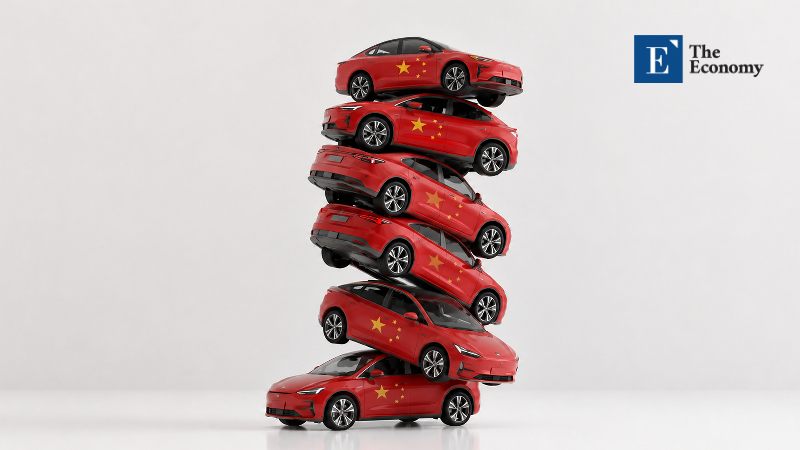
Chinese automakers are engaged in an extreme race to launch new vehicles. The intensifying battle for market share comes as domestic automotive demand contracts markedly and the market rapidly shifts toward new-energy vehicles. Market observers warn that this trend could ultimately constrain Chinese automakers’ expansion strategies. The adverse consequences of shortened development cycles—including curtailed validation procedures and disruption across maintenance and repair networks—are already undermining confidence in Chinese-made vehicles themselves.
Flood of New Chinese Models
According to a Nikkei Asia report published on August 22, at least eight Chinese automakers—from Great Wall Motor to Leapmotor—announced new-vehicle launches on July 16 alone. Six of them reportedly unveiled either new models or facelifts in the new-energy vehicle (NEV) segment, including battery electric vehicles (EVs) and plug-in hybrid electric vehicles (PHEVs). Chinese media even dubbed the succession of launches “Crazy Thursday for the automotive industry,” likening it to KFC China’s weekly discount promotion held every Thursday, known locally as Crazy Thursday.
Such excessive competition over new-model launches has become a chronic affliction of China’s automotive industry. He Zhiqi, executive vice president of BYD, recently wrote on the social media platform Weibo that “as many as 542 new models were launched in the Chinese market between January and May this year.” He added, “That works out to an average of 3.6 models a day—about as often as people eat meals.” Comparing the current competitive landscape to a “brutal gymnasium,” He continued, “Even after investing $145 million and more than two years in developing a single model, it remains at the center of market attention and peak sales for no longer than three months.”
Crisis in China’s Automotive Market
The contraction of China’s domestic market lies behind automakers’ rush to introduce new vehicles. According to the China Passenger Car Association (CPCA), retail sales of passenger vehicles in China totaled approximately 8.75 million units in the first half of this year, down around 20% from the same period a year earlier. Meanwhile, the retail penetration rate of new-energy passenger vehicles reached a monthly record of 63.6% in June. One market expert said, “China is experiencing an overall decline in automotive demand while the market is rapidly being reorganized around new-energy vehicles.” The expert added, “Electric-vehicle and plug-in-hybrid manufacturers that proliferated on the back of government subsidies have little choice but to engage in a ruinous battle over an increasingly limited market.”
As sales competition intensifies, automakers’ profitability is plummeting. CPCA data show that revenue across China’s automotive industry increased 1.4% year over year to $611.5 billion between January and May, while costs rose 2.3% to $543.2 billion. Consequently, industrywide profit fell 20% to $20.9 billion, while the average profit margin slipped to 3.4%. AC Auto also estimated that major Chinese-brand new-energy vehicles generate profits of only $725–$1,160 per unit. The industry is therefore witnessing a clear pattern of “volume growth without profit growth,” in which higher sales fail to translate into meaningful earnings.
Table 1. Sales and Profitability in China’s Automotive Industry
| Indicator | Key Development |
|---|---|
| Passenger-vehicle sales | Down approximately 20% year over year in the first half of 2026 |
| New-energy vehicle penetration rate | Reached a record 63.6% in June 2026 |
| Revenue and costs | Costs rising faster than revenue |
| Industry profit | Total profit down 20% between January and May 2026; average profit margin at 3.4% |
| Profit per vehicle | Estimated at $725–$1,160 for major new-energy vehicles |
Speed Prioritized Over Safety During Development
The adverse consequences of excessive competition are also becoming evident throughout the industry. Chinese financial media outlet Yicai reported on August 20 that China’s new-vehicle development cycle, which remained at approximately five years during the internal-combustion-engine era, has recently been compressed to two years. Some manufacturers even claim they can launch three new models within a single year. Industry sources say certain companies have accelerated product launches by relying heavily on laboratory simulation tests and reducing the frequency of real-world road testing, while others have omitted the validation of particular components altogether. Bringing a newly developed vehicle to market requires numerous stages—including initial market research, design, technology development, regulatory review, downstream platform integration, supplier matching, simulation testing and real-world road testing—and the overall process is generally understood to take approximately two years.
Industry executives are also sounding the alarm. Lee Peng-gang, president of Beijing Hyundai, warned at the 2026 China Auto Forum last month, “To keep pace with launch schedules, some brands are skipping many essential tests, effectively turning customers into test personnel rather than consumers.” He added, “This will undoubtedly create a great many latent risks.” An R&D engineer at an automotive joint venture between a foreign company and a Chinese partner similarly told Yicai, “There are normally several test vehicles, but some companies assign only a single test vehicle to conduct road testing on a particular piece of hardware.” The engineer continued, “Once that vehicle passes, the company treats the test item itself as completed, while the remaining new vehicles are required only to meet the baseline standard.”
Aftermarket Supply Chains Under Strain
Maintenance and repair networks have also been thrown into considerable disarray. Chinese regional newspaper Yiwu Business Daily reported on August 3, citing local insurance and automotive repair industry officials, that frequent model changes in the new-energy vehicle sector have exacerbated parts shortages. Facelift cycles have become excessively short, while repeated changes in contract manufacturers have produced numerous cases in which even vehicles from the same model family use different part codes and calibration programs. As a result, local independent repair shops are reportedly struggling either to obtain the necessary components or to match vehicles with parts that appear physically identical.
These shortcomings are also conspicuous in overseas markets. In Australia, for example, repeated delays have been reported in collision repairs for vehicles sold by MG, a brand owned by SAIC Motor. Vehicles are frequently stranded at repair shops for months because of delays in procuring bumpers, body panels and electrical components. Similar problems have emerged in the United Kingdom. The Times reported this month that repairs to some Chinese-made vehicles had been delayed for extended periods because supply networks for collision-repair parts were not adequately established. In particular, disruptions in the supply of panels and other components required after accidents have left a growing number of vehicles sitting in repair shops for prolonged periods. Moreover, repair-related risks have reportedly prompted insurers in the United Kingdom to charge higher premiums for certain Chinese-made vehicles—or, in some cases, decline to insure them altogether.
Potential Slowdown in Business Expansion
Gaps in after-sales service systems could impose a significant burden on the Chinese automotive industry’s expansion strategy. If the associated controversies continue to accumulate, global consumer perceptions of Chinese-made vehicles themselves could deteriorate. Chinese automakers are currently devoting considerable resources to overseas markets as they seek to escape the “chicken game” unfolding at home. Moving beyond simple exports, they are accelerating efforts to establish local production and assembly networks and build a substantive presence abroad. According to the International Energy Agency (IEA), Chinese companies had secured overseas annual production capacity of approximately 1.7 million internal-combustion-engine and electric vehicles as of last year. Southeast Asia accounted for more than half of total overseas production capacity, with Thailand and Indonesia alone representing more than 30% and 20%, respectively.
Localization efforts aimed at offsetting trade barriers have recently gained momentum in Europe as well. BYD has produced electric buses in Komárom, Hungary, since 2017 and also operates a battery assembly facility there. It is currently building its first European passenger-vehicle plant in Szeged, Hungary, while the potential acquisition of an existing automaking facility in Southern Europe has also reportedly entered discussions. Chery Automobile plans to begin trial production of Omoda and Jaecoo vehicles at a plant in Barcelona’s free-trade zone during the third quarter of this year. Leapmotor, meanwhile, is pursuing plans to produce the B10 electric sport utility vehicle (SUV) at a plant in Zaragoza, Spain, through Leapmotor International, its joint venture with Stellantis. China’s Dongfeng Motor and Hongqi, the premium vehicle brand owned by FAW Group, are also considering contract manufacturing arrangements with Stellantis, while Germany’s Volkswagen has reportedly entered discussions with China’s XPeng over a potential factory acquisition and contract production.
Matthew Reuter is a senior economic correspondent at The Economy, where he covers global financial markets, emerging technologies, and cross-border trade dynamics. With over a decade of experience reporting from major financial hubs—including London, New York, and Hong Kong—Matthew has developed a reputation for breaking complex economic stories into sharp, accessible narratives. Before joining The Economy, he worked at a leading European financial daily, where his investigative reporting on post-crisis banking reforms earned him recognition from the European Press Association. A graduate of the London School of Economics, Matthew holds dual degrees in economics and international relations. He is particularly interested in how data science and AI are reshaping market analysis and policymaking, often blending quantitative insights into his articles. Outside journalism, Matthew frequently moderates panels at global finance summits and guest lectures on financial journalism at top universities.
Similar Post