AI, Power & Society

Data centers raise household electricity prices, but unevenly across utilities Nonprofit utilities show almost no residential price effect Water impact is documented in volumes, not household bills The avera
Read More
Europe's AI compute gap remains large despite new investment Small firms face deeper barriers to meaningful AI adoption Local demand could reinforce infrastructure, competition and productivity Three
Read More
Middle powers lack AI investment scale to rival US-China ASEAN's tariff failure shows coalition governance is hard Narrow bilateral deals work better than grand AI coalitions In 2025, the United State
Read More

AI export controls protect U.S.
Read More







Managed Interdependence is the realistic path for middle powers Local data centers do not equal sovereign AI Real sovereignty needs leverage, exits and supplier choice The clearest warning in the sovereign AI debate is not a
Read More
EU trade de-risking should not be driven by import shares alone The real risk lies in concentrated, hard-to-replace inputs Europe needs selective resilience, not broad decoupling EU trade de-risking could fail in two c
Read More
EU strategic autonomy depends on reducing critical bottlenecks, not cutting trade China-linked inputs matter most where Europe cannot switch suppliers quickly The answer is targeted de-risking, stockpiles and crisis planning
Read More
Europe’s green transition depends on foreign-controlled supply chains Factories alone do not create industrial autonomy Selective de-risking is stronger than full decoupling In 2024, China supplied 98 per
Read More
South Korea bears real costs from US AI export controls The AI memory boom has provided temporary compensation Submarine cooperation adds a major strategic return In 2025, South Korea shipped $130.8 billion worth of goods to Ch
Read More

AI chip controls can buy time, not permanent dominance Chinese substitution limits their long-term power That time must build U.S. and allied capacity In 2024, U.S.
Read More
US restrictions exposed the fragility of allied AI access Europe needs leverage through capital, chips and compute A formal access compact could balance security with continuity One order from Washington on 12 June 2026 cut all f
Read More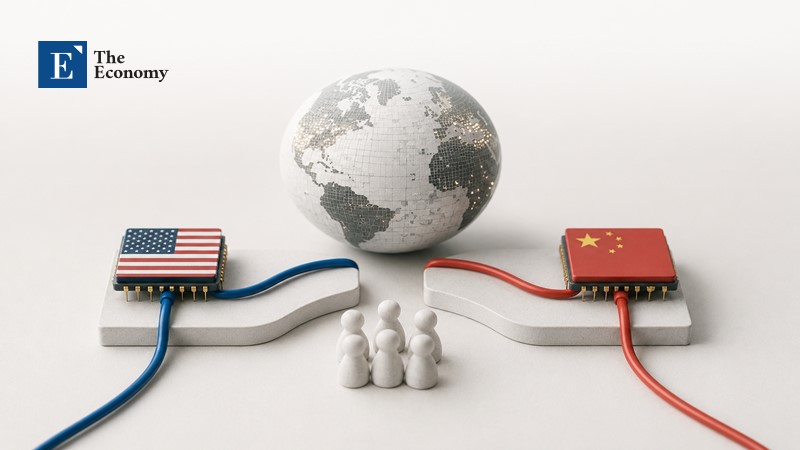
The US–China AI split is becoming structural The Global South must secure access without accepting permanent dependence Cheaper AI matters only when it builds local capacity and bargaining power The global AI divide is ofte
Read More
AI adoption measures use, but not control. Europe’s deeper weakness lies in foreign-owned compute, cloud and energy infrastructure AI compute sovereignty requires shared capacity, open access and democratic oversight About three-
Read More
Time-to-power now shapes the economics of AI infrastructure Faster deployment can strengthen innovation but also shift grid costs to the public Governments need coordinated, transparent rules that reward speed without weakening fairness or reliability.
Read More

AI leadership depends on power, chips and secure infrastructure A democratic compute coalition could align faster delivery with allied cooperation Success depends on resilience, access and wider business adoption About 415 ter
Read More
The AI adoption gap is an institutional gap, not just a tool gap The U.S.
Read More
Europe’s AI future depends on compute power The gap is also about energy, chips and access Europe needs its own AI infrastructure, not full dependence on others Europe's AI problem is no longer a software probl
Read More
Europe should build chip power through indispensability, not full self-sufficiency The real strategy is to control key bottlenecks others cannot replace A stronger chip policy must focus on leverage, coordination, and industrial demand
Read More
Cloud compute controls are becoming central to AI power The article argues for narrow, risk-based rules instead of broad bans Compute access must be governed early When a country no longer needs to buy the top-tier AI ch
Read More