“Marine Engines Emerge as Gas-Turbine Alternative” — AI Data Center Boom Brings Ship Engines Ashore, but FDC Scalability Remains in Doubt

Aoife Brennan is a contributing writer for The Economy, with a focus on education, youth, and societal change. Based in Limerick, she holds a degree in political communication from Queen’s University Belfast. Aoife’s work draws connections between cultural narratives and public discourse in Europe and Asia.
Authored On
Modified
Marine engine manufacturers accelerate expansion into onshore data center market
Data center operators turn to marine engine companies amid gas-turbine supply bottlenecks
Expectations grow for FDC integration, while sustainability of offshore AI infrastructure remains uncertain
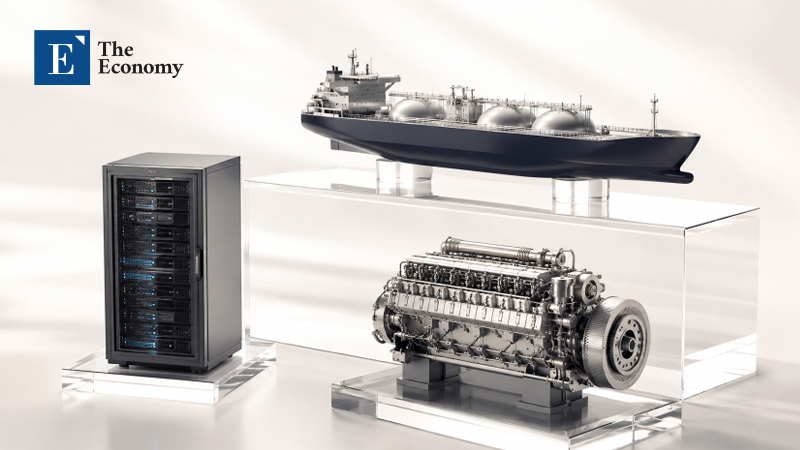
Marine engine manufacturers are expanding into the onshore power generation market. As the rapid proliferation of artificial intelligence (AI) data centers pushes the conventional gas-turbine supply chain to saturation, four-stroke medium-speed engines traditionally deployed aboard vessels are gaining traction as an alternative source of power. Market expectations are rising that this trend could eventually converge with the floating data center (FDC) sector and create a new source of demand for shipbuilders and engine manufacturers. However, the FDC industry remains positioned as an alternative to land-based data centers, leaving the prospect of a long-term transformation in the industry uncertain.
HD Hyundai Heavy Industries Makes Full-Scale Entry into Data Center Market
According to shipping industry sources on August 7, HD Hyundai Heavy Industries has drawn up plans to reorganize its HiMSEN engine production system by application, linking its engine plant in Ulsan, the Mokpo plant in South Jeolla Province operated by subsidiary HD Hyundai Engine, and a new plant to be constructed in the future. The HiMSEN engine is a proprietary four-stroke medium-speed engine developed by HD Hyundai Heavy Industries. A four-stroke medium-speed engine completes one cycle through four piston strokes. Although it generates less output than a two-stroke engine, it offers greater fuel efficiency and precise revolutions-per-minute control, enabling stable power generation. The engines are primarily used for onboard power generation and propulsion in small and midsize vessels, while their deployment has recently expanded to onshore power generation applications such as data centers.
HD Hyundai Heavy Industries’ production overhaul is aimed at raising manufacturing efficiency while responding to growing demand for engines used in onshore power generation. As more customers seek engines for data center applications, the company plans to establish a specialized component procurement system tailored to requirements distinct from those of its existing engines. HD Hyundai Heavy Industries has already secured an order for onshore power generation. In April, U.S. energy infrastructure developer Aiperion Energy Group (AEG) announced that it had signed a contract with Hyundai Heavy Industries for power generation facilities based on 20-megawatt HiMSEN engines. The deal marks HD Hyundai Heavy Industries’ first data center power-engine contract in the United States, with total supply capacity reaching 684 megawatts and the contract valued at approximately $440.6 million.
Similar Shift Spreads across Global Engine Industry
The same trend is emerging across the global marine engine industry. Finland’s Wärtsilä, for example, secured a contract in November last year to supply 507 megawatts of power generation capacity to a new data center under construction in the United States. The facility will deploy 27 Wärtsilä 50SG engines fueled by natural gas as its primary continuous power source. On April 16, the company also won a contract to supply 412 megawatts of engine capacity—comprising 40 Wärtsilä 34SG gas engines—for a large hyperscale data center project in Ohio.
In the same month, Wärtsilä secured an additional contract to supply 790 megawatts of off-grid power generation capacity to a new data center in Texas. The 42 Wärtsilä 50SG engines installed at the power plant will also serve as the facility’s primary power source. In June, U.S. energy services company Liberty Energy placed a large engine order with Wärtsilä. The contract is valued at approximately $337 million, compared with the separately converted equivalent of about $335.5 million, and the engines will be supplied to power plants supporting the development of large data centers in the United States.
U.S.-based Caterpillar has also secured a major contract in the primary power market for data centers. In January, American Intelligence & Power (AIP) signed a purchase agreement with Caterpillar to install 2 gigawatts of natural-gas generator sets at the Monarch Compute Campus. Deliveries are scheduled to begin in September and continue through August 2027, with the full 2 gigawatts of power capacity expected to become operational in 2027.
Table 1. Data Center Orders Secured by Global Engine Manufacturers
| Company | Order Date | Project and Location |
|---|---|---|
| HD Hyundai Heavy Industries | April 2026 | AEG data center project in the United States |
| Wärtsilä | November 2025 | New data center in the United States |
| Wärtsilä | April 2026 | Hyperscale data center in Ohio, United States |
| Wärtsilä | April 2026 | New data center in Texas, United States |
| Wärtsilä | June 2026 | Liberty Energy data center power plant in the United States |
| Caterpillar | January 2026 | Monarch Compute Campus |
Lead-Time and Flexibility Advantages
The growing interest in engines for onshore power generation stems from supply bottlenecks in the gas-turbine market. Large gas turbines, widely used in on-site generation facilities for AI data centers, are currently in insufficient supply to meet demand. GE Vernova of the United States said orders and reserved production slots for its gas-fired power equipment had reached 116 gigawatts as of the second quarter and were expected to total at least 125 gigawatts by year-end. Germany’s Siemens Energy secured 102 new gas-turbine orders in the first quarter of fiscal 2026 alone, while its confirmed and reserved gas-turbine volume reached 87 gigawatts as of the second quarter.
Against this backdrop, large medium-speed gas engines with comparatively manageable delivery schedules offer a viable alternative for data center operators. As of the second quarter, delivery times for new Wärtsilä 34SG equipment stood at 18 to 24 months, compared with 24 to 30 months for the 50SG and 22 to 28 months for the MAN 51/60G. Caterpillar’s G3520 carried a delivery timeline of 12 to 18 months. With production slots for some gas turbines fully booked for several years, data center developers adopting medium-speed gas engines can substantially accelerate access to power. Their modular architecture offers an additional advantage. Operators can install engines with capacities of several tens of megawatts in phases aligned with data center expansion, securing incremental power without waiting for one or two gas turbines with capacities of several hundred megawatts to be completed.
Data Centers Take to the Sea
The entry of marine engines into the data center market could eventually extend to offshore data centers. Shipbuilders have recently accelerated projects to develop FDCs that install servers, power systems and cooling equipment on floating structures. Samsung Heavy Industries secured approval in principle for its proprietary 50-megawatt FDC design in April and is now jointly developing FDCs with global shipowners and classification societies. HD Korea Shipbuilding & Offshore Engineering also agreed last month to jointly develop power and infrastructure technologies for FDCs with French energy company Schneider Electric.
Efforts to repurpose secondhand vessels are also emerging in Japan. Major Japanese shipping company Mitsui O.S.K. Lines is working with Hitachi and Hitachi Systems to convert used vessels into FDCs. The project aims to repurpose the spacious hulls of secondhand cargo ships and vehicle carriers as data center facilities. The three companies have begun assessing commercial feasibility—including demand validation, basic specifications and operating procedures—with the goal of commencing operations after 2027. Mitsui O.S.K. Lines will oversee maritime operating requirements, including vessel conversion, consultations with port authorities, mooring and maintenance, while the Hitachi companies will assess IT infrastructure requirements covering data center design and installation, networks and cybersecurity.
Evolution of Land-Based Data Centers
The durability of this demand remains uncertain. Large data centers require enormous amounts of electricity and cooling infrastructure while imposing substantial noise and environmental burdens on surrounding communities. These constraints have stalled a succession of new land-based data center projects. Offshore locations face fewer siting restrictions and allow large-scale facilities to be deployed in concentrated configurations, giving them a role as an alternative venue. If power-grid access and land supply for data centers stabilize, permitting procedures become more efficient and public acceptance improves, demand for offshore facilities could decline sharply. Marine data centers carry higher construction and maintenance costs than land-based facilities and face heavier operating burdens from salinity, waves and severe weather.
The expanding scope of applications for land-based data centers further reinforces this outlook. Across Northern Europe, the use of waste heat from data centers in district heating systems is spreading. Finland supplies data center waste heat to district heating networks in cities including Espoo and Seinäjoki, while waste heat from Meta’s data center in Odense, Denmark, provides heating for approximately 11,000 households. Japan is also increasingly considering this model as an alternative. In its Sustainable Data Center Roadmap released last year, the government-led Innovation for Cool Earth Forum (ICEF) proposed using data center waste heat for agricultural greenhouses, building heating and aquaculture as well as district heating. It also recommended institutional reforms enabling municipalities to locate data centers near facilities with demand for waste heat.
Aoife Brennan is a contributing writer for The Economy, with a focus on education, youth, and societal change. Based in Limerick, she holds a degree in political communication from Queen’s University Belfast. Aoife’s work draws connections between cultural narratives and public discourse in Europe and Asia.
Similar Post