‘Trump Tariffs and AI Boom’ Propel U.S. Steel Past Japan to World No. 3 for First Time in 26 Years

Anne-Marie Nicholson is a fearless reporter covering international markets and global economic shifts. With a background in international relations, she provides a nuanced perspective on trade policies, foreign investments, and macroeconomic developments. Quick-witted and always on the move, she delivers hard-hitting stories that connect the dots in an ever-changing global economy.
Authored On
Modified
50% steel and aluminum tariffs crush the price competitiveness of imports
AI data centers and power infrastructure investment generate massive steel demand
Tariff protection and the AI boom revive the U.S. steel industry’s production base
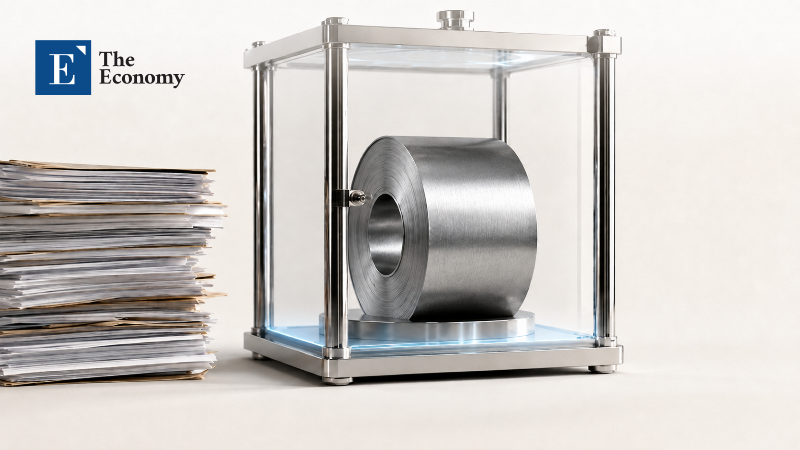
The United States has overtaken Japan to become the world’s third-largest steel producer for the first time in 26 years. The Trump administration raised tariffs on steel and aluminum to as high as 50%, displacing imports as investment in artificial intelligence (AI) data centers and power infrastructure generated massive new demand. Having confirmed the impact of the tariffs, the administration is intensifying pressure to recast procurement around U.S. supply chains by tying preferential tariff rates to the share of U.S.-made metal used and extending the tariff net to derivative products made from steel, aluminum and copper.
U.S. Rises to Third Globally With Crude Steel Output of 82 Million Metric Tons
According to the World Steel Association (WSA) on Aug. 6 local time, U.S. crude steel production increased 3.0% year over year to 81.9 million metric tons in 2025. The increase propelled the United States to third place globally behind China and India, one notch above its fourth-place ranking in 2023 and 2024. Japan, which relinquished the No. 3 position to the United States, saw production fall 3.9% from 84 million metric tons to 80.7 million metric tons over the same period. It marked the first time the United States had surpassed Japan since 1999.
The production gap swung by 5.8 million metric tons, from a 4.5 million-metric-ton lead for Japan in 2024 to a 1.3 million-metric-ton advantage for the United States last year. U.S. output increased by 2.5 million metric tons, while Japanese production declined by 3.3 million metric tons. The reversal reflected both an expansion in U.S. production and Japan’s decline to 80.7 million metric tons. Japan’s steel industry remains under pressure from weak construction and automotive demand and slowing exports, while the U.S. steel industry is showing clear signs of revival.
Imported Steel Squeezed Out by Return of 25% Tariff
The steel tariffs revived by U.S. President Donald Trump after returning to office played a major role in the increase in U.S. steel production. In February last year, Trump abolished country-specific exemptions and quotas under Section 232 of the Trade Expansion Act and imposed a uniform 25% tariff on steel and aluminum imports beginning March 12. He subsequently raised the rate to 50% on June 4. The elimination of duty-free quotas previously granted to South Korea, Japan and the European Union (EU) sharply eroded the price competitiveness of foreign steel entering the U.S. market, shifting demand toward domestic mills.
According to the American Iron and Steel Institute (AISI), finished steel imports fell 15.1% year over year to 17.55 million net tons from January through November 2025. The U.S. market share of imported finished steel declined to 19%. Imports in November dropped 18.7% from the previous month, indicating that the contraction deepened as the year progressed following the tariff increase. The decline in imports lifted sales volumes and operating rates at U.S. mills. Shipments by U.S. steel producers rose 5.0% year over year through November. AISI data showed that U.S. mill capacity utilization reached 81.0% early this month, up 2.8 percentage points from 78.2% a year earlier. Domestic products filled the space vacated by imports, establishing a foundation for the recovery in production.
Price increases constituted another pillar of the tariff effect. Data from the U.S. Bureau of Labor Statistics showed that the producer price index for iron and steel rose 10.4% between April last year and April this year, while steel mill product prices increased 13.3%. S&P Global found that U.S. steel prices rose faster than international prices following the tariffs, increasing input costs for steel-consuming companies by 10% to 13%. Improved mill profitability consequently translated into higher costs for the automotive, machinery and construction industries.
AI Data Centers Ignite Steel Boom
AI infrastructure investment provided the impetus that lifted aggregate demand. U.S. Census Bureau data showed that annualized data center construction spending reached $41.4 billion in August last year, up 32% from the same month a year earlier. The figure represented a 344% surge from 2020. Construction market research firm Dodge Construction Network found that data centers and civil infrastructure drove the increase in U.S. construction starts last year. Data center investment continued to surge even as the total floor area of building starts declined 4.7%.
AI data centers require an extensive range of metal products, spanning reinforcing bars and structural steel used in server buildings as well as cooling pipes, power cables, transformers, transmission towers and gas-fired power generation facilities. As hyperscale AI campuses expand into integrated infrastructure complexes incorporating power plants and substations, the scope of steel consumption has widened. The AI construction boom was directly reflected in the performance of U.S. rebar producer Commercial Metals Company (CMC). Shipment volumes in CMC’s North American Steel Group increased 13% in fiscal 2025, with rebar shipments rising at a similar rate. Demand from data center projects has driven sales of long steel products this year, lifting CMC’s quarterly net income from $26 million a year earlier to $93 million.
Third-quarter steel mill shipments at Nucor, the largest U.S. steelmaker, also rose 12% year over year to 6.4 million short tons last year. Rebar fabrication volumes surged 28%, while joist and deck volumes jumped 50%. Steel Dynamics’ steel fabrication order backlog increased 15% during the first half of last year and extended into this year. WSA estimated U.S. apparent steel consumption at 90.9 million metric tons last year, up 2.0% year over year. The 3.0% increase in production reflected both import substitution and higher consumption. Data centers and power infrastructure supplied new demand, while tariffs directed that demand toward U.S. mills. Any weakening in either factor would make the current pace of production growth difficult to sustain.
Table 1. Trump Administration’s Push for Additional Tariffs on Metal Derivative Products
| Category | Key Details |
|---|---|
| Policy rationale | Expansion of tariffs to metal derivative products following confirmation of import-substitution effects in the steel industry |
| Legal authority | Section 232 of the Trade Expansion Act |
| Products under review | 14 categories of steel, aluminum and copper derivative products |
| Potential tariff rate | National-security tariff of up to 25% |
| Process | U.S. Department of Commerce begins soliciting industry comments through an advance notice in the Federal Register |
| Comment deadline | Undetermined |
| Key products | Aluminum powder, brass wind instruments and parts, welding equipment, floor safes, electrical and control cables, fire extinguishers, heat exchanger and hydraulic engine parts, cranes and lifting equipment, various trailers, and steel containers filled with chemicals |
| Existing tariff measures | The first Trump administration imposed tariffs of 25% on steel and 10% on aluminum in 2018 |
| Expected impact | Higher import costs for finished goods containing metal and industrial equipment, coupled with stronger pressure to shift production to the United States |
Trump Extends Tariffs to Metal Derivative Products
After confirming the import-substitution effects in the steel industry, the Trump administration began pursuing the inclusion of 14 categories of steel, aluminum and copper derivative products under additional tariffs. The U.S. Department of Commerce began soliciting industry comments on the products through an advance notice in the Federal Register early this month. The deadline for submitting comments has yet to be determined.
The products under consideration include non-lamellar aluminum powder; brass wind instruments and parts; welding machines and parts for welding equipment; stand-alone floor safes; electrical conductor cables; fire extinguishers; heat exchanger parts; parts for linear-acting hydraulic engines and motors; mobile lifting frames and straddle carriers; self-propelled cranes and mobile lifting frames; tanker trailers and semi-trailers; other trailers and semi-trailers; self-loading and self-unloading agricultural trailers; and steel containers filled with chemicals such as liquefied propane gas (LPG), oxygen and propylene.
Section 232 of the Trade Expansion Act authorizes the president to impose tariffs when specific imports are deemed a threat to U.S. national security. The first Trump administration imposed tariffs of 25% on steel and 10% on aluminum in 2018 and continued to pursue an expansion of metal-related tariffs. If the latest proposal is implemented, the newly designated products could face national-security tariffs of up to 25%.
Tariff Design Steers Procurement Toward U.S. Materials
The widening tariff perimeter is being combined with a procurement system designed to compel the use of U.S.-made metals. In June, Trump applied a preferential tariff rate of 10% to derivative products in which steel and aluminum melted and cast in the United States account for at least 85% of total metal weight. A 15% rate was established for certain industrial and agricultural equipment from trade-agreement partners including South Korea, Japan and the EU. Access to the lower rates was conditioned on increasing the share of U.S.-made materials in procurement. Prolonged restrictions on imports are expected to further strengthen the pricing power of U.S. steelmakers.
Supply-and-demand indicators in the spot market reinforce this outlook. According to AISI, U.S. crude steel production through Aug. 1 rose 5.8% year over year to 55.51 million net tons, while average capacity utilization increased from 77.0% to 79.0%. First-quarter imports of hot-rolled sheet steel plunged 57.2% year over year to 215,027 metric tons. Scheduled mill maintenance and increased volumes under long-term contracts further accelerated the contraction in spot market availability.
Price reporting agency Fastmarkets concluded that imports would remain the only buffer capable of alleviating short-term supply shortages until new electric-arc furnace capacity comes online. The preferential tariff rates of 10% and 15% will remain in effect through the end of 2027, while the Federal Register stipulates that U.S. Customs and Border Protection (CBP) must impose statutory penalties on importers that falsely declare U.S.-made content. Overseas equipment manufacturers must secure long-term purchasing agreements with U.S. mills and overhaul their origin-management systems to qualify for lower tariff rates. As tariff barriers weaken the ability of imports to constrain prices and origin requirements lock material demand for U.S.-bound products into domestic mills, the bargaining power of U.S. steelmakers is strengthening from the procurement stage onward.
Anne-Marie Nicholson is a fearless reporter covering international markets and global economic shifts. With a background in international relations, she provides a nuanced perspective on trade policies, foreign investments, and macroeconomic developments. Quick-witted and always on the move, she delivers hard-hitting stories that connect the dots in an ever-changing global economy.
Similar Post