India’s Rare-Earth Push Confronts a Triple Barrier of Technology, Cost Competitiveness and Bureaucracy

Anne-Marie Nicholson is a fearless reporter covering international markets and global economic shifts. With a background in international relations, she provides a nuanced perspective on trade policies, foreign investments, and macroeconomic developments. Quick-witted and always on the move, she delivers hard-hitting stories that connect the dots in an ever-changing global economy.
Authored On
Modified
China’s Export Controls Put India’s Manufacturing Supply Chains on Alert
$676 Million Incentive Package Launched to Build 6,000-Tonne Annual Capacity
Raw-Material, Technology and Administrative Bottlenecks Set to Delay Mass Production
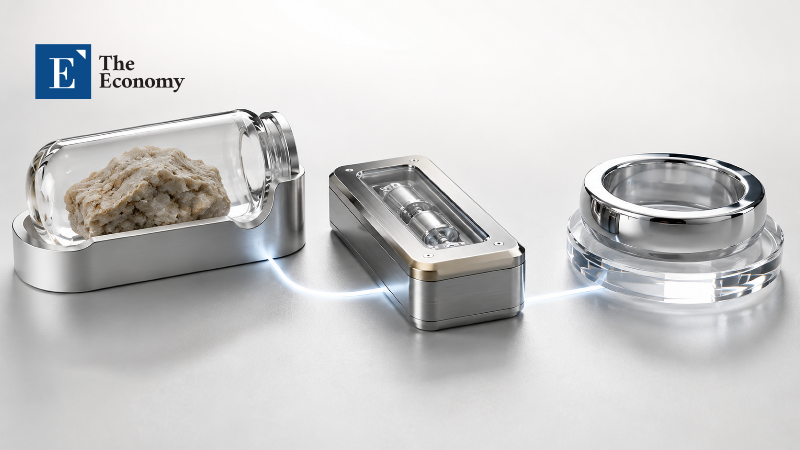
India has begun building a domestic production system to counter China’s dominance in rare-earth permanent magnets, yet low ore grades, regulations governing radioactive materials, and gaps in refining and sintering technology are obstructing commercialisation. Efforts to reduce reliance on Chinese magnets could also deepen dependence on overseas sources for oxides, production equipment and manufacturing technology. Cost pressures from small-scale production, complex licensing procedures and bureaucratic corruption are further widening the gap between the 6,000-tonne annual-capacity target and actual mass production.
Rare-Earth Magnet Self-Sufficiency Drive, Five Producers to Be Selected
According to Indian media outlets including NDTV on Aug. 12, the Indian government recently activated a rare-earth permanent magnet (REPM) development policy in response to China’s rare-earth monopoly. India’s Ministry of Heavy Industries has launched an international tender and, as of that day, had received 14 to 15 applications from domestic and foreign companies. Technical bids are scheduled to be opened on Aug. 13.
The initiative follows the Permanent Magnet Incentive Programme announced last year. In November, the Indian government approved the programme to secure 6,000 metric tonnes per annum (MTPA) of rare-earth magnet manufacturing capacity. The programme allocates $676 million in sales-linked incentives and $79 million in subsidies for the establishment of rare-earth production facilities. India had initially planned a $290 million incentive package to secure rare earths, an essential material for electric vehicles, renewable energy and defence industries, before substantially expanding the programme.
Companies participating in the scheme may receive sales incentives of up to $22.54 per kilogram of magnets, capped at 40% of net sales. The government will also subsidise 15% of eligible capital expenditure. India plans to select five operators through an international competitive bidding process by the end of the year. Individual allocations will range from 600 to 1,200 tonnes annually, with the programme spanning seven years: two years for plant construction and five years for sales-incentive payments. Successful bidders must invest $15.7 million within one year of selection and commission facilities capable of producing half of their allocated capacity within three years.
China’s Supply-Chain Grip Disrupts India’s Auto Industry
India’s move serves as a pre-emptive defence against China, which controls roughly 90% of global rare-earth refining and introduced export-licensing controls on medium- and heavy-rare-earth elements in April last year. According to the International Energy Agency (IEA), China accounted for about 60% of magnet rare-earth mining, 91% of separation and refining, and 94% of sintered permanent-magnet manufacturing in 2024. When Beijing subjected seven rare-earth elements, including heavy rare earths, and related products to export licensing in April last year, global automotive, defence, robotics and wind-power industries were immediately shaken. Sweeping additional controls announced in October of the same year were deferred until November this year under a U.S.-China agreement, but the April licensing regime remains in force.
The export-licensing regime first destabilised rare-earth procurement networks across India’s auto industry. China’s rare-earth magnet exports in April last year fell sharply to around half the previous month’s level. Indian automakers responded by warning the government of inventory depletion and possible production stoppages while immediately revising their production plans. Maruti Suzuki, for example, cut its April-to-September production target for the electric sport utility vehicle (SUV) e Vitara from 26,512 units to 8,221 units last year.
Securing domestic annual production capacity of 6,000 tonnes could provide some relief to supply pressures across India’s electric-vehicle, wind-power and defence sectors following China’s export restrictions. India’s rare-earth magnet demand is estimated to more than double from roughly 4,000 tonnes annually at present to 8,220 tonnes by 2030. India’s resource base offers a solid starting point. The Atomic Minerals Directorate for Exploration and Research (AMD) has identified 13.15 million tonnes of monazite across 136 coastal and inland placer deposits. These resources contain 7.23 million tonnes of rare-earth oxides. Hard-rock regions in Rajasthan and Gujarat have also yielded 1.29 million tonnes of rare-earth oxide resources. By U.S. Geological Survey (USGS) standards, India ranks among the world’s three largest holders of rare-earth resources.
Table 1. India’s Rare-Earth Resource Profile
| Category | Confirmed Areas or Assets | Rare-Earth Resources | Remarks |
|---|---|---|---|
| Placer deposits | 136 coastal and inland placer deposits | 7.23 million tonnes of rare-earth oxides (REO) | 13.15 million tonnes of monazite reserves |
| Hard-rock deposits | Rajasthan and Gujarat | 1.29 million tonnes of rare-earth oxides (REO) | Hard-rock rare-earth resources |
| Resource ranking | India | Among the world’s top three | Based on USGS standards |
Low Grades and Tight Regulations: India’s Dual Rare-Earth Burden
Rare-earth resources face a wide gap between geological reserves and commercial viability. Monazite concentrated in India’s coastal placer deposits has low grades and contains radioactive materials such as thorium, complicating beneficiation and separation processes. Extracting rare earths requires complex beneficiation and separation procedures as well as separate radioactive-waste treatment, sharply raising production costs. India’s Department of Atomic Energy (DAE) has also assessed that much of the country’s rare-earth resource base consists of light rare earths, while heavy rare earths such as dysprosium and terbium, which are required for high-heat-resistance magnets, are difficult to recover on a commercial scale.
Strict regulation compounds these geological constraints. Monazite is classified as a prescribed substance under India’s Atomic Energy Act, requiring central-government oversight and approval from mining-rights acquisition through extraction, processing and refining. This explains why state-owned Indian Rare Earths Ltd. (IREL) remains the only company mining rare-earth ore and refining oxides. IREL’s annual production capacity for neodymium-praseodymium oxide stands at only 400 tonnes. India also lacks an industrial-scale production base for the intermediate processes required to convert oxides into metals and alloys, produce magnetic powder, and complete automotive magnets through moulding, sintering and coating.
Technology Barriers From Oxide Procurement to Sintering
The government’s plan to establish 6,000 tonnes of annual magnet production capacity has already encountered bottlenecks at the raw-material stage. India plans to allocate 500 tonnes of neodymium-praseodymium oxide supplied annually by IREL among three operators receiving lower incentive rates: 200 tonnes, 167 tonnes and 133 tonnes, respectively. Yet this volume can produce only about 1,500 tonnes of magnets annually, equivalent to one-quarter of the government’s target. Companies will need to secure the remaining raw materials directly from overseas. The two lower-ranked operators must independently procure all required oxides, placing overseas long-term supply contracts at the core of project planning from the outset.
Even after importing oxides, companies must complete metal conversion, alloy design, magnetic-powder production, sintering and coating in sequence. These processes require precision technologies capable of controlling even minute deviations. Magnetism and heat resistance decline when alloy composition, powder particle size, oxygen concentration or sintering temperature move outside permitted ranges.
Building these capabilities requires extensive mass-production experience and collaboration among specialised firms across each production stage. Since the early 2000s, China has concentrated related companies in major manufacturing hubs, supported by low labour costs and state backing. Specialised suppliers built a division-of-labour system that lowered production costs, while process data needed to stabilise yields and quality accumulated for more than two decades. India, meanwhile, must build factories and complete a mass-production system within two years despite limited commercial-scale production experience.
Cost-Competitiveness Challenge
India’s rare-earth magnet technology remains concentrated in research and development (R&D) and pilot production, leaving mass-production experience limited. In December last year, India’s parliamentary standing committee on coal, mines and steel stated that domestic R&D achievements had yet to resolve the challenges of commercial-scale production or reach a level capable of competing in global markets. Automotive magnets must maintain consistent magnetic force for extended periods under high temperatures and vibration, making performance evaluations and quality certification by automakers essential. Under a scheme that awards incentives based on sales performance, delays in certification will also postpone revenue recognition and subsidy inflows.
The programme’s design also constrains cost competitiveness. Selected companies are required to conduct every stage—from oxide input and metal-alloy production to magnetic-powder manufacturing, moulding, sintering and coating—within a single plant. Chinese specialised firms divide mass-production processes among themselves, while Indian operators must independently build the same facilities, making duplicated investment difficult to avoid. According to Tarun Singhal, director at Indian electronics-component company Lohum, a single Chinese magnet-powder plant produces 40,000 tonnes annually. That is 33 times the 1,200-tonne production ceiling for each Indian operator. Such limited production scale could weaken bargaining power in raw-material procurement and increase equipment depreciation costs embedded in each kilogram of output, intensifying pressure on price competitiveness.
High equipment prices and lengthy delivery periods also pose a substantial burden for Indian operators already disadvantaged by limited production scale. Gaurav Shukla, vice president of Indian magnet maker N.A.N. Magnatech, said Japanese equipment requires lead times of roughly 15 months, compared with six to seven months for Chinese equipment, while prices can differ by as much as threefold. Choosing Japanese equipment would consume a substantial portion of the two-year construction period in procurement, while relying on Chinese equipment would leave India dependent on China for production facilities and maintenance technology. Securing both construction speed and supply-chain independence remains difficult.
Corruption Risks Lurking Across the Approval Process
Indian companies are accelerating partnerships with overseas specialists, but the pool of candidates with both financial strength and mass-production experience remains limited. High net-worth thresholds set by the government are further narrowing the range of potential participants. Applicants seeking 600 tonnes of annual capacity must hold net assets of at least $18.9 million, while those seeking 1,100 to 1,200 tonnes must possess $39.3 million. Mechvint Technologies, a motor manufacturer with production technology and overseas research partnerships, was unable to participate in the bidding process after failing to meet these thresholds. Large corporations with financial capacity lack manufacturing technology, while smaller companies possessing technological capabilities cannot clear the entry barrier for bidding.
Complex administrative procedures are likely to slow projects even after companies secure overseas technology partners. The Department of Atomic Energy oversees monazite management, the Ministry of Mines handles mineral development, and the Ministry of Heavy Industries is responsible for factory support and subsidy payments. Environmental and forest approvals and land acquisition involve overlapping authority between the central and state governments. The project’s oversight committee includes officials from 15 ministries and agencies, while a separate technical committee consists of 10 members. In December last year, India’s parliamentary standing committee identified lengthy regulatory approvals, forest clearances required from the exploration stage, and the lag between mine auctions and commercial operations as major impediments to the mineral industry. Delays in a single approval would inevitably cascade into postponed equipment orders, plant construction and trial-production schedules.
India’s entrenched bureaucratic corruption further complicates project execution. The country is notorious for complex regulations and opaque administrative practices. India scored 39 out of 100 in Transparency International’s 2025 Corruption Perceptions Index, below the global average of 42. Rare-earth projects involve extensive points of contact between companies and bureaucratic institutions because mining rights, environmental permits, land acquisition, raw-material allocations and subsidy reviews are dispersed across central and state governments. Opaque decision criteria and processing timelines could fuel project delays and allegations of preferential treatment.
Anne-Marie Nicholson is a fearless reporter covering international markets and global economic shifts. With a background in international relations, she provides a nuanced perspective on trade policies, foreign investments, and macroeconomic developments. Quick-witted and always on the move, she delivers hard-hitting stories that connect the dots in an ever-changing global economy.
Similar Post