“Alternative Amid Memory Supply Crunch” CXMT Pushes into Apple’s Supply Chain, Expanding Its Commodity DRAM Footprint Despite Technological Constraints and U.S. Sanctions

Oliver Griffin is a policy and tech reporter at The Economy, focusing on the intersection of artificial intelligence, government regulation, and macroeconomic strategy. Based in Dublin, Oliver has reported extensively on European Union policy shifts and their ripple effects across global markets. Prior to joining The Economy, he covered technology policy for an international think tank, producing research cited by major institutions, including the OECD and IMF. Oliver studied political economy at Trinity College Dublin and later completed a master’s in data journalism at Columbia University. His reporting blends field interviews with rigorous statistical analysis, offering readers a nuanced understanding of how policy decisions shape industries and everyday lives. Beyond his newsroom work, Oliver contributes op-eds on ethics in AI and has been a guest commentator on BBC World and CNBC Europe.
Authored On
Modified
Apple Weighs CXMT Chips Amid Memory Supply Crunch
U.S. Congressional Pressure Mounts to Add CXMT to Entity List
Chinese Memory Industry Rapidly Gains Ground in Commodity DRAM Despite Technological Constraints
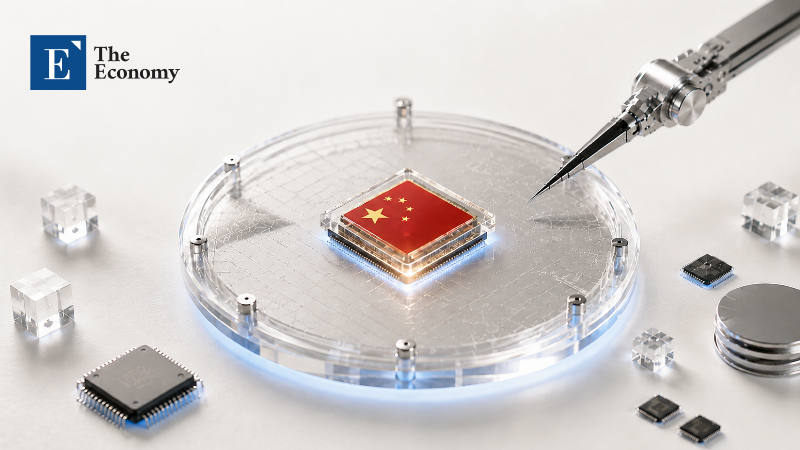
Apple is reportedly considering using memory chips produced by China’s ChangXin Memory Technologies (CXMT) in its products. As the artificial intelligence (AI) boom prolongs memory shortages and drives prices higher, Apple appears to be evaluating Chinese-made memory as part of an effort to diversify its supply chain. However, given the stringent regulatory stance in Washington and the Chinese semiconductor industry’s persistent limitations in equipment and technological capabilities, CXMT is unlikely to displace Apple’s existing memory suppliers in the near term.
Prospects for Apple-CXMT Cooperation
Citing multiple people familiar with the matter, The Wall Street Journal (WSJ) reported on the 9th local time that Apple is testing CXMT memory across several product lines, including iPhones and MacBooks. Apple has also reportedly held preliminary discussions over using CXMT components in certain devices sold in China. The move is widely viewed as a response to the prolonged memory supply crunch. Apple is regarded as one of the world’s most sophisticated supply-chain operators, yet it has struggled to insulate itself from the recent surge in memory prices and severe supply constraints. The company currently sources customized memory from the industry’s three global leaders: South Korea’s Samsung Electronics and SK Hynix, and U.S.-based Micron Technology.
In June, Apple raised MacBook prices by $100–$300 and iPad prices by $100–$200, citing an “abnormal surge in demand for memory and storage devices driven by the expansion of AI data centers,” which had sent component prices sharply higher. Apple Chief Executive Officer (CEO) Tim Cook had previously described the spike in prices for memory and other components as a “once-in-a-century flood,” warning that price increases would be unavoidable. Securing an additional Chinese memory supplier through CXMT could ease pressure on Apple’s supply chain and allow the company to recover part of its cost competitiveness.
Washington’s Sanctions Push
The central question is whether Apple can overcome regulatory barriers in Washington. In June, the U.S. Department of Defense added CXMT to its “Section 1260H list” over allegations that the company receives support from the Chinese People’s Liberation Army. The designation prevents Apple from providing CXMT with technical details, product specifications, and other information typically shared during the development of customized semiconductors. Given these restrictions, Apple is more likely to purchase off-the-shelf commodity chips already manufactured by CXMT than commission customized products. Kevin Wolf, an export-control attorney at Akin Gump, told the WSJ that “Apple’s use of CXMT’s off-the-shelf products—namely commodity memory chips—or negotiations over their pricing would not violate U.S. regulations.”
U.S. lawmakers, however, are highly likely to move to block Apple’s plans. John Moolenaar, the Republican chairman of the House Select Committee on China, previously warned that “it would be a grave mistake for Apple to partner with a Chinese military company,” arguing that such cooperation could help the Chinese Communist Party seize control of critical supply chains. Last month, Moolenaar and Democratic Representative George Whitesides also sent a letter to U.S. Commerce Secretary Howard Lutnick expressing concern over attempts by CXMT and Yangtze Memory Technologies Co. (YMTC) to enter the U.S. market. The lawmakers argued that dependence on Chinese memory producers could threaten U.S. national, economic, and supply-chain security. They also warned that government-subsidized Chinese suppliers could flood the global market with low-priced products and erode the competitiveness of Western memory manufacturers.
Calls for Tighter Restrictions
Moolenaar and Whitesides also urged the Commerce Department to add CXMT to the Bureau of Industry and Security’s (BIS) Entity List. The Entity List functions as an export-control blacklist maintained by the U.S. government. BIS places companies and institutions on the list when it determines that they have engaged in activities contrary to U.S. national security or foreign-policy interests, or pose a substantial risk of doing so. Listed entities generally require BIS authorization to receive exports or reexports of products, software, and technology subject to the U.S. Export Administration Regulations (EAR), while most license exceptions are also restricted.
The lawmakers further called for explicit purchasing restrictions to be incorporated into the existing Entity List regime. Current rules do not completely prohibit U.S. companies from purchasing products made by Entity List companies. The lawmakers argued that this regulatory gap should be closed through a separate executive order or government directive. Their proposal would bar U.S. individuals and U.S.-incorporated companies from procuring DRAM, high-bandwidth memory (HBM), and other memory components from suppliers included on either the Entity List or the Defense Department’s list of Chinese military companies. They also urged South Korea, Japan, and the European Union (EU) to adopt similar measures to prevent CXMT and YMTC from circumventing U.S. restrictions by targeting allied supply chains.
CXMT’s Persistent Technological Shortfall
Market observers nonetheless largely expect CXMT to remain incapable of overturning the global memory hierarchy currently dominated by Samsung Electronics, SK Hynix, and Micron. The company’s underlying technological capabilities remain insufficient to compete with the three industry leaders on equal terms. An analysis of CXMT’s 16-gigabit (Gb) DDR5 chip by semiconductor research firm TechInsights found that the product was manufactured using an approximately 16-nanometer-class process. That remains considerably behind the 12–14-nanometer processes currently used by the three global memory leaders for DDR5 production. TechInsights assessed CXMT’s DDR5 technology, commercialized in late 2024, as comparable to the generation that leading suppliers began mass-producing in 2021, placing the technological gap at roughly three years.
Entry barriers are even higher in leading-edge processes, a central battleground in the semiconductor technology race, owing to prolonged U.S. export controls on chipmaking equipment bound for China. CXMT cannot import advanced extreme ultraviolet (EUV) lithography systems produced almost exclusively by Dutch company ASML. It is therefore pursuing process miniaturization through multipatterning, which exposes the same circuitry several times using existing deep ultraviolet (DUV) equipment. This strategy carries substantial disadvantages in yield and production costs. The gap is wider in HBM. While CXMT continues to struggle with the commercialization of fourth-generation HBM (HBM3), the three incumbent memory leaders have already expanded shipments of fifth-generation HBM (HBM3E) and shifted the center of competition toward sixth-generation HBM (HBM4). When production scale, yields, customer qualification, and the broader ecosystem are taken into account, CXMT’s market influence remains negligible.
Table 1. Technology Gap Between CXMT and the Three Global Memory Leaders
| Comparison Category | CXMT | Samsung Electronics, SK Hynix, and Micron |
|---|---|---|
| DDR5 Process | Approximately 16-nanometer class | 12–14-nanometer class |
| Advanced-Process Equipment | Restricted access to EUV equipment; dependent on DUV multipatterning | Use of EUV and other technologies to secure yield and cost competitiveness |
| HBM Mass Production | Insufficient technology, production scale, yields, and customer-qualification infrastructure | Large-scale production of advanced products and established qualification systems with major customers |
| Near-Term Outlook | Limited influence on the advanced-memory market | Continued leadership in the advanced-memory market |
Growing Influence in Commodity DRAM
Some observers caution that viewing CXMT solely as a technologically inferior latecomer also carries risks. As the three global memory leaders concentrate production capacity on higher-margin products such as server DRAM and HBM amid the AI boom, CXMT is rapidly expanding into the commodity DRAM segment, where supply has tightened. CXMT’s DRAM products have recently passed quality certifications from global PC manufacturers including HP, Asus, and Acer, leading to a noticeable increase in their use in laptops sold in some non-U.S. markets. The shift is also becoming visible in market-share data. According to market research firm Counterpoint Research, CXMT’s share of global DRAM revenue climbed to 7% in the second quarter of this year. Omdia, another market research firm, had placed its share at 4% during the same period a year earlier.
Its production capacity is also expanding rapidly. Industry estimates indicate that CXMT’s monthly DRAM wafer-input capacity will increase from 265,000 wafers at the end of last year to 350,000 by the end of this year, before reaching between 500,000 and 600,000 by 2028. Long-term financial support from the Chinese government underpins this aggressive capacity expansion. CXMT was established in 2016 with funding from an investment company affiliated with the Hefei Economic and Technological Development Area in Anhui Province. According to Reuters’ analysis of CXMT’s listing documents, state-owned capital originating from Anhui and Hefei currently controls roughly half of the company’s equity, while China’s national semiconductor fund, known as the “Big Fund,” is also a major investor. “CXMT has continued investing in research and development (R&D) and factory expansion for years despite sustaining massive losses, with government support providing the financial foundation,” a market official said. “Its investment capacity has expanded further after raising substantial private capital through its Shanghai stock market listing this year.”
Oliver Griffin is a policy and tech reporter at The Economy, focusing on the intersection of artificial intelligence, government regulation, and macroeconomic strategy. Based in Dublin, Oliver has reported extensively on European Union policy shifts and their ripple effects across global markets. Prior to joining The Economy, he covered technology policy for an international think tank, producing research cited by major institutions, including the OECD and IMF. Oliver studied political economy at Trinity College Dublin and later completed a master’s in data journalism at Columbia University. His reporting blends field interviews with rigorous statistical analysis, offering readers a nuanced understanding of how policy decisions shape industries and everyday lives. Beyond his newsroom work, Oliver contributes op-eds on ethics in AI and has been a guest commentator on BBC World and CNBC Europe.
Similar Post