AI Talent Retention Is Key to America’s AI Lead

Working across research, policy, and data-driven analysis, the Editorial Board ensures that published pieces reflect a consistent institutional perspective grounded in quantitative reasoning and long-term structural assessment.
Authored On
Modified
US AI leadership depends on retaining global talent
China is turning returnees into domestic research strength
Singapore is emerging as a third AI talent hub

Over a year, the gap in performance on a major language benchmark between the top American and Chinese AI systems narrowed from 17.5 points to 0.3. That drop is more telling than any number of patents, chips, or billion-dollar rounds of funding. It demonstrates that the US is no longer the sole country to maintain technical leadership by default, as rivals can willfully achieve that feat in a single product cycle. The deeper lesson is that ethnicity is not the cause: the real fight is over AI talent retention—the ability to translate globally trained people into long-term research teams, startups and institutions. The US still has major advantages, but it is raising barriers to entry and settlement just as rival ecosystems make both easier.
AI Talent Retention, Not Ethnicity, Is the Real Advantage
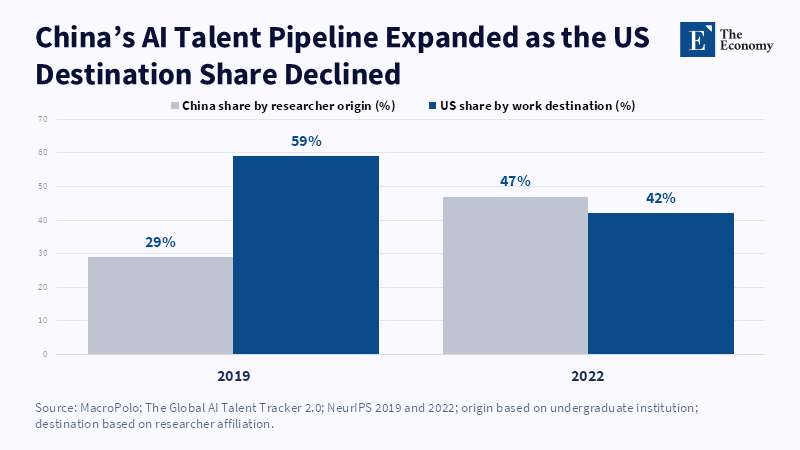
China’s gains in frontier AI are substantial but not inevitable. MacroPolo’s study of NeurIPS authors found that China produced 47 percent of the world’s top-tier AI researchers in 2022, up from 29 percent in 2019. Within US institutions, China-trained researchers made up 38 percent of top-tier talent, compared with 37 percent trained in the United States. How the estimate is arrived at makes a difference. It defined origin by the country of undergraduate education—not ethnicity, citizenship, or intelligence. And it looked at researchers at a premier research conference, not the whole AI trade. What this shows is the strength of education patterns and migration networks. It does not show that native-born Americans or native-born Chinese have a monopoly on AI. China spun a gigantic training machine. American academia and American business then drew on that tool kit on a huge scale. The gain was the link. The concentration of Chinese-trained researchers is therefore central to the talent race, but its policy meaning lies in mobility and retention rather than ethnicity.
The same general principle applies to chip industry giants. Nvidia founder Jensen Huang and AMD chief executive Lisa Su were born in Taiwan, but their achievements do not prove that the best engineers are (or should be) of one race. They illustrate that American institutions have long excelled at attracting mobile human capital and promoting it to leadership positions. The semiconductor supply chain reflects the same trend. Although Taiwan, South Korea and Japan are dominant in cutting-edge fabrication, memory, materials and equipment, the US is still powerful in chip design, core IP, software design tools and production systems. The American-based chip corporations supplied approximately 50 percent of the world market for chips in 2024. The modern-day hardware is built by a distributed system, rather than a single culture. As far as East Asia is concerned, regarding it as an education or racial conglomerate also conceals a variety of differences within different institutions from China, Taiwan, Korea and Japan. That broad label obscures more than it explains.
This distinction matters because a racial account engenders fatalism; a policy account identifies choices that institutions can make. The US cannot determine a scientist's birthplace; it can determine whether a scientist gets a visa on time, can find a well-funded lab to work in, can trust the security process, can achieve permanent residency, can start a business and can believe in a family's future. In 2021, 58 percent of US doctorate-level computer and mathematical scientists were foreign-born. A study of leading US-based AI researchers found that 70% of the top computer vision practitioners were either foreign-born or foreign-educated and 87% remained affiliated with a US institution in 2022. These are not signs of weakness; these are the operational pieces of American power; they are the research infrastructure.
China Built a Pipeline; America Built a Magnet
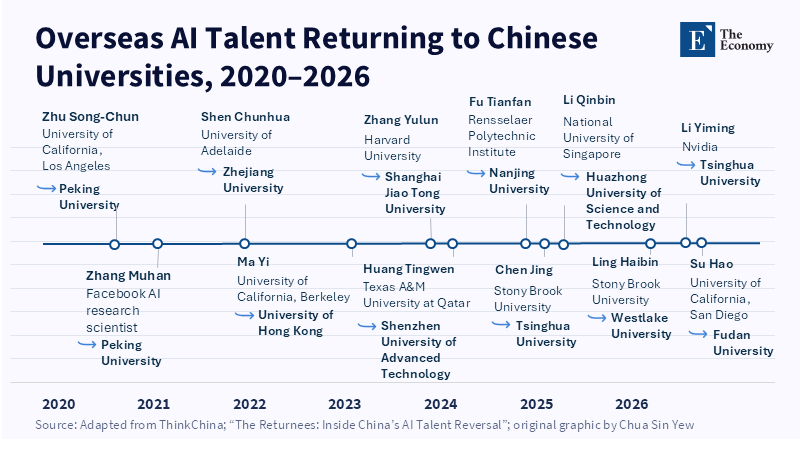
There is nothing mysterious about China's rise. It has been cultivating this path for years, rapidly expanding computer science courses and establishing specialist institutions, heavily investing in laboratories and domestic talent and treating AI expertise as a national resource. An early government scheme proposed numerous AI institutes and large-scale programs to develop both students and teachers. That scale is now being reflected in the research workforce, but also in the increasing confidence of Chinese scientists who are now going on to perform key activities in China. Reports on recent returnees point to better laboratories, strong private firms, generous compensation packages and companies such as DeepSeek that show global impact can now be produced from China. One conference-based evaluation claimed the proportion of Chinese AI researchers with foreign PhDs who returned to China jumped from 12% in 2019 to 28% by 2025 (the actual rate varies according to what was assessed).
The United States still holds the stronger hand. In 2024, US-based institutions produced 40 notable AI models, versus 15 in China and three in Europe; private AI investment in America in 2024 was roughly $109 billion, approximately twelve times what China officially reported; MacroPolo noted that as of 2022, the United States accounted for 57% of the most elite AI researchers and 60% of the best AI research centers in its sample. These are formidable assets. But they are accumulated assets; the flow is less assured. The US share of top-tier researchers as a work destination fell from 59 percent in 2019 to 42 percent in 2022, while global mobility among leading researchers also weakened. More leading researchers remained in the country where they had advanced their skills. When they have robust domestic computing power, compensation, leadership and research autonomy, the American lure will have to prove even stronger.
This is exactly why a narrow debate about whether the United States or China is "ahead" can be false. A lead in models or investment does not mean future dominance in the aggregate talent pipeline. The precipitous decline in benchmark gaps reminds us how quickly knowledge diffuses and how rapidly capabilities compound. China can now leverage a powerful domestic training infrastructure with returning researchers who know American laboratories and firms. The United States continues to offer universities, venture investors, cloud platforms and high wages. Yet its immigration system inserts uncertainty into what should be a path from education to long-term productive work. For fiscal 2026, USCIS received 343,981 eligible registrations and selected 118,660 unique beneficiaries. Selection does not guarantee approval and other visa routes exist. For the fiscal 2027 H-1B cap, the process transitioned to wage-weighted selection - potentially favouring senior hires while disadvantaging some early-career researchers and startup founders. The underlying challenge is nonetheless the cap and the lack of a reliable long-term path.
Research universities are at the heart of this issue. They are not merely institutions of higher learning, but portals into the entire national innovation system. Their international PhD researchers teach courses, publish articles, experiment in research labs, commercialize findings in firms and often start up new companies. Administrators should therefore monitor more than enrollment. Visa delays, rejected offers, postdoctoral attrition, employer sponsorship, green-card conversions and entrepreneurship are indicators of institutional health. Federal support should incentivize universities to build clear paths from study into research careers without lowering standards. Domestic training must also flourish, particularly for students without access to high-powered computing before entering doctoral study. However, domestic and international talent are complementary. American students learn in the laboratories of world-class foreign researchers, produce more papers, interact with more ideas and increase the accessibility of public research investments.
Singapore Is Rewriting the AI Talent Retention Map
Singapore shows what happens when talent policy, industrial policy and national strategy are coordinated. Its national AI strategy targeted a tripling of its AI practitioner pool to 15,000 through local training and overseas recruitment. This went hand in hand with investment in advanced computing, scholarships, visiting professors, applied research and industry projects. It also created clearer employment routes for AI scientists and engineers. Small Singapore cannot emulate the US or China in terms of research scale, but the importance is predictability. A researcher or company can rely on clear visa rules, strong intellectual property protection, English-language business, close ties with China and Southeast Asia and a state that views technical migration as an asset rather than a short-term anomaly.
That package has transformed Singapore into a competitive regional hub. US companies can hire international researchers there, away from the congested US visa channels. Chinese entrepreneurs can gain global markets, investors and partners while locating intellectual property outside mainland China. The best researchers can begin to move flexibly between Western and Asian talent pools without having to make a sudden, definitive geopolitical decision. Singapore is not fully neutral and cannot escape export controls, security rules, or geopolitical pressure. It is that the talent race is no longer merely a matter of traveling from China to California. A third site can claim the team, the patents, the tax base and the next firm, however much the initial training was done elsewhere.
Singapore also reveals a weak premise of US strategy: that high wages and renowned laboratories will always trump uncertainty. They might not. China can provide its missions, scale, proximity to family and a vibrant research ecology. Singapore can provide legal certainty, regional reach and a stable residence path. Other centers can mix lower costs with public computing services or targeted tax incentives. The US still offers a unique blend of frontier firms, university partners, capital and open scientific networks. But these assets become less compelling when researchers face long queues, shifting rules, or fear that their nationality will shape how institutions treat them. AI talent retention is about the entire package. Compensation may get the candidate in the door. Security, dignity, family security and a credible future determine whether the candidate stays.
A Policy for AI Talent Retention, Not Talent Possession
The most powerful argument is national security. Some development work has military applications. Research ties can produce conflicts of interest and misappropriation of intellectual property is a real danger. Those considerations justify controls, but not ethnic screening. A nationality-based system can miss domestic threats and cast suspicion on innocent researchers. Better controls track the work. Sensitive labs might employ monitored access, transparent reporting criteria, project-specific restrictions, strong cybersecurity and sanctions for identified misconduct. Export restrictions might be applied to specified capabilities. Assessments should be prompt and open to challenge. The goal should be to secure vital knowledge while keeping the wider research community attractive. Security that depletes laboratories of valued expertise is not security. It is self-defeating.
A second objection claims that immigration reform harms American workers. This is a false choice. The US also needs a far bigger domestic flow of people: from basic school mathematics to Master's and MD degrees and on to doctoral research, including the very best doctoral researchers who have already been trained elsewhere. Both sides of this equation can be built into well-constructed rules. Public funding can require meaningful training opportunities for American students. It can also widen access to advanced computing through partnerships across the US economy. At the same time, it can give highly skilled immigrants and their families a clearer path to permanent residence. It can extend immigration exemptions to more research laboratories. It can ease restrictions on immigrant founders for research-backed start-ups.
The last reform is measurement. Washington tracks chips, investment, publications and performance of their models, but does not explain to the public the retention of its AI talent. A national dashboard should include international applications, visa processing, doctoral graduation, five-and ten-year stay rates, exits by field, startups created and moves to other competitive clusters. Data should be disaggregated by training stream and field and NOT used in an ethnic-group ranking. Higher education should publish similar retention outcomes and publicly subsidized enterprises should disclose how they train and keep technical staff. All indicators would flag problems before they become issues in benchmark models years later. All would make it more difficult for political claims to arrive in the absence of evidence.
The 0.3-point gap should be read as a warning, not a verdict. US leadership in AI will depend less on where researchers were born than on whether they can enter, stay, build teams and create institutions over time. China’s growing talent pipeline, the return of overseas-trained scientists and Singapore’s rise as a trusted hub all show that skilled researchers now have credible alternatives. The United States still holds major advantages in universities, capital, firms and research networks, but those strengths can erode when immigration rules remain slow and uncertain. A durable AI strategy must therefore treat talent retention as part of national infrastructure. Clearer visa routes, stronger university pathways, targeted security controls and better retention data are no longer secondary reforms. They are central to preserving long-term technological leadership.
The views expressed in this article are those of the author(s) and do not necessarily reflect the official position of The Economy or its affiliates.
References
Abdulla, S. and Chahal, H. (2023) Voices of Innovation: An Analysis of Influential AI Researchers in the United States. Washington, DC: Center for Security and Emerging Technology.
Capelouto, J.D. (2026) ‘China’s AI talent war heats up’, Semafor, 26 May.
Department of Homeland Security (2025) ‘Weighted selection process for registrants and petitioners seeking to file cap-subject H-1B petitions’, Federal Register, 29 December.
Kania, E.B. (2018) ‘China’s AI talent “arms race”’, The Strategist, 23 April.
Liu, S. (2026) ‘The returnees: Inside China’s AI talent reversal’, ThinkChina, 4 June.
MacroPolo (2024) The Global AI Talent Tracker 2.0. Chicago, IL: Paulson Institute.
Maslej, N., Fattorini, L., Perrault, R., Gil, Y., Parli, V., Kariuki, N., Capstick, E., Reuel, A., Brynjolfsson, E., Etchemendy, J., Ligett, K., Lyons, T., Manyika, J., Niebles, J.C., Shoham, Y., Wald, R., Walsh, T., Hamrah, A., Santarlasci, L., Betts Lotufo, J., Rome, A., Shi, A. and Oak, S. (2025) Artificial Intelligence Index Report 2025. Stanford, CA: Stanford Institute for Human-Centered Artificial Intelligence.
National Science Board (2024) The STEM Labor Force: Scientists, Engineers, and Skilled Technical Workers. Science and Engineering Indicators 2024. Alexandria, VA: National Science Foundation.
Semiconductor Industry Association (2025) 2025 SIA Factbook. Washington, DC: Semiconductor Industry Association.
Singapore Economic Development Board (2023) ‘Singapore updates AI strategy with aim to contribute globally valuable breakthroughs’, 14 December.
U.S. Citizenship and Immigration Services (2025) H-1B Electronic Registration Process. Washington, DC: U.S. Department of Homeland Security.
Villasenor, J. (2026) ‘The closing window of opportunity for US global technology leadership’, Brookings, 11 June.
Working across research, policy, and data-driven analysis, the Editorial Board ensures that published pieces reflect a consistent institutional perspective grounded in quantitative reasoning and long-term structural assessment.