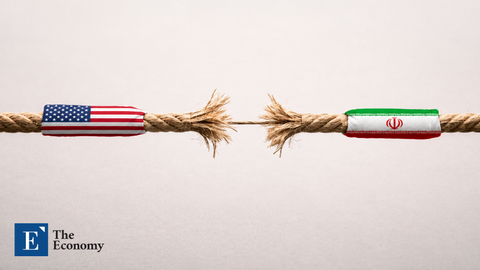
“Iran Wants to Charge Service Fees”: Tehran’s Bid to Become Hormuz Gatekeeper Threatens Freedom of Navigation and Gulf Order

As one of the youngest members of the team, Tyler Hansbrough is a rising star in financial journalism. His fresh perspective and analytical approach bring a modern edge to business reporting. Whether he’s covering stock market trends or dissecting corporate earnings, his sharp insights resonate with the new generation of investors.
Authored On
Modified
Iran and Oman Near Agreement on Service Fees for Strait of Hormuz Transit
Europe Signals Willingness to Compromise as Cost of Upholding Freedom of Navigation Rises
Gulf States Face Diverging Fortunes Depending on Access to Bypass Infrastructure

Iran and Oman are nearing an agreement to resume maritime traffic through the Strait of Hormuz. The proposal would impose a “service fee” in return for safe passage, while formally stopping short of levying a transit toll on vessels crossing the strait. If implemented, the plan would effectively place a critical energy corridor long governed by the principle of freedom of navigation under the authority of individual states, precipitating a fundamental shift in the global maritime order. Gulf oil producers heavily dependent on the Strait of Hormuz are particularly likely to experience a realignment of regional power as they compete to secure alternative export infrastructure.
Iran and Oman Push Fee-Based Hormuz Transit
According to a New York Times report published on August 3, Esmaeil Baghaei, spokesperson for Iran’s Foreign Ministry, said that day, “Iran and Oman have exchanged maps outlining a navigable route through the Strait of Hormuz,” adding, “We are discussing with Oman a single route capable of handling two-way traffic, rather than two or three separate lanes.” Under the proposal, vessels entering the Persian Gulf through the strait would use a route on the Iranian side, while outbound ships would follow a route on the Omani side. Before the outbreak of the war involving Iran, the Strait of Hormuz operated under an internationally established traffic separation scheme (TSS). To prevent collisions, vessels traveled in only one direction along separate northbound and southbound lanes, most of which lay within Omani territorial waters.
Iranian officials told the NYT, “Ships passing through the strait will not be charged a toll, but a service fee will be levied to cover environmental impact, security and personnel deployment costs,” adding that “Iran and Oman will split the proceeds equally.” The Strait of Hormuz, where vessels previously enjoyed unrestricted passage without control by any single country, would effectively become a fee-based maritime corridor. The arrangement would largely realize the demands Iran began advancing when it agreed to a 60-day ceasefire with the United States in June. A U.S. official, however, disputed the claim, telling the NYT that Iran’s account was inaccurate and that no transit charges would be imposed.
Global Maritime Order at an Inflection Point
If Iran’s proposal materializes, the established international order is expected to undergo a profound upheaval. The United Nations Convention on the Law of the Sea grants vessels of all states the right of transit passage through straits used for international navigation. Coastal states may establish shipping lanes and safety regulations, but they cannot obstruct or suspend passage. The International Maritime Organization (IMO) also maintains that coastal states cannot close straits used for international navigation and have no legal grounds to impose tolls, fees or discriminatory conditions. Last month, the IMO Council explicitly reaffirmed that “transit through the Strait of Hormuz must remain free from all tolls and charges in accordance with international law.”
Those provisions could become effectively meaningless if Iran and Oman impose service fees on traffic through the Strait of Hormuz. If vessels are required to use routes designated by Iran, obtain final clearance from Iranian authorities and make mandatory payments, the service fee would amount to a political charge for securing Tehran’s permission, rather than compensation for navigational services. Under such a system, Iran would likely set fees at the highest level that shipping companies and energy-importing countries could absorb. Excessively high charges could undermine the economics of maritime transport, prompting shipping companies to curtail operations and oil-producing countries to expand investment in overland pipelines and alternative export terminals.
Europe Signals Openness to Hormuz Fee Regime
Once transiting vessels begin making regular payments, Iran would evolve from a coastal state into a gatekeeper governing the maritime order. Service fees initially justified as compensation for navigational safety could subsequently become instruments for countering sanctions or exacting diplomatic retaliation. Even so, signs have emerged that parts of the international community are prepared to compromise with Tehran in response to operational realities. According to Bloomberg, several major European countries have shifted toward accepting that fees in the Strait of Hormuz may be unavoidable. Instead of demanding that Iran and Oman abandon the charges, they are reportedly focusing on prohibiting nationality-based discrimination and ensuring transparency in the fee structure.
The shift reflects the military and political costs of defending the principle of freedom of navigation. One diplomatic expert said, “Fully reopening the Strait of Hormuz would require the United States and its allies to commit sustained military power capable of neutralizing Iranian mines, missiles, drones and coastal defenses.” The expert added, “Paying Iran a limited fee, by contrast, could improve the predictability of vessel operations and stabilize energy prices.” The expert continued, “For Europe and other Western countries, the payment would function as a form of insurance designed to avert an immediate war and supply shock while keeping Iran at the negotiating table. If it is linked to nuclear negotiations and the restoration of International Atomic Energy Agency inspections, the Strait of Hormuz fee would become a form of political rent for managing military tensions in the Middle East.”
Shifting Positions of Gulf Oil Producers
A prolonged increase in the cost of transiting the Strait of Hormuz would also rapidly reshape the regional standing of Gulf oil producers. Bypassing the strait requires moving energy supplies to the Red Sea or Mediterranean coast through pipelines and overland transport networks before loading them onto vessels. Saudi Arabia currently possesses the strongest infrastructure for this purpose. The kingdom operates an oil pipeline extending from the Abqaiq region in the east to the Red Sea port of Yanbu in the west. According to the U.S. Energy Information Administration (EIA), the pipeline has a capacity of approximately 5 million barrels per day. That represents one-quarter of the roughly 20 million barrels of oil that passed through the Strait of Hormuz each day before the war.
The pipeline allows crude produced in Saudi Arabia’s eastern oil fields to reach the Red Sea for export to Europe and Asia without passing through the Strait of Hormuz. If Hormuz transit fees become permanent, the pipeline would emerge as a central component of Saudi export infrastructure, shedding its previous status as an emergency facility. Saudi Arabia could consequently rise as an intermediary linking the Iranian-controlled waters of the Gulf with the Suez Canal. Under that scenario, Saudi territory would serve as a conduit to the Red Sea for the kingdom’s own crude as well as oil produced by Iraq and other Gulf states.
Table 1. Gains and Losses for Gulf States Under a Fee-Based Strait of Hormuz Regime
| Country | Bypass Capacity and Geographic Conditions | Expected Benefits | Constraints and Risks |
|---|---|---|---|
| Saudi Arabia | Operates the East-West Pipeline linking integrated oil fields with Red Sea infrastructure | Could evolve from a crude exporter into an energy transit hub connecting the Gulf and the Red Sea | Asia-bound exports must pass through the Bab el-Mandeb Strait, exposing shipments to Houthi threats |
| Egypt | Controls the Suez Canal connecting the Red Sea and the Mediterranean | Could restore transit-fee revenue and attract cargo diverted from the Strait of Hormuz | Dependent on security in the Red Sea and the normalization of vessel traffic |
| Yemen | Located at the Bab el-Mandeb Strait, the southern gateway to the Red Sea | Could become a hub for port services, maritime support and strait security management if political conditions stabilize | Houthi threats to vessel traffic impede the expansion of Red Sea logistics |
| Qatar | Approximately 93% of LNG exports pass through the Strait of Hormuz | Limited | Core export industry risks becoming subject to Iranian decisions |
| Kuwait | Major export terminals are located inside the Gulf | Limited | Insufficient bypass infrastructure |
| Bahrain | Major export terminals are located inside the Gulf | Limited | Insufficient bypass infrastructure |
| UAE | Operates the Abu Dhabi–Fujairah pipeline with a capacity of 1.8 million barrels per day | Greater utilization of the pipeline and Port of Fujairah | LNG and non-oil trade remain heavily dependent on the Strait of Hormuz |
Qatar and Kuwait Face Mounting Pressure
Egypt is also highly exposed to developments in the Red Sea. Traffic through the Suez Canal has plummeted since Yemen’s Houthi rebels began attacking vessels. According to the United Nations Conference on Trade and Development, vessel tonnage passing through the canal in May last year fell 70% from 2023 levels. Egypt would receive a clear windfall if barriers to Hormuz transit rise and ships return to the Red Sea. Yemen’s strategic value is also expected to increase because of its proximity to the Bab el-Mandeb Strait, the southern gateway connecting the Red Sea and the Gulf of Aden. With political stability and an effective coast guard system, Yemen could develop into a pivotal economy in the Red Sea region through maritime services and port development. The Houthi threat to commercial shipping nevertheless remains a significant variable.
Qatar faces a particularly severe risk of becoming trapped. Its principal export is liquefied natural gas (LNG), rather than crude oil. Crude can be transported efficiently through pipelines, while natural gas requires large-scale gas pipelines, liquefaction facilities and dedicated terminals. Qatar’s existing LNG production facilities and loading terminals are concentrated inside the Gulf, making a rapid relocation to the Red Sea coast exceedingly difficult. The Washington-based Center for Strategic and International Studies (CSIS) has estimated that approximately 93% of Qatar’s LNG exports normally pass through the Strait of Hormuz and that no meaningful alternative route currently exists to deliver those volumes to global markets. Kuwait and Bahrain face similar risks because their export terminals lie inside the Gulf and neither possesses an independent, large-scale bypass pipeline. The United Arab Emirates (UAE) remains heavily dependent on the Strait of Hormuz for LNG and non-oil trade, but it operates the Abu Dhabi–Fujairah pipeline with a capacity of 1.8 million barrels per day and can divert a substantial share of its exports through the Port of Fujairah.
As one of the youngest members of the team, Tyler Hansbrough is a rising star in financial journalism. His fresh perspective and analytical approach bring a modern edge to business reporting. Whether he’s covering stock market trends or dissecting corporate earnings, his sharp insights resonate with the new generation of investors.
Similar Post