Optimus Targets 20,000 Units a Week but Produces Only Hundreds as Hand Assembly, AI, Cooling and Battery Challenges Mount

Siobhán Delaney is a Dublin-based writer for The Economy, focusing on culture, education, and international affairs. With a background in media and communication from University College Dublin, she contributes to cross-regional coverage and translation-based commentary. Her work emphasizes clarity and balance, especially in contexts shaped by cultural difference and policy translation.
Authored On
Modified
Hand assembly errors and inconsistent component quality slow Optimus production
Production delays compound the days needed to learn basic tasks, limiting factory deployment
Heat dissipation and battery drain raise doubts about sustained operation
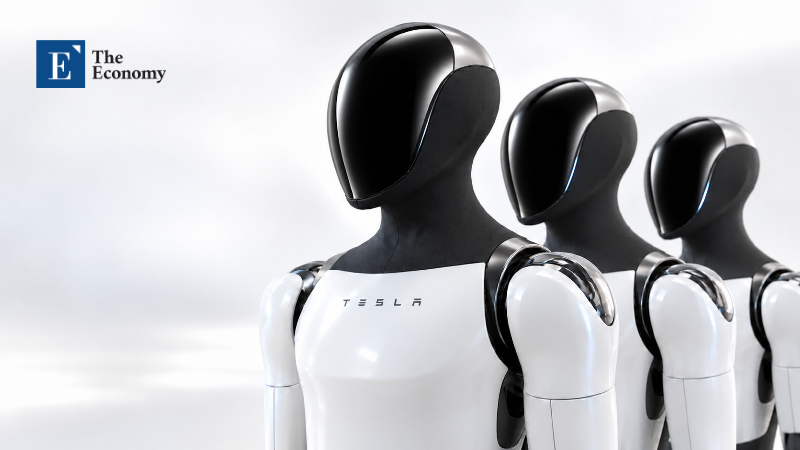
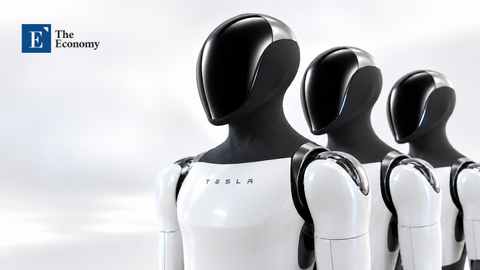
Mass production of Tesla’s humanoid robot, Optimus, has run into technical obstacles involving precision assembly, component quality and artificial intelligence (AI) performance. Its complex hand design and assembly errors are impeding production growth, while the robot reportedly takes days to learn even basic tasks, constraining its use on factory floors. Heat generation and limited battery capacity further restrict operating time, leaving the productivity of sustained autonomous work unproven.
Tesla Targets 1,000 Units a Week but Produces Only Hundreds
According to US technology publication The Information on September 27 (local time), Tesla produced only several hundred Optimus robots a week last month. The company had originally set a target of at least 1,000 a week by year-end. Its longer-term production target is approximately 20,000 a week. Even the lower bound of its year-end target is just one-twentieth of that longer-term figure, and last month’s output fell short of the nearer-term goal.
Last month’s output was higher than the dozens of units produced each week during limited pilot production in the second quarter, but it remained below the year-end target. Tesla’s second-quarter earnings materials also classified its Optimus production facilities in Fremont and Texas as “under construction,” without specifying annual production capacity. Most of the additional units are reportedly being used for internal testing, training and data collection. Tesla has said it would assign initial production units to its Optimus Academy, but has not specified how many would be supplied externally.
The Robotic Hand: The Biggest Obstacle to Mass Production
Tesla Chief Executive Officer (CEO) Elon Musk has long described Optimus as a next-generation flagship product that could surpass Tesla’s electric vehicle business, claiming it has the potential to lift the company’s valuation to $25 trillion. In practice, however, the project faces technical hurdles. The greatest is considered to be designing a robotic hand with human-level dexterity. The hands and forearms of the third-generation Optimus (V3), currently in production, contain more than 100 small components, including screws. Workers must assemble these parts by hand. Because a humanoid robot must move its fingers and joints precisely to grasp and manipulate objects as a person does, the work demands greater assembly precision than automobile production.
The difficulty of assembling the hands is compounded by precision problems across Tesla’s production line. According to The Information, equipment in some processes does not consistently position components accurately when assembling hands and joints or inspecting electronics. As a result, more completed robots require rework. Some automated equipment has also reportedly malfunctioned when production speeds increased. Faster operation appears to bring more assembly errors and rework, limiting the line’s ability to run continuously.
Apart from assembly errors, Tesla must establish whether the finished hands can withstand prolonged use. According to US technology publication Ars Technica, reliability problems have emerged in some of Optimus’s tactile sensors, raising the prospect of replacing an entire hand because of a sensor fault. Tesla has consequently developed a “Sensing Glove” that groups the tactile sensors into a separately replaceable component. The design allows the sensors to be replaced while retaining the rest of the hand, showing how difficulties with the robotic hand have affected both the latest model’s development schedule and its costs.
Table 1. Principal Bottlenecks in Mass-Producing Tesla Optimus Hands
| Production bottleneck | Core problem | Impact and response |
|---|---|---|
| Hand assembly | Manual assembly of more than 100 hand and forearm components | High assembly precision required |
| Production line | Component-positioning errors and equipment problems at higher operating speeds | More rework and constraints on continuous production |
| Tactile sensors | Sensor reliability and the burden of replacing an entire hand | Development of a “Sensing Glove” that allows sensor-only replacement |
Specifications, Quality and Delivery: Three Supply-Chain Challenges
Unreliable component supply is another obstacle to increasing Optimus output. Tesla sources motors that move the robot’s joints and precision reduction gears from outside suppliers. It has also discussed supplies of sensors, motors, reduction gears and other components sufficient for thousands of robots with Chinese partners. Some suppliers, however, have struggled to maintain consistent quality and specifications as orders increased, even after meeting the requirements for prototypes and small batches. Alongside the rise in rework on assembled robots, the quality of parts entering the production line has become a constraint on manufacturing speed.
Securing suppliers capable of delivering Optimus components at scale also takes time. Even established automotive suppliers must separately demonstrate that they can mass-produce robotic joint modules and actuators to Tesla’s standards. Meeting the specifications is demanding. One Chinese precision-screw manufacturer was asked to make its components smaller and 25% more durable while pricing them 25% below a European competitor’s products. Although it has supplied other robot manufacturers, work to meet Tesla’s service-life requirement is still under way. This month, Tesla visited Chinese automotive-parts suppliers to audit the quality of their joint-module and actuator production lines. Even companies that have received Optimus component orders cannot begin full-scale production until they pass the audits, making supplier readiness a direct factor in the production timetable.
Even Basic Tasks Take Days to Learn
Developing AI that enables robots to learn and perform new tasks independently is another technical challenge. Optimus reportedly takes days to learn basic tasks, and its behavior can be difficult to predict in situations for which it has not been trained. This helps explain why robots deployed in factories remain confined to specified tasks under close supervision. During Tesla’s second-quarter earnings presentation, Musk likewise identified getting a robot to perform a task from a verbal instruction or a video demonstration as one of the hardest problems. Tesla is developing an approach in which the robot builds a repertoire of basic movements and then combines them as needed for new tasks.
For that approach to work in a factory, the robot must reliably reproduce learned movements when its working environment changes. Tesla has accumulated more than 500,000 hours of training data and plans to double that figure by year-end. Identifying movements in videos of people at work, however, is a separate process from having a robot execute them. Once the movements have been translated into joint actions, the robot must adjust its force to an object’s position and weight and correct errors that arise during the task. Tesla’s second-quarter earnings materials, however, omit performance measures such as the success rate of autonomous tasks after those adjustments and the time required to learn a new task.
Thermal and Energy-Density Limits
Improving Optimus’s computing performance and joint output also entails thermodynamic constraints. The central limitation is that heat generated by its AI chips and joint motors must be continuously dissipated while it works: some of the power supplied to those components becomes heat. As the robot lifts objects and performs repetitive tasks, its joint motors become hotter. If the heat cannot be removed adequately, output may have to be reduced to protect the components. Preventing that outcome requires cooling systems that expel heat from the computing hardware, motors and battery. Adding fans and heat-dissipation components to a human-sized body, however, leaves less space for other equipment and increases the robot’s weight. Power used for cooling further reduces the energy available for sustained work.
Battery energy density compounds the heat problem and limits continuous operating time. The second-generation Optimus carried a 2.3-kilowatt-hour (kWh) battery and was estimated to operate for about two hours during movement-intensive tasks. Humanoid robots currently tend to run for about two to four hours, making it difficult for a single charge to cover a standard factory shift. Adding more battery capacity increases the load on the joint motors and raises power consumption along with the weight. Under these conditions, productivity calculations that assume prolonged continuous work require verified improvements in energy density or power efficiency. Assuming the robot can operate throughout a factory shift without that evidence would treat power capacity it has yet to secure as though it were already available.
Siobhán Delaney is a Dublin-based writer for The Economy, focusing on culture, education, and international affairs. With a background in media and communication from University College Dublin, she contributes to cross-regional coverage and translation-based commentary. Her work emphasizes clarity and balance, especially in contexts shaped by cultural difference and policy translation.
Similar Post