China Brings Up South Korea in Australian Nuclear Submarine Talks, Wary of Expanding U.S. Allied Capabilities in Western Pacific

Matthew Reuter is a senior economic correspondent at The Economy, where he covers global financial markets, emerging technologies, and cross-border trade dynamics. With over a decade of experience reporting from major financial hubs—including London, New York, and Hong Kong—Matthew has developed a reputation for breaking complex economic stories into sharp, accessible narratives. Before joining The Economy, he worked at a leading European financial daily, where his investigative reporting on post-crisis banking reforms earned him recognition from the European Press Association. A graduate of the London School of Economics, Matthew holds dual degrees in economics and international relations. He is particularly interested in how data science and AI are reshaping market analysis and policymaking, often blending quantitative insights into his articles. Outside journalism, Matthew frequently moderates panels at global finance summits and guest lectures on financial journalism at top universities.
Authored On
Modified
China raises South Korea-U.S. cooperation during deliberations on Australian nuclear-powered submarines
Calls for agreement among member states before safeguards arrangement is signed
Watches potential expansion of South Korea-U.S. anti-submarine cooperation in Western Pacific
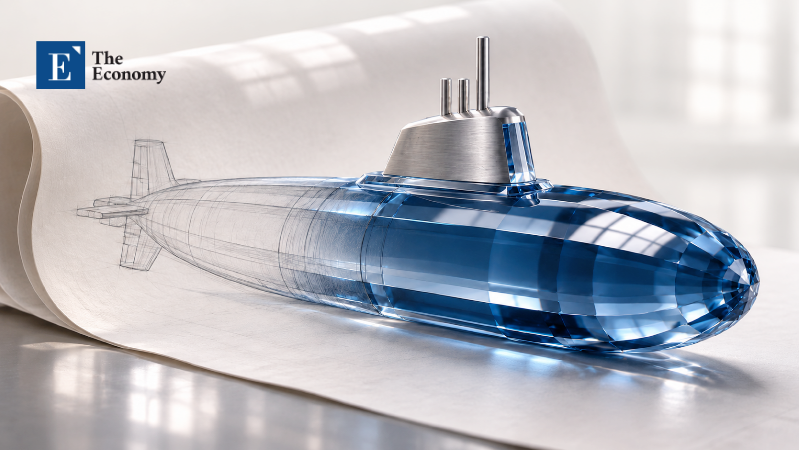
China questioned how fuel for Australia's nuclear-powered submarines would be verified at a meeting of the International Atomic Energy Agency (IAEA) Board of Governors, also bringing up South Korea's plans to build nuclear-powered submarines. Its argument is that IAEA member states must first reach agreement because the verification approach applied to Australia would set a precedent for South Korea, which is pursuing nuclear-powered submarine construction with U.S. support. China specifically cited Washington's decision to support South Korea's submarine construction after backing Australia's acquisition, warning that such cooperation would threaten international security and the safety of shipping routes. The remarks reflect China's wariness of an increase in allied forces that could track its submarines alongside the U.S. Navy in the Western Pacific.
China Objects to IAEA Agenda Title for South Korean Nuclear-Powered Submarines
According to China's mission in Vienna, Austria, on the 22nd (all dates hereafter local time), China objected at the regular IAEA Board of Governors meeting held in Vienna the previous week to addressing South Korea's nuclear-powered submarine program under the agenda item “Naval Nuclear Propulsion: Republic of Korea.” The South Korean program came up when Li Song, China's ambassador in Vienna, exercised his right of reply on the Australian nuclear-powered submarine agenda item. Li noted that South Korea-U.S. cooperation was the second instance of nuclear-powered submarine cooperation between nuclear-weapon states and a non-nuclear-weapon state, following AUKUS, under which the United States and Britain are supporting Australia's acquisition of nuclear-powered submarines. He identified the transfer of nuclear material for military purposes, to be used as submarine fuel, as a common feature of the two programs. China argues that the agenda title “Naval Nuclear Propulsion” does not adequately encompass the implications of nuclear material transfers for the international nuclear nonproliferation regime.
China called for prior consultations among IAEA member states on the grounds that the approach to verifying AUKUS submarine fuel would also set a precedent for South Korea-U.S. cooperation. Li first challenged the nuclear material verification approach being discussed by the AUKUS countries and the IAEA Secretariat. His point was that the Secretariat should explain to member states whether the IAEA had previously used this approach to verify the quantity and composition of nuclear material intended for submarines, and what legal basis existed for the additional transparency measures being requested. Li argued that successive nuclear-powered submarine cooperation programs would pose threats to international security, the marine environment and the safety of international shipping routes. He stressed that the board and member states should first hold discussions and reach agreement, while the Secretariat should answer member states' questions and provide the technical expertise needed for verification during that process.
China Has Sought to Check South Korea-U.S. Nuclear Submarine Cooperation Since U.S. Construction Approval
China has urged South Korea and the United States to proceed cautiously since around November last year, when Washington formalized its approval for Seoul to build nuclear-powered submarines. At a press conference on November 13, a day before a joint fact sheet on the South Korea-U.S. summit was released in Seoul, Chinese Ambassador to South Korea Dai Bing said he had already conveyed concerns to the South Korean government through diplomatic channels. Dai said South Korea-U.S. nuclear-powered submarine cooperation directly affected the international nuclear nonproliferation regime and regional peace and stability, urging Seoul to give full consideration to the concerns of relevant countries. The joint fact sheet released the following day explicitly stated that the United States had approved South Korea's construction of nuclear-powered attack submarines. The matters on which the two countries agreed to continue follow-up consultations included arrangements for procuring submarine fuel.
This year, China also formally raised South Korea-U.S. nuclear-powered submarine cooperation at the Nuclear Non-Proliferation Treaty (NPT) Review Conference. In that section, China called on both countries to establish safeguards for submarine fuel and faithfully fulfill their nonproliferation obligations. It also included language stating that their cooperation must not target a “third country.” The same report proposed establishing a special committee within the IAEA to discuss safeguards for submarine reactors and nuclear material in non-nuclear-weapon states. Under the proposal, all member states would have an opportunity to participate, and the committee would examine legal and technical issues before submitting recommendations to the IAEA Board of Governors and General Conference.
Table 1. Developments in South Korea-U.S. Nuclear-Powered Submarine Cooperation and China's Demands
| Date | Announcement or document | Key points |
|---|---|---|
| November 13, 2025 | Press conference by Chinese Ambassador to South Korea Dai Bing | Disclosed that concerns had been conveyed to the South Korean government through diplomatic channels Urged caution in light of the international nuclear nonproliferation regime and regional peace and stability |
| November 14, 2025 | Joint fact sheet on the South Korea-U.S. summit | Explicitly stated U.S. approval for South Korea to build nuclear-powered attack submarines South Korea and the United States agreed to follow-up consultations on submarine fuel procurement |
| 2026 | Chinese report to the Nuclear Non-Proliferation Treaty (NPT) Review Conference | Called on South Korea and the United States to establish safeguards for submarine fuel and fulfill their nonproliferation obligations Opposed cooperation targeting a third country |
| Proposed establishing an International Atomic Energy Agency (IAEA) special committee to discuss safeguards for submarine reactors and nuclear material in non-nuclear-weapon states Give all member states an opportunity to participate, examine legal and technical issues, and submit recommendations to the IAEA Board of Governors and General Conference |
China Seeks to Check South Korean Nuclear Submarines, From Fuel Verification to Their Western Pacific Role
If the special committee proposed by China is established, China would participate directly in discussions on the standards to be applied to fuel verification for South Korea's nuclear-powered submarines. The South Korean government is currently discussing submarine fuel verification methods with the IAEA Secretariat. Seoul has already informed the Secretariat of its plan to use low-enriched uranium as fuel, and the IAEA assessed in its first report that South Korea had fulfilled its reporting obligations concerning the nuclear-powered submarine program. The two sides plan to set out specific verification procedures in a separate arrangement following further consultations. China's call for agreement among member states, at a stage when Washington has approved construction and Seoul and the IAEA have begun verification talks, suggests an intention to exert diplomatic pressure on South Korea ahead of the arrangement's signing.
China's reference to a third country in connection with South Korea-U.S. nuclear-powered submarine cooperation is also seen as reflecting its wariness of growing capabilities among U.S. allies to track Chinese submarines in the Western Pacific. At the South Korea-U.S. summit in Gyeongju last October, President Lee Jae Myung mentioned both North Korean and Chinese submarines as he asked President Donald Trump for help procuring nuclear-powered submarine fuel. He explained that the South Korean Navy's diesel submarines had difficulty remaining submerged for extended periods, limiting their ability to track submarines from both countries. Lee said at the time that South Korea's construction of several nuclear-powered submarines carrying conventional weapons would also substantially reduce the burden on U.S. forces. The South Korean government subsequently told China that the move was intended to prepare for North Korea's development of nuclear-powered submarines, but China included language in its report to the following year's NPT Review Conference stating that South Korea-U.S. cooperation must not target a third country.
Debate Over Acquiring Nuclear-Powered Submarines Also Flares in Japan
Although China did not specify which country it meant by a third country, the U.S. Navy's leadership has explicitly identified China as a country that South Korean nuclear-powered submarines would help counter. During a visit to Seoul on November 14 last year, U.S. Chief of Naval Operations Daryl Caudle described such a role as a “natural expectation” when asked about South Korean nuclear-powered submarines countering China. He also qualified his remarks by saying that South Korea would decide for itself what missions to assign its submarines. However, he identified the Chinese Navy's expansion as a shared concern for South Korea and the United States, citing the example of U.S. forces operating alongside the South Korean Navy when it deploys nuclear-powered submarines in its own waters. His remarks lent weight to the interpretation that Washington's approval of South Korean nuclear-powered submarine construction, which it had long withheld, was partly motivated by a desire to share with allies the burden of countering China in the Western Pacific.
The ally that reacted most sensitively to U.S. approval at the time was Japan. According to a person familiar with discussions within the Japanese government, Prime Minister Sanae Takaichi's cabinet had expected Japan to be Washington's first partner if it supported an East Asian ally's acquisition of nuclear-powered submarines. On November 1 last year, shortly after President Trump approved South Korean nuclear-powered submarine construction, Japanese Defense Minister Shinjiro Koizumi met with U.S. Defense Secretary Pete Hegseth to discuss the issue. Five days later, appearing on Japanese television, he cited the approval for South Korea's construction plans and noted that neighboring countries were acquiring nuclear-powered submarines one after another. On the 12th of this month, Koizumi again maintained that Japan's acquisition of nuclear-powered submarines should not be treated as taboo.
China Wary of Division of Missions Between South Korean and U.S. Navies
The renewed debate in Japan over acquiring nuclear-powered submarines was also an issue Russia raised in its opposition to South Korea-U.S. nuclear-powered submarine cooperation. Russia expressed concern about the implications of South Korea's acquisition for an arms race on the Korean Peninsula. After North Korean leader Kim Jong Un characterized South Korean nuclear-powered submarines last December as a force that would infringe on North Korea's maritime sovereignty, Russian Ambassador to South Korea Georgy Zinoviev also argued in February this year that South Korean possession of nuclear-powered submarines would hinder efforts to ease tensions on the peninsula. Responding to South Korea's stated commitment to uphold nonproliferation principles, he also said transparent verification measures must follow. At the time, South Korean military authorities were watching whether Russia was supporting North Korea's development of nuclear-powered submarines. With North Korea and Russia announcing plans to expand defense cooperation, the South Korean government was checking intelligence that Russia had supplied North Korea with a submarine reactor.
South Korea now faces the diplomatic burden of explaining the intended use of its nuclear-powered submarines to China while securing capabilities to respond to North Korea's development of such vessels. According to National Security Adviser Wi Sung-lac, President Lee Jae Myung personally explained to Chinese President Xi Jinping last November that South Korea's nuclear-powered submarines would be a defensive force intended to deter North Korea. Yet a year later, at the IAEA Board of Governors meeting in Vienna, China's focus was on the United States' role in successively supporting Australia's and South Korea's acquisition of nuclear-powered submarines. Indeed, given the U.S. Navy's expectations, China's decision to raise South Korea-U.S. cooperation during discussions on Australian nuclear-powered submarines also reflects its wariness of an increase in allies operating nuclear-powered submarines in the Western Pacific with U.S. support. The arrangement South Korea is currently discussing with the IAEA is intended to prevent submarine fuel from being diverted to nuclear weapons; the submarines' operational scope is not part of those discussions. With the U.S. Navy publicly discussing a role for South Korean nuclear-powered submarines in countering China, Beijing's wariness of the possibility that the South Korean and U.S. navies could jointly track its submarines in the Western Pacific is expected to persist even after fuel verification procedures are established.
Matthew Reuter is a senior economic correspondent at The Economy, where he covers global financial markets, emerging technologies, and cross-border trade dynamics. With over a decade of experience reporting from major financial hubs—including London, New York, and Hong Kong—Matthew has developed a reputation for breaking complex economic stories into sharp, accessible narratives. Before joining The Economy, he worked at a leading European financial daily, where his investigative reporting on post-crisis banking reforms earned him recognition from the European Press Association. A graduate of the London School of Economics, Matthew holds dual degrees in economics and international relations. He is particularly interested in how data science and AI are reshaping market analysis and policymaking, often blending quantitative insights into his articles. Outside journalism, Matthew frequently moderates panels at global finance summits and guest lectures on financial journalism at top universities.
Similar Post