

Taiwan’s political division is weakening deterrence Defence spending needs durable cross-party support Clearer US commitments could reinforce domestic consensus That one conclusion should cast doubt on all the rest.
Read More
Occasional office contact can strengthen remote teams No single work model suits every role Hybrid productivity depends on purposeful design During a nine-month experiment with a remote customer-services team in Turkey, <
Read More
AI chip controls can buy time, not permanent dominance Chinese substitution limits their long-term power That time must build U.S. and allied capacity In 2024, U.S.
Read More
US restrictions exposed the fragility of allied AI access Europe needs leverage through capital, chips and compute A formal access compact could balance security with continuity One order from Washington on 12 June 2026 cut all f
Read More
China transshipment now extends beyond tariff avoidance Southeast Asia is both a chip hub and a diversion risk Export controls should track ownership and final use In less than a month in 2025, at least $510m worth of high-end U
Read More








The Economy Research Editorial*
Read More
Women’s representation does not automatically reduce corruption Evidence from Brazil and India points instead to experience, incentives and institutional control Political equality and anti-corruption reform should advance together, but through separate policies
Read More
Most attacks were armed robberies; not piracy Japan should back policing; not naval expansion Regional cooperation can protect vital trade routes Authorities reported 80 attacks through the Malacca and Singapore straits in th
Read More
Europe built trade through linked treaties Middle powers can adapt that model Deeper access should depend on verified compliance Almost 900 trade agreements connected the nations of Europe from 1815 to 1919.
Read More
AI answers are weakening the traffic bargain that once supported original reporting Licensing can compensate publishers, but it cannot guarantee reliable AI outputs A fair settlement requires transparency, attribution, collective bargaining and funded verification
Read More

The Economy Research Editorial*
Read More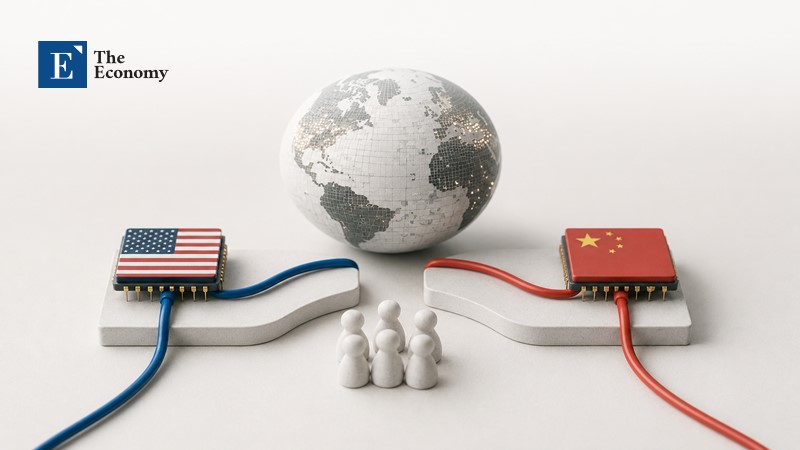
The US–China AI split is becoming structural The Global South must secure access without accepting permanent dependence Cheaper AI matters only when it builds local capacity and bargaining power The global AI divide is ofte
Read More
Trade policy uncertainty deters FDI more than predictable barriers Lower-income and highly integrated economies face the largest losses Stable rules have become essential investment infrastructure An increase in
Read More
China’s clean-energy scale has lowered costs while concentrating industrial power Rare-earth controls show how market dominance can become geopolitical leverage Managed rivalry can preserve low prices without accepting strategic dependence
Read More
US AI leadership depends on retaining global talent China is turning returnees into domestic research strength Singapore is emerging as a third AI talent hub Over a year, the gap in performance on a major language benchmark be
Read More

Tariffs create openings, not automatic winners Europe gains only while it remains outside the tariff wall Productive capacity determines who captures diverted trade The most striking number from the US–China tariff war is not
Read More
Small tariffs can permanently redirect trade Large retaliation can damage domestic supply chains Europe must protect capacity without protecting failure A tariff imposed in June 2018 slashed the value of target
Read More
AI access does not guarantee real learning Teacher AI literacy determines whether AI supports or replaces thought Schools need stronger training, clearer rules and better assessment An AI tutor raised high school students’ mat
Read More
Reserve quality matters more than headline size Borrowed reserves can hide future repayment risks Governments should disclose how reserves are financed The household comparison makes the logic airtight.
Read More
AI adoption measures use, but not control. Europe’s deeper weakness lies in foreign-owned compute, cloud and energy infrastructure AI compute sovereignty requires shared capacity, open access and democratic oversight About three-
Read More