Berlin Housing Market: How Regulatory Risk Still Shapes Prices

Working across research, policy, and data-driven analysis, the Editorial Board ensures that published pieces reflect a consistent institutional perspective grounded in quantitative reasoning and long-term structural assessment.
Authored On
Modified
Berlin’s rent-cap legacy still depresses housing valuations
Policy uncertainty pushed investors and builders toward caution
Expropriation debate keeps regulatory risk embedded in prices

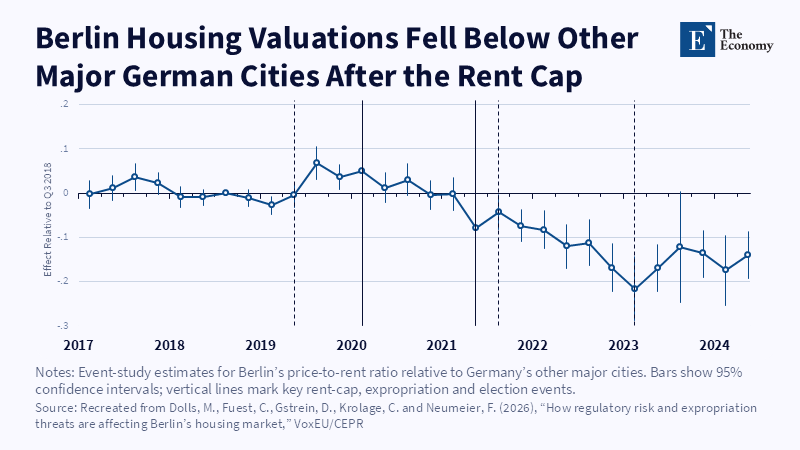
By 2024, three years after Berlin's rent cap was struck down, the city's price-to-rent ratio remained around 10 percent to 15 percent below the level predicted by comparable major German cities. The gap persisted even though the 2020 rent freeze was no longer in force. It arises from something more difficult to measure but equally real: the regulatory risk that the market continues to price. The history of Berlin shows that a political intervention can leave a deep imprint even when the measure itself has long since disappeared. The question is not only what happened in 2021, but why the market has not yet turned the page.
How Berlin Built a Regulatory Risk Premium
The story begins in 2019, when the then-ruling alliance of the SPD, Die Linke and Greens announced a law to limit rents, known as Mietendeckel. The law came into force at the end of February 2020 and froze the rents of about 1.5 million apartments built before 2014, at the levels of June 2019. It also imposed statutory base rent ceilings ranging from €3.92 to €9.80 per square meter, with permitted adjustments for location and certain property characteristics. Since November 2020, landlords who asked for rent above the limit by more than 20 percent had to reduce it, with fines of up to 500.000 euros for those who did not comply. This was one of the strictest rent control regimes ever tested in a major Western housing market.
The rift came on April 15, 2021, when the Federal Constitutional Court published a March 25 ruling declaring Mietendeckel unconstitutional, just fourteen months after it took effect. The reasoning of the judges did not concern the economic correctness of the measure. It concerned the division of responsibilities. The federal state of Berlin, the court ruled, did not have the legislative authority to regulate rents, as federal law had already covered the issue through the so-called Mietpreisbremse, the general rent brake that applies throughout the country. The court did not assess the economic merits of the policy. It held that Berlin lacked legislative competence because federal law had already conclusively regulated residential rent levels. Tenants who had benefited from the freeze were asked to refund the difference, while almost half had not saved the amount.
The political turmoil did not stop there. On September 26, 2021, the same day as the parliamentary elections, the people of Berlin were called to a referendum demanding the expropriation of companies that own over 3,000 apartments, with Deutsche Wohnen as the main target. According to the official results of the Landeswahlleiterin, 57.6 percent of the voters voted in favor, which corresponds to 42.3 percent of all registered voters, above the required threshold. The referendum was advisory rather than binding, but it sent a clear message: the majority of residents viewed even more radical interventions in property as positive, just as Mietendeckel was being shot down in the courts. For investors and owners, the message was clear. The legal defeat of the state did not mean a political defeat of the request for intervention.
Why Berlin Still Prices the 2021 Policy Shock
The persistence of the price-rent gap is best explained through a simple model of regulatory risk. Institutional owners, such as large listed real estate companies, are more exposed to future interference, as the referendum explicitly targeted them. Retail investors, in contrast, demand a higher risk premium to hedge against uncertainty, even if they are not at the center of the political debate. The model predicts that when perceived risk increases for institutional players, prices fall, large owners reduce their activity and private individuals partially fill the gap. The crucial point is that these effects do not depend on whether the regulation is actually valid. They last as long as the perception that it could come back lasts. The figure shows how the valuation gap emerged after repeal and persisted through 2024.
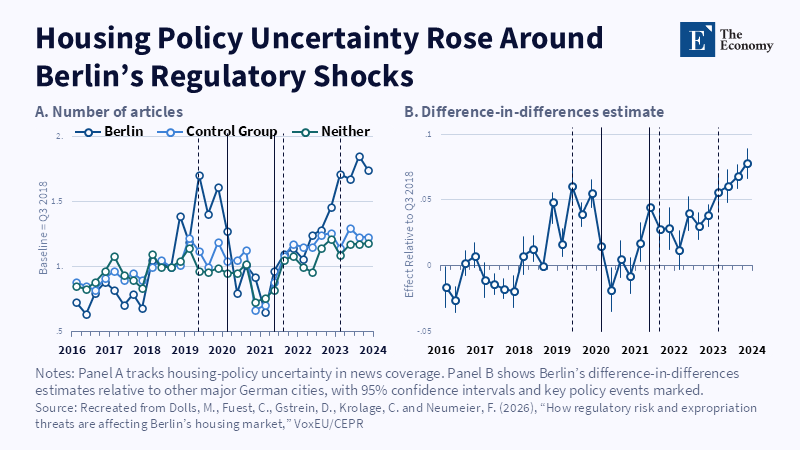
This assumption is confirmed by a housing policy uncertainty index, constructed on more than 230 media outlets, with a methodology similar to that developed by Baker, Bloom and Davis to measure economic uncertainty. The index soared around Mietendeckel's announcement in 2019, fell while the law was in force and bounced back after it was repealed, fueled by the expropriation debate and the referendum. This pattern did not appear in the other thirteen major German cities used as a comparison group. The coincidence of timing between political events and uncertainty spikes reinforces the interpretation that uncertainty itself and not some other macroeconomic factor, drove the depreciation of real estate.
A reasonable objection would argue that the price-rent gap simply reflects the general course of interest rates or a normal price convergence after a period of overheating, unrelated to political uncertainty. This argument does not stand up to comparison. If it were an interest rate cycle or a broader market correction, similar behavior would be expected in the other thirteen cities that share the same monetary environment. Instead, the divergence occurs exclusively in Berlin, clustered around specific political dates and coincides with the peaks of the uncertainty index. This statistical consistency between prices, rents and journalistic coverage leaves little room for an alternative explanation.
How Regulatory Risk Changed Ownership and Construction
The movements of large owners confirm the same pattern. Deutsche Wohnen, Berlin's largest private landlord in 2018 and a key target of the expropriation campaign, has been under Vonovia's control since 2021 and has since gradually reduced its exposure to the city through significant property sales to the state of Berlin itself. The ownership structure of the leased housing stock in the city was thus shifted, measurably, towards the public side. Large companies reduced asking rents more sharply than private individuals during the Mietendeckel period and after its cancellation they remained more restrained, while private landlords and brokers increased rents by 15 percent to 20 percent above the trend that other cities would have predicted.
The real economy followed the same direction. Large companies accepted consistently lower selling prices than other sellers, a behavior consistent with a deliberate retreat under increased regulatory risk, while approvals of new construction and renovations in Berlin fell relative to other cities, with the largest decline recorded in the corporate housing sector. Meanwhile, the rental market remains one of the most expensive in the country. In 2024, the average asking rent in Berlin reached 15.79 euros per square meter, the third highest price in Germany after Munich and Frankfurt, while in 2025 the increase stabilized, with a marginal increase of 0.1 percent to 15.80 euros. The slowdown indicates market fatigue, not a return to cheaper levels.
Why Berlin's Regulatory Risk Is Not Over
In November 2025, the Berlin Senate extended the federal Mietpreisbremse, the general rent brake in place in high-demand areas, until the end of 2029, limiting new lease rents to 10 percent above the local comparative rent. It also extended until 2030 the ban on converting rented apartments into privately owned, in buildings with five or more apartments. These decisions did not revive the abolished Mietendeckel, but they confirmed something equally important for the market: that the political will to regulate remains alive and institutionalized in the long term, even when the strictest tool has been taken off the table.
At the same time, the expropriation campaign did not abandon its goal. In September 2025, exactly four years after the first referendum, it presented its own draft socialization law, which would turn about 220,000 rented apartments of large companies into a public institution, with a new referendum not expected before 2027. But in July 2026, the federal governing alliance of the CDU, CSU and SPD agreed to push through a federal law that would prevent states from transferring private leased housing to public ownership, a move that could stall the plan before it even reaches a vote. For markets, managers and policymakers, the message is clear. The danger does not disappear. It simply changes the level of government, from the municipal to the federal.
The 2024 gap in the price-to-rent ratio is not a remnant of a law that expired three years ago. It is the current price of regulatory risk, a perception that has survived the very measure that gave birth to it. Berlin shows that the credibility of a regulatory framework works like an asset in itself, at a price that the market learns to calculate. Policymakers in other cities considering similar interventions need to assess not only the direct impact on rents, but also the signal they send about the future of ownership. As long as the debate on expropriation remains open, the cost of regulatory risk will continue to be paid, even if no new law is ever passed.
This article reflects the analytical judgment of The Economy Editorial Board and does not constitute policy advice or the official position of any affiliated institution.
References
Baker, S.R., Bloom, N. and Davis, S.J. (2016) 'Measuring economic policy uncertainty', Quarterly Journal of Economics, 131(4), pp.1593-1636.
Berlin Hyp and CBRE (2025) Wohnungsmarktreport Berlin 2025 (Housing Market Report Berlin 2025). Berlin: Berlin Hyp AG and CBRE GmbH.
Federal Constitutional Court (2021): Law on rent limitation in the housing sector in Berlin ("Berlin rent cap") null and void. Press Release No. 28/2021.
Dolls, M., Fuest, C., Gstrein, D., Krolage, C. and Neumeier, F. (2026) The Price of Regulatory Risk in Housing Markets: Evidence from Berlin. CESifo Working Paper No. 12851. Munich: CESifo.
Hahn, A.M., Kholodilin, K.A., Waltl, S.R. and Fongoni, M. (2024) 'Forward to the past: short-term effects of the rent freeze in Berlin', Management Science, 70(3), pp.1901-1923.
Land Returning Officer for Berlin (2021) Referendum on a resolution on the drafting of a bill by the Senate on the socialisation of the housing stocks of large housing companies: result. Berlin: Berlin State Electoral Office.
Senate Department for Urban Development, Building and Housing Berlin (2025) Rent Cap Extended Until 2029. Berlin: Berlin.de (dpa).
Working across research, policy, and data-driven analysis, the Editorial Board ensures that published pieces reflect a consistent institutional perspective grounded in quantitative reasoning and long-term structural assessment.