“From the Seabed to the Surface”: AI Data Centers Move Offshore, Raising Marine Ecosystem Risks amid Infrastructure Expansion Race

Matthew Reuter is a senior economic correspondent at The Economy, where he covers global financial markets, emerging technologies, and cross-border trade dynamics. With over a decade of experience reporting from major financial hubs—including London, New York, and Hong Kong—Matthew has developed a reputation for breaking complex economic stories into sharp, accessible narratives. Before joining The Economy, he worked at a leading European financial daily, where his investigative reporting on post-crisis banking reforms earned him recognition from the European Press Association. A graduate of the London School of Economics, Matthew holds dual degrees in economics and international relations. He is particularly interested in how data science and AI are reshaping market analysis and policymaking, often blending quantitative insights into his articles. Outside journalism, Matthew frequently moderates panels at global finance summits and guest lectures on financial journalism at top universities.
Authored On
Modified
AI data centers head underwater as South Korea and China accelerate related projects
FDC market also expands, drawing Panthalassa and Samsung Heavy Industries into the fray
Marine ecosystems face potential damage from waste heat, underscoring need for stronger management capabilities
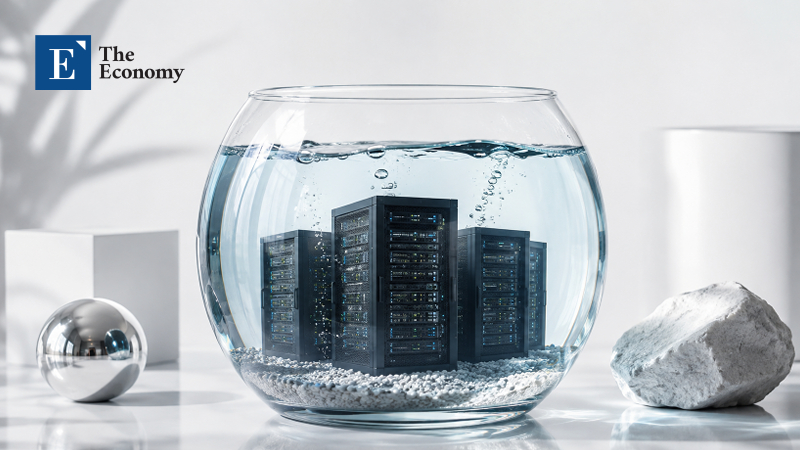
The artificial intelligence (AI) data center market has begun to view the ocean as a new hub for infrastructure development. South Korea and China are accelerating the demonstration and commercialization of underwater data centers, while floating data center (FDC) projects led by private companies are also gaining momentum. Market observers expect operators with robust environmental impact management capabilities to secure a competitive advantage, given the risk that offshore data centers could disrupt marine ecosystems through waste heat discharge.
Ulsan Advances Underwater Data Center Project
According to AI industry sources on Aug. 18, South Korea’s Ministry of Oceans and Fisheries selected the coast of Ulsan, the country’s southeastern industrial hub, in April as the final site for a pilot project to develop a large-scale underwater AI infrastructure complex. The Korea Institute of Ocean Science and Technology (KIOST) will lead the demonstration project, backed by a total budget of approximately $33 million. Beginning this year, the Ulsan municipal government and KIOST will conduct research and development (R&D), including optimal site analysis and preliminary design for the underwater data center, geological data analysis and design work to enhance server-cooling performance.
The project aims to combine pressure-resistant vessel design technology with ultra-efficient hybrid cooling technology and verify operating performance at a power usage effectiveness (PUE) ratio of 1.2 in waters 20 meters deep. Servers and power transformation and distribution equipment will be developed according to modular standardized specifications to secure cost efficiency and scalability. The design will allow individual modules to be integrated and expanded, ultimately increasing server capacity to as many as 100,000 units. Development of the prototype is scheduled for completion in 2030, with construction of a commercial underwater data center complex expected to begin in 2031.
Microsoft’s Project Natick
South Korea is one of several countries to have undertaken such an initiative. One prominent precedent is Project Natick, launched by Microsoft (MS) in the 2010s. Natick was an experimental project involving the installation of sealed data centers on the seabed. A freshwater-based heat exchanger absorbed heat from the enclosed servers, while an external heat exchanger transferred that heat to the surrounding seawater. Following the operation of its first test facility off the coast of California in 2015, MS deployed an underwater data center near Scotland’s Orkney Islands in 2018, equipped with 864 servers and 27.6 petabytes (PB) of storage. When retrieved in 2020, the servers recorded a failure rate equivalent to just one-eighth that of servers housed in land-based data centers.
At the time of retrieval, MS said the experiment had demonstrated the technical and operational feasibility of underwater data centers. The company subsequently refrained from pursuing further demonstrations or commercialization, and the termination of Project Natick was officially confirmed in 2024. Noel Walsh, then corporate vice president of cloud operations and innovation at MS, said the servers had operated effectively underwater and that the company had gained extensive knowledge from the experiment, while confirming that no additional underwater data centers were planned. MS has instead applied the enhanced equipment reliability and research findings obtained from operating servers for extended periods in a sealed, unmanned environment to the design and operation of land-based data centers.
China Pursues Similar Initiatives
China also officially inaugurated the Shanghai Lingang Underwater Data Center, billed as the world’s first offshore wind-powered underwater data center, in May. The facility was jointly developed by the technical team of data center specialist HiCloud and state-owned China Communications Construction Company with a combined investment of $238 million. It consists of server units with a total capacity of 24 megawatts (MW), installed 10 meters below the surface and more than 16 kilometers off the Shanghai coast.
The Lingang data center is directly connected to a 200MW offshore wind farm equipped with more than 50 turbines, allowing clean energy to supply over 95% of its total electricity consumption. Its power demand is also more than 80% lower than that of a conventional land-based data center of comparable scale. The natural cooling effect of cold seawater sharply reduces the facility’s underlying energy consumption. Land-based data centers generally allocate approximately 25% to 40% of their total power demand to coolant circulation systems used to dissipate heat generated during AI computation.
Table 1. Major Underwater and Offshore Data Center Projects Worldwide
| Country·Company | Key Details |
|---|---|
| South Korea·KIOST | Plans to conduct a demonstration at a depth of 20 meters off the Ulsan coast and begin developing a commercial complex in 2031 |
| United States·Microsoft | Confirmed the technical feasibility of underwater data centers through Project Natick but terminated the project in 2024 |
| China·HiCloud | Built an underwater data center off Shanghai using offshore wind power and natural seawater cooling |
| United States·Panthalassa | Developing floating AI computing infrastructure that generates its own electricity from ocean waves |
| South Korea·Samsung Heavy Industries | Developed a 50MW floating data center model and is pursuing a project in the United States |
Private Sector Drives FDC Market Growth
Projects to build data centers on the ocean surface are also advancing in multiple locations. Panthalassa, a US offshore AI data center startup, is developing off-grid infrastructure powered by ocean-wave energy. The concept is based on Panthalassa’s proprietary AI computing node technology. Nodes deployed offshore use wave motion to draw in water, store it under pressure and release it to drive turbines that generate electricity. The power is immediately used to operate AI chips housed inside the nodes. On-site generation addresses the enormous power consumption associated with conventional land-based data centers. Data transmission is handled through low-Earth orbit (LEO) satellites.
At Data Center World (DCW) 2026 in Washington, DC, in April, Samsung Heavy Industries secured approval in principle (AiP) from the American Bureau of Shipping (ABS) and Lloyd’s Register (LR) for its proprietary 50MW FDC model. The company has since expanded global partnerships aimed at commercialization. One prominent example came in June, when Samsung Heavy Industries established a joint development project (JDP) with Greek shipowner Capital Clean Energy Carriers and Lloyd’s Register. Last month, the company also signed an engineering contract with US data center developer Musterean to build the first 50MW moored FDC in the United States. The two companies plan to jointly undertake the entire process from basic design through detailed and production engineering before converting the arrangement into an engineering, procurement and construction (EPC) contract.
Environmental Risks Remain Difficult to Ignore
As countries accelerate efforts to transform the ocean into a new hub for AI infrastructure, some observers warn that marine data centers will struggle to provide a comprehensive solution to the power and cooling constraints facing conventional facilities. Using seawater as a cooling medium does not eliminate the heat generated by servers. When seawater that has absorbed server heat during the cooling process is discharged back into the ocean, it can alter water temperatures and thermal distribution in surrounding areas. If data centers grow larger or multiple facilities are concentrated within a confined body of water, sustained waste heat discharge could also entrench localized warming patterns.
Changes in seawater temperature can trigger substantial cascading effects. Higher water temperatures reduce dissolved oxygen levels while increasing the metabolic rates of ectothermic organisms such as fish and invertebrates. Oxygen supply consequently falls as consumption rises. Prolonged exposure to such conditions can impair the growth and reproductive success of marine organisms while altering feeding behavior and spawning periods. Population declines or migration among specific species could then destabilize existing food chains. “Marine data center operators must consider the speed at which waste heat will disperse through surrounding waters alongside cooling efficiency,” a market expert said. “The capacity to distribute and manage environmental burdens efficiently will emerge as another source of competitive strength in the market.”
Matthew Reuter is a senior economic correspondent at The Economy, where he covers global financial markets, emerging technologies, and cross-border trade dynamics. With over a decade of experience reporting from major financial hubs—including London, New York, and Hong Kong—Matthew has developed a reputation for breaking complex economic stories into sharp, accessible narratives. Before joining The Economy, he worked at a leading European financial daily, where his investigative reporting on post-crisis banking reforms earned him recognition from the European Press Association. A graduate of the London School of Economics, Matthew holds dual degrees in economics and international relations. He is particularly interested in how data science and AI are reshaping market analysis and policymaking, often blending quantitative insights into his articles. Outside journalism, Matthew frequently moderates panels at global finance summits and guest lectures on financial journalism at top universities.
Similar Post