The Dollar's Quiet Unwinding: What a Reserve Currency Status Simulation Really Shows

Working across research, policy, and data-driven analysis, the Editorial Board ensures that published pieces reflect a consistent institutional perspective grounded in quantitative reasoning and long-term structural assessment.
Authored On
Modified
Dollar privilege can erode before formal displacement
Higher borrowing costs outweigh the exchange-rate effect
War accelerates shifts that markets have already begun
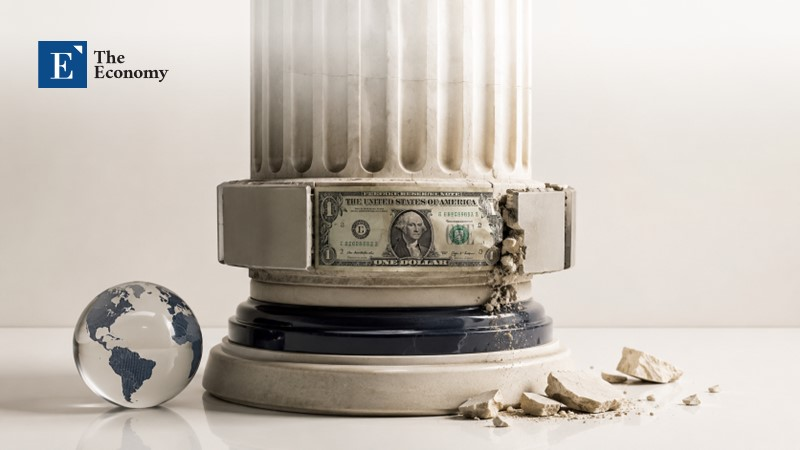
One number should stop any reader cold. Almost thirty trillion dollars. That is the wealth a recent economic model attaches to a full loss of reserve currency status for the United States and it comes close to one full year of national output. This is not a market dip and it is not a bad quarter. It is a permanent loss of value, priced today, tied to a role built up over decades. That role is now being questioned, quietly, by central banks around the world. The model does not predict a sudden collapse. It predicts something slower and in some ways more unsettling, a gradual shift that has already begun. You can see it in bond yields and in who owns U.S. debt and in the gold piling up in vaults from Warsaw to Beijing to New Delhi. That story deserves to be told on its own terms.
Reading The Simulation Instead Of Arguing With It
Every model rests on assumptions and critics can always pick them apart. Change one input and the output shifts too. That game is open to anyone, but it misses the point of building a model in the first place. A good simulation is not a prophecy. It is a clear way to ask what would follow if one condition changed, while holding other things steady enough to actually see the effect. The value of the recent reserve currency exercise does not sit in the exact size of the depreciation it produces. It sits in the shape of the result. Currency effects turn out to be real but modest, interest rate effects turn out to be larger and the wealth effect turns out to be the largest of all. That ranking is the finding worth keeping, no matter which small input gets adjusted later.
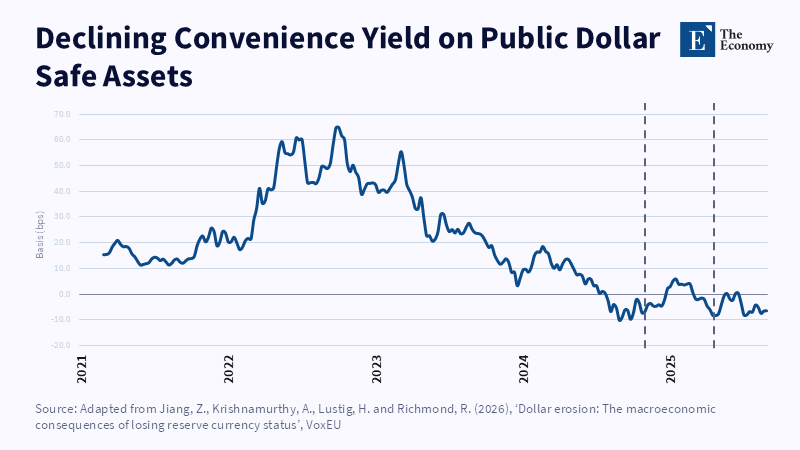
The mechanism itself is fairly simple. Foreign investors have long accepted lower returns on dollar assets in exchange for safety that no other market offers at the same scale and that trade works like a form of income for the United States. The rest of the world pays it, in effect, for a service only the dollar currently supplies. Take away the willingness to pay that price and three things happen at once. The currency weakens, because the wealth that once flowed in stops flowing in. Interest rates rise, because domestic investors now have to absorb debt that foreigners no longer want at the old price. National wealth falls, because the income stream itself disappears, not just its price. None of this needs a crisis and none of it needs a war. It only needs a slow, steady drop in demand, which is what the numbers below already suggest is underway.
The Numbers Already Moving
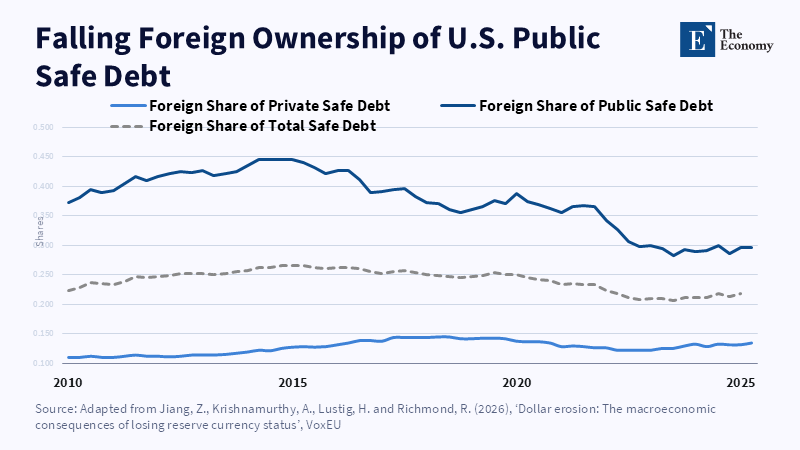
This part is not speculation. The dollar's share of global currency reserves has slipped from about seventy-two percent at the start of this century to under fifty-seven percent by late 2025, according to the International Monetary Fund's own survey of how central banks hold their reserves, which is the most complete public record that exists. The slide has not been dramatic in any single quarter. It has been long and uneven, pausing at times and then picking back up. At the same time, foreign holdings of U.S. government debt have dropped from close to forty-five percent a decade ago to about thirty percent today and that drop is concentrated in government bonds specifically. Private dollar debt has kept its foreign ownership share far better. This gap matters because it points to a choice being made about government risk in particular, not about the dollar as a trading currency more broadly.
The clearest signal sits in vaults, not spreadsheets. Central banks bought more than one thousand tonnes of gold in each of 2022, 2023 and 2024, a pace not seen since the late 1960s and roughly double the average rate of the decade before. Gold's share of official reserves has more than doubled since 2015, moving from under ten percent to above twenty-three percent. Buying slowed a little in 2025, but the direction has not reversed. Poland has pushed its gold target toward a third of total reserves and India has brought gold home that used to sit in storage abroad. When a central bank picks a metal with no counterparty risk over a bond backed by the deepest market on earth, it is making a statement about trust. It is not chasing yield.
History Moves Slowly, Then Confirms Itself All At Once
The last time a dominant reserve currency lost its crown, the shift took years, not moments and it did not require a lost war to get started. Research on the years between the two world wars found that the dollar had already overtaken the British pound as the leading reserve currency by the middle of the 1920s, more than two decades before the date most people assume. The cause was the growing depth of New York's financial markets, not one dramatic event. For years afterward, the two currencies stood as close rivals, each holding a real share of world reserves and that alone challenges the old idea that only one currency can lead at a time. Then came the Great Depression and confidence swung back toward the pound for a while. That uncertain decade dragged on, with no currency holding clear global trust, until Britain went to war against Nazi Germany. Only then did the pound's run as a truly global store of value end for good. The lesson is not that war caused the shift. The lesson is that war closed a gap that had already been opening for fifteen years.
An older case makes a similar point, on a starker scale. Spain's grip on trade and money across the Atlantic had been fading for decades before the Battle of Trafalgar in 1805, but historians still widely treat that single naval defeat as the moment that broke Spanish imperial power beyond repair. It triggered the loss of most of Spain's American territories and the slow retreat of the Spanish peso from its central place in transatlantic trade. No currency simply stepped into that gap right away, though. The Napoleonic Wars kept European markets confused for another decade and no single power or currency could claim clear leadership until those wars finally ended. Both cases point to the same pattern. Decline builds slowly, across years or decades and a single dramatic event mostly confirms in public what markets had already begun pricing in private.
What This Means For Policy And Markets
None of this is a call for panic and it is not a call for calm indifference either. The income built into reserve status, worth roughly one percent of GDP every year, is real and it has funded decades of cheap borrowing. Losing it would not arrive as one headline event. It would build from decisions already visible in the data today, a point of reserve share lost here, a few billion in Treasury holdings pulled there, another few hundred tonnes of gold bought somewhere else. Policymakers who wait for one clear crisis moment will likely find the useful window for action closed years earlier. That is exactly what happened to the pound in the 1920s and to the peso before Trafalgar. The smarter approach is to treat this erosion as already partly real and to plan fiscal and monetary policy around a slowly rising cost of borrowing rather than a permanently cheap one.
One fair objection says the dollar's network advantages, in trade billing, in swap lines and in the sheer depth of dollar markets, make any shift far slower than the earlier examples suggest. Digital finance did not exist in either past case to lock in an incumbent's edge and that point carries real weight. It likely does stretch the timeline out. But it does not change the direction of travel. The interwar case already shows that these network effects are weaker brakes on currency change than economists once thought, since sterling held every comparable edge in infrastructure and habit during the 1920s and it still lost ground within a single decade. Deep, liquid markets slow a transition, but they do not stop one once the trust behind it starts to crack.
The number worth returning to is not a forecast of collapse. It is a measure of what standing still already costs. Almost thirty trillion dollars in present value is not a hypothetical price tag for some future disaster. It is closer to a running bill on a service the rest of the world already values a little less than it once did. Reserve currency status was never a permanent right and history offers no case of one lasting forever once the ground beneath it started to shift. Gold flowing into vaults, shrinking foreign appetite for government bonds and a falling reserve share all point the same way. Policymakers, investors and long-term institutions should treat that direction as the likely path, not the unlikely risk and the time to prepare budgets, balance sheets and expectations is now, before a shift that will probably stay gradual becomes impossible to ignore.
The views expressed in this article are those of the author(s) and do not necessarily reflect the official position of The Economy or its affiliates.
References
Bertaut, C.C., von Beschwitz, B. and Curcuru, S.E. (2023) ‘The international role of the U.S. dollar: Post-COVID edition’, FEDS Notes, 23 June. Washington, DC: Board of Governors of the Federal Reserve System.
Bignon, V., Mojon, B. and Ortiz Serrano, M. (2026) The Trafalgar Squeeze of Global Liquidity. BIS Working Papers No. 1347. Basel: Bank for International Settlements.
Eichengreen, B. and Flandreau, M. (2008) The Rise and Fall of the Dollar, or When Did the Dollar Replace Sterling as the Leading International Currency? NBER Working Paper No. 14154. Cambridge, MA: National Bureau of Economic Research.
Jiang, Z., Krishnamurthy, A. and Lustig, H. (2021) ‘Foreign safe asset demand and the dollar exchange rate’, The Journal of Finance, 76(3), pp. 1049–1089.
Jiang, Z., Krishnamurthy, A., Lustig, H. and Richmond, R. (2026) ‘Dollar erosion: The macroeconomic consequences of losing reserve currency status’, VoxEU, 20 July.
Krishnamurthy, A. and Vissing-Jorgensen, A. (2012) ‘The aggregate demand for Treasury debt’, Journal of Political Economy, 120(2), pp. 233–267.
Marichal, C. (2007) Bankruptcy of Empire: Mexican Silver and the Wars Between Spain, Britain and France, 1760–1810. Cambridge: Cambridge University Press.
Nephew, E., Vu, H.L. and Wei, H. (2025) ‘Little change in the composition of international reserves in the third quarter of 2025’, IMF Data Brief, 18 December. Washington, DC: International Monetary Fund.
World Gold Council (2025) Gold Demand Trends: Q4 and Full Year 2024. London: World Gold Council.
World Gold Council (2026) Gold Demand Trends: Q4 and Full Year 2025. London: World Gold Council.
Working across research, policy, and data-driven analysis, the Editorial Board ensures that published pieces reflect a consistent institutional perspective grounded in quantitative reasoning and long-term structural assessment.