[AI Implementation] How AI Is Reshaping the Consulting Industry in 2026

The Economy Markets Editorial Board is a multidisciplinary group of researchers, analysts and sector specialists covering the structure and evolution of global professional and institutional markets. Its work examines competitive landscapes, market positioning, buyer choice and the forces reshaping industries across advisory services, capital markets, wealth management, healthcare and other specialist sectors.
The Board also contributes to The Economy’s ranking research, where its members assess firms, institutions and market participants using structured research, sector evidence and comparative analysis. This combination of market research and ranking coverage gives the Board a continuing view of how competitive positions develop within individual industries and how firms differentiate themselves as markets evolve.
Through The Economy Markets, the Board translates this research into accessible analysis of market structure, competitive dynamics and institutional change, complementing The Economy’s rankings, Wiki profiles and broader research coverage with a comparative view of the markets in which ranked organisations operate.
Authored on
Modified
AI implementation advisory now ranks firms once seen as back-office vendors
Consulting pyramids are flattening as billing models shift toward outcomes
Headcount cuts coexist with record hiring demand and applications

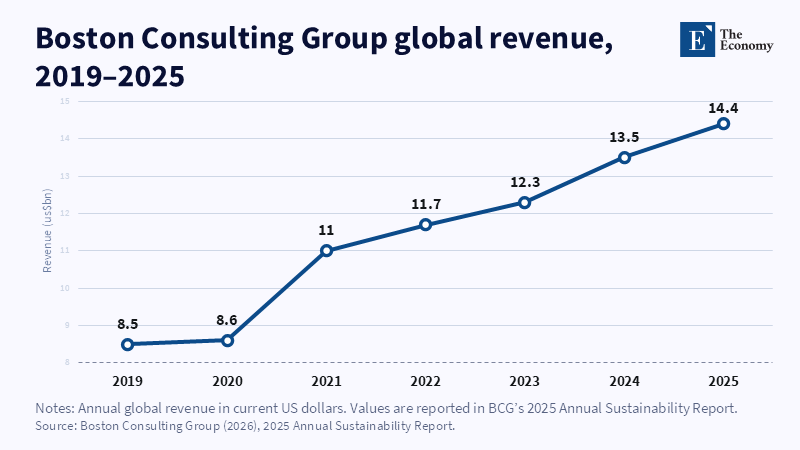
Boston Consulting Group closed the fiscal year with revenue of $14.4 billion, a 7% increase over the previous year, while its workforce continued to expand despite predictions that AI would make the traditional consultant redundant. At the same time, an independent evaluation of around 80 AI and data implementation firms selected 20 institutions for the Top 20 AI & Data Implementation Advisory 2026 ranking. These two observations, one from a major management consultancy and the other from the specialized implementation market, show an industry changing its structure rather than simply shrinking. The shift is changing project pricing, entry-level hiring and implementation partnerships.
How AI Is Reshaping the Consulting Pyramid
The traditional model of consulting firms relied on layers of young analysts who produced research, calculations and presentations under the guidance of fewer senior executives. This structure, known as a pyramid, relied on workforce scale to accommodate a large volume of work. Generative AI, predictive models and agentic assistants are increasingly performing parts of the lower-tier work at consulting firms such as McKinsey, BCG, Bain, Deloitte and PwC, which have developed or adopted AI tools for internal work.
The traditional pyramid is becoming flatter because technologically skilled junior consultants increasingly manage AI workflows, middle managers interpret results and formulate strategy, while senior partners focus on client relationships and judgment. AI-native boutiques such as Unity Advisory use expert-led teams with AI embedded into how work is delivered, reducing reliance on the large junior analyst cohorts associated with the traditional consulting pyramid.
AI Investment, Productivity and Workforce Restructuring
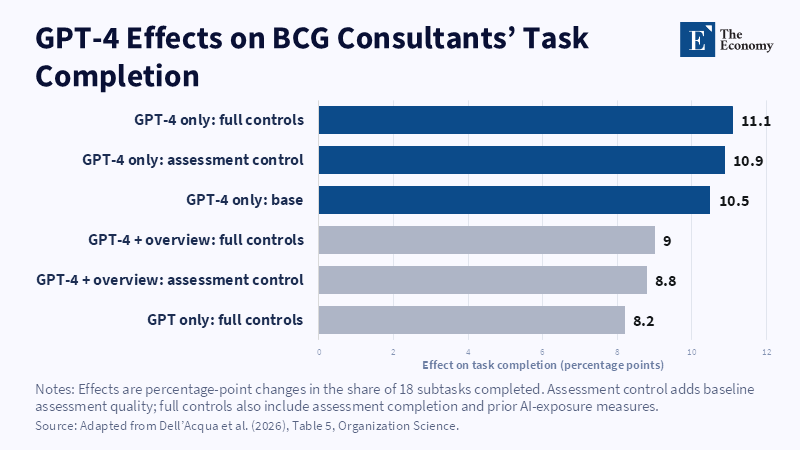
Large professional services firms have expanded partnerships with AI developers, staff training and proprietary platforms. McKinsey launched its internal Lilli platform in 2023, BCG has partnered with firms including Anthropic, whereas KPMG has begun assessing employees partly against AI objectives in its 2026 performance reviews. Deloitte research found that 66% of organizations reported productivity and efficiency gains from enterprise AI adoption. A separate study conducted with BCG and published in Organization Science examined 758 consultants and found that participants using GPT-4 completed 12.2% more tasks and worked 25.1% faster on tasks within the model’s capability frontier.
Increased productivity has coincided with workforce restructuring, although the changes cannot be attributed solely to AI. McKinsey’s workforce fell from more than 45,000 employees at the end of 2023 to about 40,000 amid a broader consulting slowdown and restructuring. Accenture’s global headcount also fell by more than 11,000 over a three-month period while the company continued expanding its AI capabilities. By the end of fiscal 2025, Accenture had approximately 77,000 skilled AI and data professionals against its target of 80,000 by the end of fiscal 2026. Its generative and agentic AI bookings reached $5.9 billion in fiscal 2025, nearly double the previous year’s level.
At the same time, hourly billing is gradually losing ground in some parts of the industry. Outcome-linked pricing is becoming more common as AI changes the relationship between labor input and client value. The shift reduces the logic of charging clients purely for the number of consultant hours used to produce an analysis.
Implementation Rankings Reshape the Competitive Landscape
The independent Top 20 AI & Data Implementation Advisory 2026 ranking evaluated around 80 firms worldwide and selected 20, divided into three tiers according to relative institutional positioning. Five firms were placed in Tier I, including Palantir Technologies, known for integrating fragmented data environments into operational systems; Databricks Professional Services, with a focus on enterprise data infrastructure, lakehouse architecture and MLOps; and Fractal, alongside Quantiphi and Tredence.
Firms focused primarily on digital transformation, ERP implementation or general IT services were excluded from the ranking methodology, keeping the category centered on technical AI and data implementation. Slalom, Tiger Analytics and ZS Associates were placed in Tier II, combining consulting capabilities with technical delivery. The distinction matters because the tiers represent relative institutional positioning rather than simple performance scores. The ranking therefore provides evidence of a market in which specialized implementation capability has become a distinct competitive category.
Outcome-Based Pricing and Entry-Level Hiring
At BCG, the picture is not one of simple contraction. Variable fees are used in three-quarters of the firm’s largest AI projects, according to CEO Christoph Schweizer, although outcome-linked arrangements remain significantly below one-third of BCG’s activity overall. Entry-level recruitment has not decreased. The company ended 2025 with more staff than it started and received 1.7 million applications, with less than 1% of applicants ultimately joining the firm.
This challenges the widespread narrative that the traditional consultant is disappearing. A preliminary MIT NANDA study found that roughly 95% of enterprise generative AI initiatives examined had not produced measurable profit and loss impact. The finding does not show that AI itself is failing. Instead, it points to a gap between acquiring AI tools and integrating them effectively into business processes. Companies with established client relationships, implementation experience and organizational knowledge may therefore retain an advantage even as access to advanced models becomes widespread.
Human Oversight Remains Central to AI-Enabled Consulting
Over-reliance on AI without human control has already produced costly errors. In 2025, part of a A$439,000 Deloitte contract fee was refunded after errors were identified in a report prepared for the Australian government, including citations to academic publications that did not exist. Deloitte acknowledged that generative AI had been used in drafting the report. The incident reinforced the importance of specialist oversight even when AI assists with substantial parts of analytical work.
Consultants involved in operations transformation argue that attaching AI tools to existing workflows without addressing friction between functions and systems often produces limited value. A stronger approach examines how value moves across the organization, one critical workflow at a time, with human judgment retained where validation, accountability and organizational change are required. Research on AI implementation similarly suggests that value depends less on access to models than on their integration with data, workflows and decision processes.
Table 1: AI’s Reshaping of Consulting
| Evidence | Verified finding | Implication |
|---|---|---|
| BCG | $14.4bn 2025 revenue, up 7% | AI adoption has not produced firm-wide contraction |
| BCG experiment | 12.2% more tasks, 25.1% faster | AI can materially raise consultant productivity |
| McKinsey | Headcount fell from 45,000+ to about 40,000 | Traditional staffing structures are under pressure |
| Accenture | $5.9bn FY2025 AI bookings; about 77,000 AI and data professionals | Investment and workforce composition are shifting |
| Advisory Ranking | 20 firms selected from around 80; five in Tier I | Specialist implementation capability has become competitive evidence |
| Advisory Ranking | A$439,000 contract was partially refunded after citation errors | Human verification remains commercially important |
Taken together, BCG’s revenue growth, workforce restructuring at McKinsey and Accenture and the ranking of specialist AI implementation firms point to realignment rather than contraction. Value is increasingly tied to the ability to convert data infrastructure into measurable operational output rather than to billing hours alone. Organizations evaluating consulting partners must therefore weigh not only firm size but also documented implementation capability, workflow integration and the ability to combine technical systems with human judgment.
This article reflects the analytical judgment of The Economy Markets Editorial Board and does not constitute business advice or the official position of any affiliated institution.
References
Advisory Ranking (2026) Top 20 AI & Data Implementation Advisory 2026. Dublin: Gordon Institute Limited.
Bagnall, W. (2026) How Is AI Changing the Consulting Industry? London: MCR Consulting.
Cutter, C. (2026) AI Is Changing How Consultants Get Paid—and Much More, BCG's CEO Says. New York: The Wall Street Journal, republished by Boston Consulting Group.
Duncan, D.S., Anderson, T. and Saviano, J. (2025) AI Is Changing the Structure of Consulting Firms. Boston: Harvard Business Review.
The Economy Markets Editorial Board is a multidisciplinary group of researchers, analysts and sector specialists covering the structure and evolution of global professional and institutional markets. Its work examines competitive landscapes, market positioning, buyer choice and the forces reshaping industries across advisory services, capital markets, wealth management, healthcare and other specialist sectors.
The Board also contributes to The Economy’s ranking research, where its members assess firms, institutions and market participants using structured research, sector evidence and comparative analysis. This combination of market research and ranking coverage gives the Board a continuing view of how competitive positions develop within individual industries and how firms differentiate themselves as markets evolve.
Through The Economy Markets, the Board translates this research into accessible analysis of market structure, competitive dynamics and institutional change, complementing The Economy’s rankings, Wiki profiles and broader research coverage with a comparative view of the markets in which ranked organisations operate.
Similar Post