[AI Implementation] Why Access Alone No Longer Wins Clients

The Economy Markets Editorial Board is a multidisciplinary group of researchers, analysts and sector specialists covering the structure and evolution of global professional and institutional markets. Its work examines competitive landscapes, market positioning, buyer choice and the forces reshaping industries across advisory services, capital markets, wealth management, healthcare and other specialist sectors.
The Board also contributes to The Economy’s ranking research, where its members assess firms, institutions and market participants using structured research, sector evidence and comparative analysis. This combination of market research and ranking coverage gives the Board a continuing view of how competitive positions develop within individual industries and how firms differentiate themselves as markets evolve.
Through The Economy Markets, the Board translates this research into accessible analysis of market structure, competitive dynamics and institutional change, complementing The Economy’s rankings, Wiki profiles and broader research coverage with a comparative view of the markets in which ranked organisations operate.
Authored on
Modified
AI advisory value now hinges on implementation, not tool access
Boutique data-AI specialists lead rankings; big consulting firms adapt
Consultants stay valuable for judgment, validation and change management

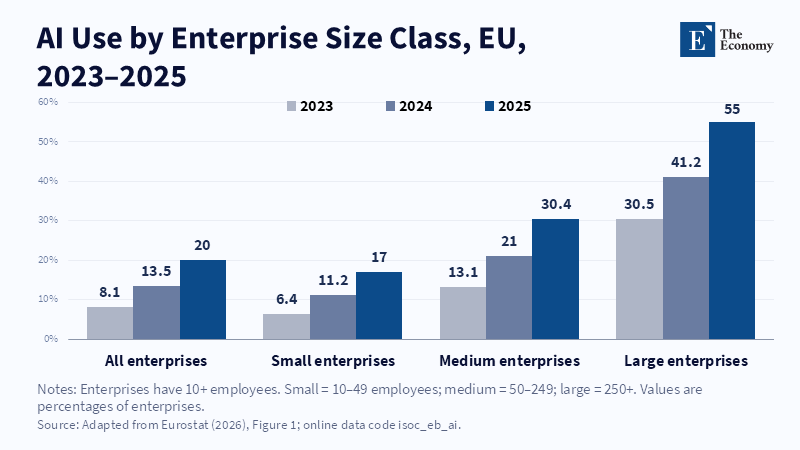
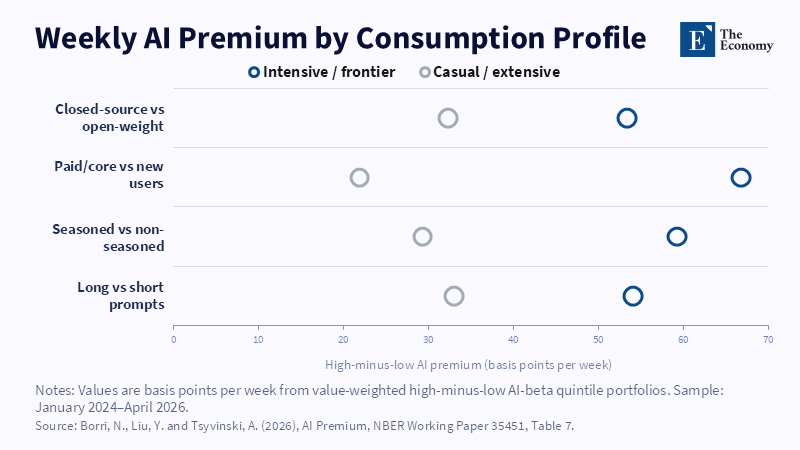
The AI implementation advisory market now shows a clear separation between those with simple access to tools and those with real implementation capability. Recent research by the Swiss Institute of Artificial Intelligence shows that businesses with extensive and sophisticated AI consumption experienced a weekly outperformance of 64.1 basis points compared to those with limited or occasional use. The difference does not come from the possession of licenses, but from the depth of integration into the operational processes. At the same time, Eurostat data show that 55% of large European companies were using artificial intelligence in 2025, compared to just 17% of small ones, a distance that mainly reflects the cost of implementation rather than the cost of access to technology. That gap is now where consulting firms compete. Boutique specialists have been handed an opening and larger firms have been pushed to rethink their offer.
Beyond Access: Where the Gap Really Lies
Obtaining a license for an AI model is currently a cheap and fast process. Connecting this model to real-world data, workflows and accountability structures remains challenging and time-consuming. Implementation is described, in research by the Swiss Institute of Artificial Intelligence, as an intermediate organizational layer between access and productive use, one that requires skills, access rules, interfaces and evaluation criteria no model arrives with.
The same research records that market pricing seems to reward businesses that consume AI in an intensive, specialized and repetitive way, rather than those that simply have licenses. Installation, system integration and persuasion skills currently appear to have a more positive exposure to the market than purely analytical skills, which is attributed to the fact that implementation remains the scarce raw material of the current phase of technology diffusion.
Seventy Percent of the Value Lies in People
A survey by Boston Consulting Group of hundreds of companies comes up with an indicative ratio: only 10% of the value resulting from artificial intelligence projects is attributed to the algorithms themselves, 20% to the technology of their implementation and the remaining 70% to the restructuring of the human factor. Companies described by the study as fully developed in this sector are planning to have more than half of their workforce upskilled, compared to just 20% in companies that lag behind and record an average shareholder return of about four times over three years.
Why Consultants Remain Irreplaceable
The rapid adoption of AI tools by major consulting firms has not reduced the demand for human judgment, but instead seems to be shifting it towards more complex tasks. The skills analysis accompanying the AI premium findings shows positive exposure to persuasion, coordination and institutional action skills, while purely analytical skills show negative exposure as analysis production becomes cheaper. A model can produce the analysis. Someone still has to own the decision.
This partly explains why organizations still pay for human consulting even when technology can first produce draft reports or analytics within minutes. Consulting's value is shifting from producing content to validating it, managing change and signing off on decisions; work automation hasn't touched it yet.
Boutiques vs. Traditional Groups: A Market That Is Being Rearranged
In the ranking for AI and data implementation consulting, the first tier is dominated by niche names like Palantir Technologies, Databricks through its services, Fractal, Quantiphi and Tredence, companies built around technical immersion in data and machine learning rather than traditional management consulting. Large global consulting groups are explicitly excluded by the ranking methodology itself, a sign of how far the technical implementation market has drifted from traditional management consulting.
In the digital transformation category, companies such as Slalom, Thoughtworks, Globant, Publicis Sapient and Valtech are leading, while in the business technology consulting category, independent agencies such as Avasant, ISG, Info-Tech Research Group, Metis Strategy and West Monroe are leading the way. The common element between these three categories is the absence of the largest traditional groups from the top positions, not because they lack technological investment, but because these rankings evaluate purely technical deepening of implementation and not wider organizational influence.
Table 1: Leading Firms Across the AI Implementation Advisory Landscape
| Firm / Entity | Sub-vertical | Key Differentiator | Verdict |
|---|---|---|---|
| Palantir Technologies | AI & Data Implementation | Runs AI inside sensitive, regulated environments | Technical execution leader |
| Slalom | Digital Transformation | Turns strategy into shipped systems | Platform execution leader |
| Metis Strategy | Enterprise Technology | Advises CIOs and boards directly | Strategic technology leader |
The Next Stage of AI Implementation Advisory
Research by the Swiss Institute of Artificial Intelligence predicts that the current advantage of specialized implementation companies is transient. As platforms, connections and implementation practices become standardized, the scarcity of purely technical installation is expected to decrease, shifting the competitive advantage towards quality of use, i.e., what tasks are assigned to models, how results are verified and how workflows are reconfigured. In this transitional phase, traditional groups, with long-standing experience in human resource reorganization and institutional change, possess exactly the skills that seventy percent of the value seems to require.
That gap in the market: access alone doesn't earn it, deep integration does. The consulting firms that will lead the next phase will not necessarily be those who possess the most advanced technical tools, but those who can combine the technical ability of implementation with the deep knowledge of human resources restructuring. Firms hiring for AI implementation now need to check both boxes, technical depth and workforce experience, or risk picking the wrong partner.
This article reflects the analytical judgment of The Economy Markets Editorial Board and does not constitute business advice or the official position of any affiliated institution.
References
Bedard, J. and Beauchene, V. (2026) 'AI Transformation Is a Workforce Transformation', BCG, 4 February.
Borri, N., Liu, Y. and Tsyvinski, A. (2026) AI Premium. NBER Working Paper 35451. Cambridge, MA: National Bureau of Economic Research.
Brynjolfsson, E., Rock, D. and Syverson, C. (2021) 'The Productivity J-Curve: How Intangibles Complement General Purpose Technologies', American Economic Journal: Macroeconomics, 13(1), pp. 333–372.
Eurostat (2026) The Use of Artificial Intelligence Technologies in the European Union: Key Results, 2026 Edition. Luxembourg: Publications Office of the European Union.
Krishna, R. (2026) 'AI Consulting Services: Why Strategy Comes Before AI Success', IABAC, 13 August.
Lee, K. (2026) 'From AI Access to Organizational Capability: Pricing the Corporate AI Transition', Swiss Institute of Artificial Intelligence, 9 August.
Lee, K. (2026) 'The AI Premium Is About Implementation, Not Access', Swiss Institute of Artificial Intelligence, 11 August.
Ranking News — Advisory Desk (2026) 'Top 20 AI & Data Implementation Advisory 2026', Advisory Ranking, 1 April.
Ranking News — Advisory Desk (2026) 'Top 20 Digital Transformation Advisory 2026', Advisory Ranking, 1 April.
Ranking News — Advisory Desk (2026) 'Top 20 Enterprise Technology Advisory 2026', Advisory Ranking, 1 April.
The Economy Markets Editorial Board is a multidisciplinary group of researchers, analysts and sector specialists covering the structure and evolution of global professional and institutional markets. Its work examines competitive landscapes, market positioning, buyer choice and the forces reshaping industries across advisory services, capital markets, wealth management, healthcare and other specialist sectors.
The Board also contributes to The Economy’s ranking research, where its members assess firms, institutions and market participants using structured research, sector evidence and comparative analysis. This combination of market research and ranking coverage gives the Board a continuing view of how competitive positions develop within individual industries and how firms differentiate themselves as markets evolve.
Through The Economy Markets, the Board translates this research into accessible analysis of market structure, competitive dynamics and institutional change, complementing The Economy’s rankings, Wiki profiles and broader research coverage with a comparative view of the markets in which ranked organisations operate.
Similar Post