[European Strategic Autonomy] Can Enlargement Add Capacity Without Adding Paralysis?

Working across research, policy, and data-driven analysis, the Editorial Board ensures that published pieces reflect a consistent institutional perspective grounded in quantitative reasoning and long-term structural assessment.
Authored On
Modified
Enlargement can add resources faster than the EU adds decision-making capacity
Moldova's facility links payments to verified reform steps
EU-side reforms still depend on decisions by existing members
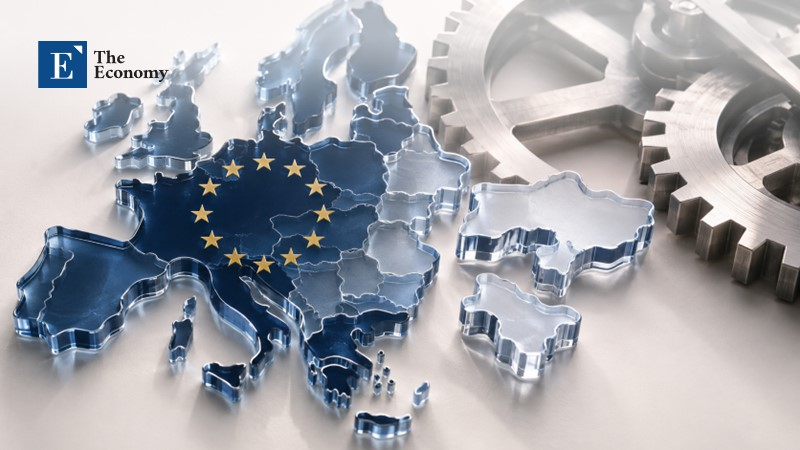
The latest steps towards eventual accession were reviewed by the Commission on 4 November 2026, giving an almost "business-as-usual" impression. By then, 21 chapters had been provisionally closed with Montenegro, Albania had opened its last remaining cluster, and Ukraine and Moldova had each opened 4 clusters. The latter two had begun opening clusters only after Hungary lifted its veto on Ukraine in June 2026. Both aspire to complete negotiations in 2028, Moldova early in the year and Ukraine by its end. As with most such timelines, these depend very much on all 27 Member States agreeing to conclude negotiations, followed by agreement on an accession treaty and ratification by all contracting states.
Considerably more would need to happen, however, before a Treaty could be concluded with any of them. In an enlargement that includes Ukraine, the area, population, agricultural landmass and border with Russia of a Union of 30 or more would all increase substantially. Its overall impact and influence would increase to the extent that its various decision-making processes could be extended to cope: adequate funding, implementation, sanctions and appropriate majorities all questions of internal arrangements for the Union.
The same tension arose in the closing discussion at the Chatham House Berlin Conference: would taking in more members strengthen the Union or make decisions harder? The argument for enlargement was linked to acceptance of common rules and the mutual trust needed to apply them. For The Economy, this puts the EU side of the bargain at the centre of the assessment. Candidate reforms can be measured, but their next step still depends on political agreement among existing members.
Readiness of Candidates Will be Tested Against Stringent Criteria
There is thus a considerable onus on candidates to demonstrate readiness, and a range of further stages at the discretion of Member States. All decisions on candidacy and the opening and closing of clusters and individual chapters are by unanimity of the Member States. The final accession treaty requires the European Parliament’s consent and ratification by every contracting state, potentially by referendum in France. Candidate reforms are reviewed annually against detailed accession conditions. Existing Member States also face substantive EU-law obligations, but the Union’s own institutional preparations depend on political agreement among them, allowing national preferences to dominate the agenda.
So far, the experience of Ukraine and Moldova illustrates how an objection to one candidate can hold back another. Their accession tracks were politically linked, so Moldova was held back from opening its first cluster until Hungary agreed in June 2026 to lift its veto over Ukraine following the change of government and assurances on the treatment of minorities in Transcarpathia. Thus, a highly motivated small State was delayed by a dispute not directed at its own reforms. On substance, Ukraine appeared from a wide review by SWP (April 2026) to have made considerable progress in transposition and other legislation, but substantial deficiencies remained in implementation by courts and in combating corruption.
It would be wrong to conclude that enlargement on the whole has only brought costs. The Commission reported that living standards in the 2004 acceding states had roughly doubled over the following 20 years. The Council’s retrospective also recorded more than a fivefold rise in trade since 2000 between those countries and the pre-2004 members, excluding the United Kingdom for comparability. There would presumably be significant losses from continued delay for candidates, and domestic supporters of change would gradually lose ground. The Council stated that Moldova's growth package would strengthen its resilience to subversion and disruption from Russia. It would be self-serving and counter-productive for the Union to insist on full capacity to absorb further members if it does not make comparable efforts, with similar timescales, to improve its own functioning.
Provisional Benefits Can Be Linked Objectively to Stages of Reform
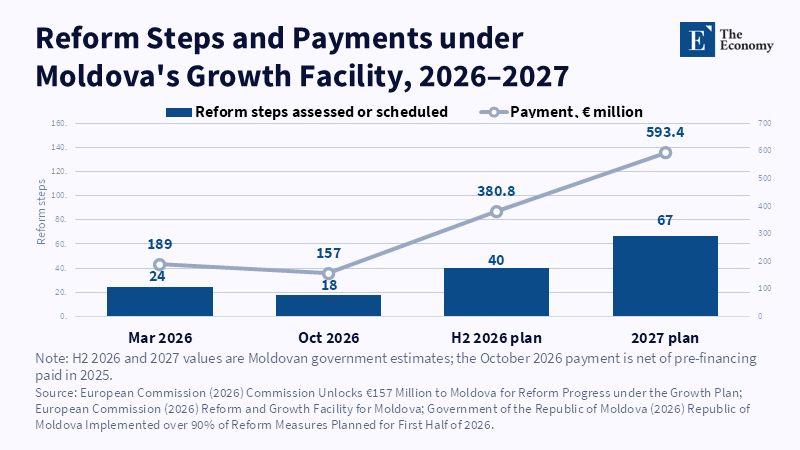
The Economy's March 2026 analysis suggested various ways in which Ukraine could be progressively integrated, distinguishing temporary, conditional benefits from the more lasting obligations of full membership. Significant resources are being made available to Moldova over 2025–2027 under the Reform and Growth Facility, approved by the Council on 18 March 2025, of up to €1.9bn, comprising grants of up to €385m and loans of up to €1.5bn on favourable terms. They are payable semi-annually subject to the Commission's judgement on the completion of identified measures.
A total of €661m had been made available by 5 October 2026, about one third of the overall envelope. The latest €157m release followed completion of 18 of the 20 steps assessed for that request, including one carried over from 2025, and was net of pre-financing already advanced. The uncompleted measures held back the corresponding funds rather than cancelling the entire instalment; withheld amounts can be released if the conditions are subsequently met within the applicable period. This seems a sensible approach, maintaining an element of positive incentive in a less successful period. Substantial numbers of measures are planned for completion in H2 2026 (40) and the full year 2027 (67), with the government estimating associated funding of €380.8m and €593.4m respectively, subject to fulfilment of the relevant conditions.
Some other benefits of market integration are beginning to apply. Mobile users have roamed between the EU and Ukraine and Moldova at domestic prices since 1 January 2026, and Moldova has been operationally connected to the Single Euro Payments Area (SEPA) since 6 October 2025. The 2026 package also proposed a wider framework for progressive integration of candidate countries, including Ukraine and Moldova, with participation remaining conditional and reversible.
An even wider package of benefits, short of formal accession, was suggested by Lippert, von Ondarza and Seebass (SWP, April 2026): association with the EU and the single market, substantial investment to aid reconstruction, representation in the European Parliament as Observers. They favoured substantial integration before accession over admitting Ukraine with reduced membership rights. This remains a research proposal rather than an agreed EU accession model. It shares a general risk of such interim measures: they may become sufficiently beneficial to weaken the urgency of accession and so allow easy procrastination by Member States as to the final step. The many years of candidacy of Türkiye are a caution about indefinite waiting, although its stalled negotiations also reflect democratic backsliding and unresolved political disputes.
There are thus already examples of single-market participation without EU membership, notably Norway, Iceland and Liechtenstein through the European Economic Area (EEA), accepting relevant EU rules without a vote in the EU institutions that adopt them, although they can contribute to preparing those rules. Such an arrangement may suit Norway given its prosperity and general security, but is hardly an attractive fallback for Ukraine or Moldova.
The pace of closing chapters and other formal steps would quickly outstrip effective implementation if courts and other authorities fail to keep pace. The "fundamentals" cluster opens first and closes last; opening it does not mean its requirements have been fulfilled. At the other extreme, protracted progressive integration would lose impetus when further benefits ceased to be substantial, and there was no clear expectation of when the next stage might be reached.
Ukraine’s participation in European defence programmes provides another example of integration before accession. On 16 October 2026, the Commission announced that the agreements covering its association with the European Defence Fund and financing under the European Defence Industry Programme had entered into force. These allow Ukrainian firms and research institutions to join collaborative projects with EU partners. The resulting industrial capacity still depends on projects, funding and implementation, but the institutional route is already in place.
The Union's Enlargement Capacity Depends on Reforms Not Yet Adopted
Many areas where the Union itself needs to improve are identified in the Commission’s communication of 6 October 2026, Preparing for a Wider Union. Most of these directions still require further decisions. Qualified majority voting (QMV) is proposed for opening negotiating clusters and other intermediate accession decisions, though final accession would remain subject to unanimity. The existing decision retaining one Commissioner per Member State also provides for review in connection with the accession of a thirtieth member. A proposed institutional safeguard in future accession treaties could permit suspension of a new Member State’s Council voting rights in particularly serious cases during the first 15 years after accession. These changes still require political and legal decisions, but the Commission considers that enlargement can be accommodated within the existing Treaties and future accession treaties. Activating passerelle clauses to change voting rules requires unanimity, while accession treaties require ratification by every contracting state.
Adequate resources to meet all common tasks, decisions where preferences differ, and implementation and sanctions would all be major areas of strain. A specific feature of the financial package proposed for Montenegro on 30 June 2026 was to accommodate accession without reducing the pre-allocated envelopes of existing members. Council conclusions on the package followed on 12 October, while the final arrangements remain subject to budget and accession negotiations. As argued in The Economy's book The Cost of Order, the continuance of an acceptable order in Europe depends on adequate resources being provided by its participants. It is very far from clear how the substantial costs of integrating Ukraine would be shared. This will be discussed further in Who Will Pay for Europe's Strategic Commitments?
Decisions by less than unanimity could create other problems if major States, or significant elements of their populations, resented decisions and failed to implement them, and ultimately any accession treaty requires national ratification decisions. Unanimity allows each national preference to predominate, at the cost of greater difficulty in reaching any common decision. Between the formal opening of accession negotiations in June 2024 and the opening of its first cluster in June 2026, Moldova experienced the consequences of linked negotiations without any vote itself.
Presumably ratification would be most likely to prove difficult where national opinion was most hostile; 53% of respondents across the EU were in favour of further enlargement, compared with 40% against (Eurobarometer, Spring 2026). There was a majority against in Germany, France, Austria and the Czech Republic, while opposition narrowly exceeded support in Belgium and Luxembourg without reaching 50%. The majority against in France reached 54%, with a possible referendum decision. These findings concern enlargement in general, rather than a vote on any particular accession treaty.
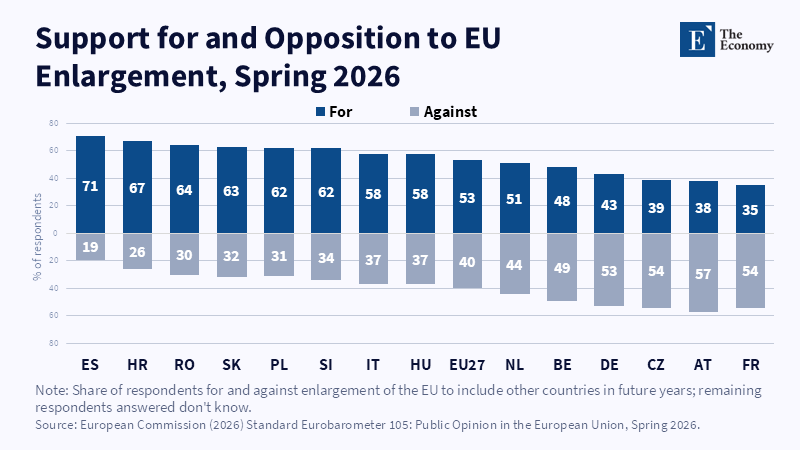
Implementation and sanctions remain areas of strain. Poland’s Article 7 procedure ended in May 2024 after the Commission withdrew its proposal, while Hungary’s remained ongoing in October 2026 without suspension of its voting rights. Article 7 involves distinct preventive and sanctions stages, alongside other enforcement instruments such as infringement proceedings and budget conditionality. Principal obligations of candidates and of the Union are compared in the following summary, limited to matters for which a relevant dated decision, proposal or official status report has been identified.
Table 1. Two-Sided Readiness Matrix: Candidate and Union Capacity
| Field | Requirements of candidate state(s) | Requirements of the Union | Decision or status date |
|---|---|---|---|
| Compliance with rules | Satisfactory body of national legislation; effective courts, authorities incl. against corruption | Satisfactory systems to ensure continuation | Four clusters each opened for Ukraine and Moldova by 13 Oct 2026; 21 chapters provisionally closed with Montenegro by 12 Oct 2026 |
| Adequate public finances | Implement measures to qualify for payments; effective public finance | Provide adequate resources for additional members; agree how costs will be shared | Moldova: €661m made available from an envelope of up to €1.9bn by 5 Oct 2026. Montenegro: financial package proposed 30 June; Council conclusions, 12 Oct 2026 |
| Market integration | Appropriate legislation, implementation and monitoring | Permit progressive participation in various markets, defining conditions to advance and to withdraw | Ukraine and Moldova: domestic roaming rates from 1 Jan 2026. Moldova: operational SEPA connection from 6 Oct 2025 |
| Security and other external actions | Adequate approach to CFSP, including application of sanctions | Appropriate arrangements for participation, e.g., in defence | Ukraine’s EDF association and EDIP financing agreements in force; Commission announcement, 16 Oct 2026 |
| Participation in decisions | Accept decisions taken | Decide necessary changes to voting arrangements and institutional size | QMV for opening clusters and other intermediate decisions proposed, 6 Oct 2026. Final accession requires unanimity, Parliament’s consent and national ratification |
The immediate EU-side constraint is the ability to agree on these obligations together. A change in voting rules can ease a blockage at one stage, but funding must still be provided and common rules enforced after admission. Treating each as a problem for later risks adding members before the Union has agreed how the enlarged system will work.
Value of Interim Stages Depends on Expectation of Continuation to Final Goal
To the extent that commitments by candidate states are extensive and fulfilled, and that corresponding capacities to decide and provide adequate resources exist within the Union, all will contribute to greater Strategic Autonomy of Europe. Intermediate measures would be valuable insofar as they themselves develop capacities of both candidates and the Union, and can reasonably be expected to lead on to accession. There are encouraging features of the arrangements with Moldova, in particular linkage of substantial payments to objective assessment of progress. Much of the corresponding range of changes needed within the Union remains at the stage of recommendation. Important reforms remain proposals, while activating passerelle clauses still requires unanimous agreement. It is far from certain that they would all be adopted before accession.
Clear conditions, review dates and a stated next step can make interim arrangements more credible, but they cannot guarantee accession while unanimous approval and national ratification remain necessary. The Union should therefore make its own preparations visible alongside candidate benchmarks: which funding has been agreed, which decision rules will apply and how compliance will be maintained after entry. Enlargement will add capacity when these commitments advance together. If only the candidates are required to move, progressive integration risks becoming an indefinite waiting room.
This independent series by The Economy Review examines questions on the agenda of the Chatham House Berlin Conference 2026 and develops the publication's earlier research. The articles draw on public sources and, where indicated, discussions at the conference. The analysis and conclusions are those of the authors; references to the conference do not imply endorsement by Chatham House.
References
Całus, K. and Sienicki, K. (2026) Moldova Pulls Ahead of Ukraine on the Path to EU Accession. Warsaw: Centre for Eastern Studies, 13 November.
Council of the European Union (2025) Moldova: Council Gives Final Green Light to Support Reforms and Economic Growth with Almost €2 Billion. Press release, 18 March.
Council of the European Union (2026) How EU Enlargement Works. Brussels: Council of the European Union.
European Commission (2026a) 2026 Enlargement Package Shows Reform Commitment Delivers Progress towards EU Membership. Press release, 4 November.
European Commission (2026b) Preparing for a Wider Union: Pre-Enlargement Policy Reviews, COM(2026) 705, 6 October.
European Commission (2026c) Commission Unlocks €157 Million to Moldova for Reform Progress under the Growth Plan. 5 October.
European Commission (2026d) Standard Eurobarometer 105: Public Opinion in the European Union, Spring 2026. Data Annex, question QB2.6, p. 158.
European Western Balkans (2026) Support for EU Enlargement at 53% across the Union, Lowest in France. 11 May.
Government of the Republic of Moldova (2026) Republic of Moldova Implemented over 90% of Reform Measures Planned for First Half of 2026, 10 July.
Lippert, B., von Ondarza, N. and Seebass, F. (2026) EU Enlargement: Ukraine as a Special Case, the Western Balkans as the Norm. SWP Comment 17. Berlin: SWP, 20 April.
Polish Institute of International Affairs (2026) Ukraine and Moldova Open the First EU Negotiations Cluster. Warsaw: PISM, 16 June.
The Economy (2026a) Will Ukraine Join the EU in the Next Decade? Rethinking 'Fast-Track' Membership and Its Costs. Strategy Review, 2 March.
The Economy (2026b) [Arctic Maritime Strategy] Who Governs Europe's High North? Sovereignty, NATO and Arctic Cooperation. Strategy Review, 24 October.
The Economy Editorial Board (2026) The Cost of Order: Ukraine and the Remaking of Europe. The Economy Books
Chatham House (2026) Berlin Conference, 25–26 November. Conference agenda and closing discussion.
Council of the European Union (2024) 2004 Enlargement: Facts and Figures, 26 April.
Council of the European Union (2025) Article 7 Procedures, updated 8 July.
Council of the European Union (2026) General Affairs Council, 13 October; Four Accession Conferences: More Progress for Montenegro, Albania, Ukraine and Moldova, 13 October.
European Commission (2026e) Commission Implementing Decision C(2026) 6853, approving the third release of funds under the Reform and Growth Facility for Moldova, 29 September.
European Parliament and Council of the European Union (2025) Regulation (EU) 2025/535 establishing the Reform and Growth Facility for the Republic of Moldova, 18 March.
European Commission (2026f) Ukraine’s Association with the European Defence Fund and European Defence Industry Programme Funding Entered into Force, 16 October.
European Commission (2026g) Financial Package for Montenegro’s Accession to the European Union, COM(2026) 334, 30 June.
European Parliamentary Research Service (2026) EU Enlargement Reform: Challenges and Debates, briefing, 23 October.
National Bank of Moldova (2026) One Year of Operational Connection to SEPA: Citizens and Businesses Save More than EUR 16 Million, 6 October.
Centre for Eastern Studies (2026) Ukraine and Moldova Launch EU Accession Negotiations, 16 June.
European Free Trade Association (n.d.) Questions and Answers about the EEA Agreement.
Working across research, policy, and data-driven analysis, the Editorial Board ensures that published pieces reflect a consistent institutional perspective grounded in quantitative reasoning and long-term structural assessment.