[European Strategic Autonomy] Does Europe Need Its Own Frontier AI Model?

Working across research, policy, and data-driven analysis, the Editorial Board ensures that published pieces reflect a consistent institutional perspective grounded in quantitative reasoning and long-term structural assessment.
Authored On
Modified
Europe should not default to financing a frontier champion
A European model must win paying customers on merit
Fund deployment and named capabilities before any frontier race

When the discussion on Europe's edge in the global AI race opened to the floor at the Chatham House Berlin Conference on 26 November, one of the more practical questions was how European AI products could be made attractive to users rather than imposed on them. None of the answers that followed settled it. The question matters because the case for a European frontier AI model, a general-purpose system built and controlled in Europe and competing near the global frontier, usually moves straight from capable researchers and a wish for strategic influence to the conclusion that Europe needs its own champion. Demand, continuing finance and the value that European control adds all sit between those two points, and each has a price. Europe should not make a publicly financed frontier race its default AI strategy or treat one as a condition of technological power. A programme that asks for public money should first show who will use the model, who will pay for the generations after it and what Europe would lose by not owning it.
European Customers Must Still Be Won Over on the Product
The size of the home market is the usual reply. Eurostat estimated 452.0 million people in the EU on 1 January 2026, but residents are not subscribers, enterprise contracts or profitable usage and nothing in that number says where a model developer breaks even. A European lab can sell far beyond Europe and an American or Chinese one can sell inside it. What decides the matter is paid adoption, spending per customer, retention through later releases, distribution and the cost of serving each request and geography fixes none of them.
Customers choose on performance, price, integration, privacy, reliability and the option of running a model on their own systems. European origin may tip a decision for a bank or a ministry with strict data rules, yet it cannot stand in for a product that does the work. HSBC's multi-year partnership with Mistral, announced on 1 December 2025, covers Mistral's commercial models and future releases and lets the bank host them on its own infrastructure, so a European supplier has already won a demanding global customer on terms that matter to that customer. The contract's value and Mistral's margin on it are not public, which means the case shows that demand exists without showing that such relationships, multiplied, would carry the cost of staying near the frontier.
Public procurement is the other route. Discussion at Chatham House pointed to German states acting as anchor clients for non-American software, while acknowledging how hard it is to turn first contracts into scale. Governments can be legitimate customers where continuity or confidentiality matters, and a ministry paying for a model it can audit and run locally is buying something real. Procurement preference alone cannot establish competitiveness in the wider market. A developer sustained mainly by protected public orders should be judged by the cost and quality of the public capability it delivers, alongside any claim that it can compete for customers elsewhere.
Frontier AI Costs Recur Long After the First Successful Model
Research talent alone does not settle the financial question, and engineering can move the cost curve. DeepSeek's technical report for V3 put official training, including pretraining and post-training, at 2.788 million H800 GPU-hours, or roughly $5.6 million at an assumed rental price of $2 per GPU-hour. The report explicitly excludes earlier research and experiments. That exclusion matters for a policymaker. A technically successful release has to be followed by further development, computing access, data work, evaluation, serving infrastructure and customer acquisition. One successful model does not establish how Europe would finance all the models that must follow it. This article extends The Economy's earlier analysis in Europe's AI Compute Gap: Why Strategic Leverage Matters More Than Hyperscale Parity, which treated parity in computing capacity as an incomplete objective, by adding the tests of customers and recurring revenue.
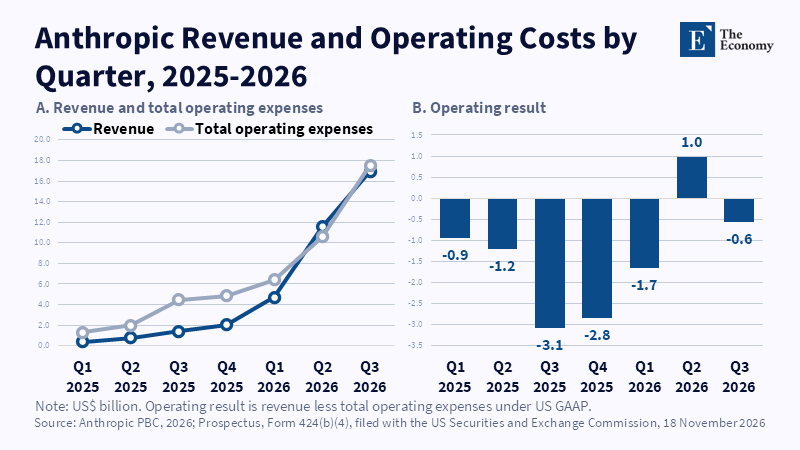
In a question submitted online, Keith Lee, Executive Editor of The Economy Review, asked whether Europe could build competitive, commercially viable frontier models when leading US and Chinese developers still faced difficult profitability and funding questions. He also asked whether Europe should instead build businesses around leading global models and negotiate reliable access. Published accounts complicate the premise. Anthropic's 18 November 2026 prospectus reports nine-month revenue of $33.2 billion, up from $2.5 billion, a $1.26 billion operating loss and $4.08 billion in adjusted operating income, excluding stock compensation and non-cash charitable charges. Operating cash inflow was $6.57 billion, which does not by itself establish independence from external finance. Quarterly revenue rose from $376 million in early 2025 to $16.96 billion in the third quarter of 2026, when expenses of $17.52 billion produced a $567 million operating loss after a $974 million profit in the preceding quarter. That reversal included a $2.0 billion non-cash donation-matching charge and $5.0 billion of expensive short-term compute. Adjusted quarterly operating income still rose from $2.24 billion to $2.46 billion, although its margin narrowed from 19% to 15%.
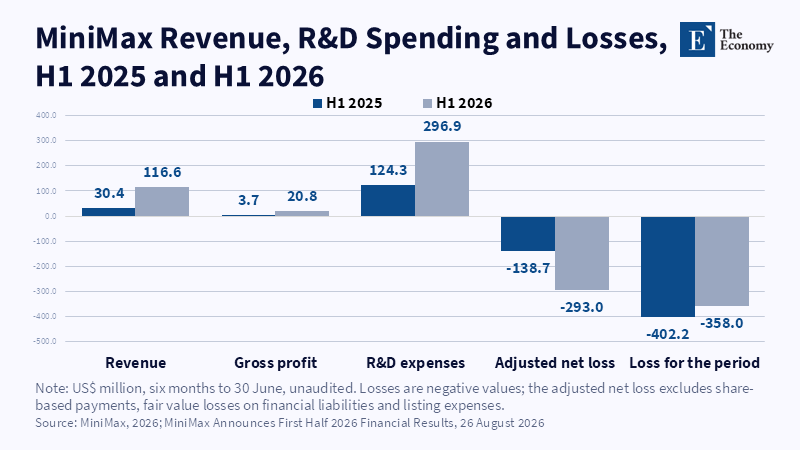
MiniMax, one of China's better-known model developers, shows a different position. Its first-half 2026 results report revenue of $116.6 million, almost four times the $30.4 million of a year earlier, and research and development spending of $296.9 million, with the increase driven mainly by cloud-computing costs for training. The adjusted net loss rose from $138.7 million to $293.0 million, even as gross margin improved to 17.9%. The reported IFRS loss, however, narrowed from $402.2 million to $358.0 million, mainly because fair-value charges fell. The distinction matters when comparing earnings measures. Neither company settles the general case. Improving profitability at an established developer does not itself establish the case for a European challenger, and losses at a challenger elsewhere do not prove that every new entrant must fail. Both sets of accounts show the continuing cost of development, while the ability of a European entrant to finance that cost remains a separate question. Efficiency gains of the DeepSeek kind can also benefit incumbents.
A European frontier programme therefore faces a plain financial test. After serving its customers, could the business fund the next model under plausible assumptions, and what would happen if a competitor cut prices, a large customer switched or the next generation cost twice as much as this one? Equity investment, public grants, guarantees and procurement commitments put that risk on different balance sheets. The EU's AI Gigafactories tender, opened on 30 July 2026, offers up to €10 billion in EU and national funding for up to seven facilities, intended to unlock at least €20 billion of private investment. The updated tender deadlines run to 30 December 2026 and 4 February 2027. The programme supports computing infrastructure and purchases access time; it does not by itself create a competitive model or establish sufficient demand. As The Economy's work on AI infrastructure financing explains, the return depends on usable capacity, customers and operating costs over many years.
Sovereignty Has to Name the Dependence It Is Paying to Reduce
The strongest argument for a European model concerns control rather than profit. A foreign provider could restrict access, change its terms or stop releasing useful models. Discussion at Chatham House argued that holding today's open weights still leaves Europe dependent on whoever trains tomorrow's, and raised development partnerships, including with Chinese firms, as a possible response. Another position was that open-weight models from the United States, China, Taiwan and Europe already cover many needs and that deployment deserves priority. The discussion also raised the prospect of frontier developers absorbing businesses built on their models, a strategic risk worth pricing rather than an established forecast.
These concerns can justify keeping research capability in Europe and funding specific systems that must run independently. Scientific spillovers and the continuity of critical services carry value that no revenue line captures. SIAI's September 2026 research paper on Europe's place in the AI value chain proposed a CERN-style open-model institution supported by public research funding and defence demand. That proposal identifies an institutional purpose and a prospective source of demand, giving it a more specific rationale than a model's nationality alone. It still has to pass the tests set out here: which capabilities require European development, what performance users need, how much procurement can be committed and what recurring budget is justified against alternatives. An open research institution can deserve support without being a self-financing commercial frontier champion, but that distinction does not make its costs disappear.
The alternatives deserve the same scrutiny. Diversified suppliers, locally operated open models, specialist development and joint research can address parts of the risk, potentially at lower cost. The OECD's May 2026 report on AI openness finds that running and adapting models locally can improve control and support downstream firms. Its cost advantages depend on workloads, utilisation and internal expertise, while local hosting still leaves reliance on hardware suppliers and future model development. Market size and regulatory influence, the levers Keith Lee's question identified, strengthen Europe's hand in negotiating access but cannot guarantee that every technology stays available. The productivity opportunity extends through industrial workflows, proprietary data, integration and the products European firms sell, where The Economy has argued that firms can capture value from AI. An EIB working paper published in January 2026 estimated a roughly 4% firm-level labour-productivity gain from AI adoption using 2019–2024 data, with benefits concentrated in medium and large firms and linked to complementary investment. This is a level effect estimated for broad AI adoption, not an annual growth rate or a measured payoff to owning a frontier generative model. The Commission's Apply AI Strategy already directs support towards industrial adoption, skills, open solutions and specialist systems, so the policy question concerns priorities and execution rather than a missing chatbot.
Table 1. Why Each Rationale for a European Frontier Model Needs Its Own Test
| Rationale | Evidence required | Implication for a European frontier model |
|---|---|---|
| Commercial returns | Repeat paying customers, differentiation and economics that sustain development | A possible business, but nationality alone establishes no necessity |
| Productivity gains | Measurable gains after integration, operating and adjustment costs | Often achievable with models developed elsewhere |
| Strategic and scientific value | An important capability or spillover, comparison with credible alternatives and the continuing cost | Can justify selective support, not a general frontier race |
Deployment Comes First and a Frontier AI Model Must Earn Its Place
Public money should go first to productive deployment and to strategic capabilities that can be named, each with a defined user and a continuing budget and a European frontier programme should receive support only where its added commercial, scientific or security value justifies a recurring cost against credible alternatives. That verdict could change. Durable global demand for a European model, a material cost advantage, research spillovers that can be demonstrated or a critical dependency that no alternative can address would each strengthen the case and the growth of Mistral's paying customer base is one place where the first of these would show. Europe does not have to own the model behind every productivity gain. It does have to know which dependencies it can live with, which it cannot and what reducing them costs and until a frontier-model programme can name its customers or justify its strategic purpose at that price, being European is not a sufficient reason to finance it.
This independent series by The Economy Review examines questions on the agenda of the Chatham House Berlin Conference 2026 and develops the publication's earlier research. The articles draw on conference discussions and public sources. The analysis and conclusions are those of the authors; references to the conference do not imply endorsement by Chatham House.
References
Anthropic PBC (2026) Prospectus, Form 424(b)(4). US Securities and Exchange Commission, 18 November.
DeepSeek-AI (2025) DeepSeek-V3 technical report. arXiv 2412.19437v2, 18 February.
European Commission (2026a) Apply AI Strategy. Updated 25 November.
European Commission (2026b) EU launches AI gigafactories call to boost Europe’s computing capacity and unlock more than €30 billion. 30 July.
EuroHPC Joint Undertaking (2026) Call for tenders for the selection of Artificial Intelligence Gigafactory Consortia and the establishment of AI Gigafactories. Updated 25 November.
European Investment Bank (2026) AI adoption, productivity and employment: Evidence from European firms. Economics Working Paper 2026/02, 13 January.
Eurostat (2026) EU population continued to grow in 2025. 10 July.
HSBC (2025) HSBC and Mistral AI join forces to accelerate AI adoption across global bank. 1 December.
MiniMax (2026) MiniMax announces first half 2026 financial results. 26 August.
OECD (2026) Benefits of AI openness. Paris: OECD Publishing.
SIAI Research (2026) Europe in the AI value chain: Fiscal limits, untapped talent and the case for open weights. 21 September.
The Economy Research (2026) Europe’s AI compute gap: Why strategic leverage matters more than hyperscale parity. 26 May.
The Economy Review (2026) When AI makes copying cheap: Can Europe rewrite its comparative advantage?. 15 November.
Working across research, policy, and data-driven analysis, the Editorial Board ensures that published pieces reflect a consistent institutional perspective grounded in quantitative reasoning and long-term structural assessment.