[European Strategic Autonomy] Europe's Innovation Gap: Who Can Afford to Take Risks?

Working across research, policy, and data-driven analysis, the Editorial Board ensures that published pieces reflect a consistent institutional perspective grounded in quantitative reasoning and long-term structural assessment.
Authored On
Modified
Start-up risk is harder to diversify for workers than investors
Scale-up finance and safer career moves should be assessed together
Investment policy needs evidence of hiring, recovery and growth

A hypothetical engineer in Munich, eight years into a career at a large automotive supplier, has an offer from a battery-software start-up with eighteen months of cash in the bank. The salary is a little lower, the equity is illiquid and uncertain and, in Germany's broader business economy, fewer than six in ten enterprises born in 2021 were still active in 2024. For the fund behind the start-up, the venture is one position among thirty. For the engineer, one job and a career trajectory are at stake. The decision depends not only on the expected payoff but on what happens if the firm folds: how long it takes to find comparable work and what happens to future employer pension contributions, unvested benefits, seniority and access to training. Europe's innovation gap is usually described as a shortage of capital. The investment discussion at the Chatham House Berlin Conference on 25 November concentrated on finance and market integration, while the personal cost of changing jobs remained less developed. An investment strategy that leaves that question out can end up funding ventures it cannot staff.
The Cost of a Failed Move Falls on the Employee
The Economy's November analysis, Europe's Innovation Trap, argued that mature industrial economies make entrepreneurial risk expensive even when unemployment is low, because what a worker prices is the cost of a move that goes wrong rather than the bare chance of being jobless. This article extends that analysis by asking what the distinction means for investment policy. A working paper released by Danmarks Nationalbank on 9 October 2026 develops a theory in which lower job-loss costs reduce the wage premium workers require to join risky young firms, encouraging experimentation. Danish employer–employee data and a randomised survey experiment provide evidence consistent with that mechanism. The productivity gains belong to the model; the paper does not establish that a particular reform will deliver them across Europe. The central bank states that the views in its working papers belong to their authors rather than to the institution.
Nothing in the mechanism requires European engineers to be more timid than Californian ones. A stable employer can offer serious training and complex work and many workers are right to stay where they are. The policy question is narrower: whether the cost of a transition blocks moves that would pay off for the economy even when they do not pay off for the person who makes them.
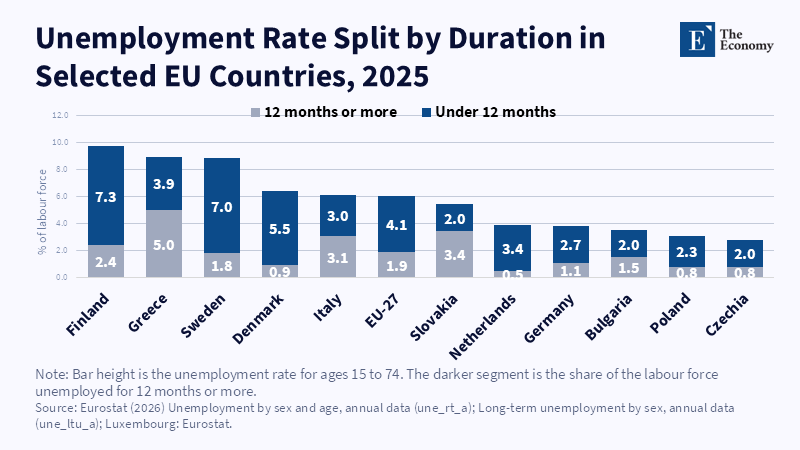
Headline unemployment rates capture transition risk badly. Denmark's rate in 2025 was 6.4%, above the EU's 6.0%, yet only 14.1% of unemployed people aged 15–74 had been out of work for a year or more. Slovakia's rate was lower at 5.4%, but 63.4% of its unemployed were long-term cases, against 50.3% in Italy and 55.8% in Greece. A low unemployment rate can therefore coexist with a large long-term share. That is relevant background for a prospective recruit, although the share does not measure how quickly a newly displaced start-up employee finds comparable work.
Scale-Up Finance Is Still the Better-Documented Gap
The financing case loses none of its force once the worker enters the picture. The ECB's Economic Bulletin of August 2026 found the venture gap with the United States widest in later funding rounds, when capital needs rise, and observed that foreign investors often supply the extra money EU scale-ups need while foreign acquisitions and listings remain common exits. The EIB's 2024 study examined 261 EU-headquartered firms that reached valuations of $500 million to $10 billion during 2013–23. Among exits in that sample, non-EU buyers accounted for more than 60% of acquisitions and 38% of IPOs took place outside the EU, with the United States the preferred destination. The EBRD's Transition Report 2026–27, published on 17 November, adds evidence from its regions: growth-stage finance is thin and tends to be concentrated in one metropolitan area per economy, while later rounds come largely from abroad. Firms that scale are more likely to have internationally experienced founders and at least one foreign investor, although those associations do not establish causation.
Discussion at the Chatham House Berlin Conference 2026 added texture more than new figures. Venture capital was described as smart money, valued for the advice and pressure that come with it. The investment session also heard how businesses seek London or Silicon Valley because valuations reflect the market they can reach and the cost of expanding within a fragmented Europe. The China discussion raised a different possibility on the labour side: a more hostile US environment for Chinese university students could make European destinations more attractive. That was an assessment of a potential opening, not evidence of a general shift in global talent flows. The Economy's reading is that attracting finance and attracting people are related tasks whose incentives should be examined separately.
Keith Lee, Executive Editor of The Economy Review, submitted an online question asking how Europe can strengthen ambition, work ethic and competitive drive without compromising labour standards, given the intensity of competition from Chinese researchers and workers, sometimes at the expense of working conditions. The evidence here directs attention to incentives as well as temperament: a failed attempt is easier to contemplate when its personal cost is lower. Separately, the investment discussion at Chatham House highlighted the 28th regime. The Commission's EU Inc. proposal of 18 March 2026 would provide an optional company form and employee stock options with taxation deferred until the acquired shares are disposed of. The Council adopted its negotiating position on 23 October, limiting that special tax treatment to qualifying companies with fewer than 750 employees and annual turnover no higher than €150 million. Parliament's procedure file still awaited a committee decision as of 27 November, and the Council proposed 21 months for implementation. Employment and social protections would remain applicable; the proposal would change the timing of option taxation without generally harmonising national tax rates.
Finance and Labour Mobility Belong in One Investment Decision
Capital and recruitment are usually handled as separate files, which hides how they interact. A young firm rests on four separate bets: an investor decides whether to fund it, an employee whether to join, a founder whether to start again after a failure and a first customer whether to rely on an untested supplier. Each bet has its own risk bearer and calls for its own instrument, so a package built only for the first leaves the other three to chance.
Table 1: Four Decisions in a Young Firm and What Each Needs
| Decision | Risk bearer | Proposed instrument | Evidence of success |
|---|---|---|---|
| Fund the venture | Investor | Late-stage co-investment and guarantees, released by milestone | Follow-on private rounds without further public money |
| Join the venture | Employee | Portable occupational benefits and continuity of cover; stock-option tax deferred until share disposal | Time taken to fill posts; share of staff back in comparable work within a year of a closure |
| Start again after failure | Founder | Quick insolvency and discharge; unemployment cover for the self-employed | Repeat founding; access to credit after closure |
| Buy from the venture | First customer | Staged public procurement tied to performance milestones | Contracts renewed on commercial terms |
The strongest objection is that the financing gap and the recruitment gap may overlap substantially. A better-capitalised firm can pay market wages, survive longer and offer equity with a more credible exit, each of which can reduce the premium a worker demands without changing labour law. If capital scarcity explains the hiring difficulty, a separate programme for workers risks adding administration without resolving the binding constraint. The Economy's earlier analysis of the AI market in Europe makes the related point that resources need to be matched to the obstacle they are intended to remove. A useful test here is whether firms that have just closed a substantial funding round still struggle to recruit, compared with otherwise similar firms and labour markets.
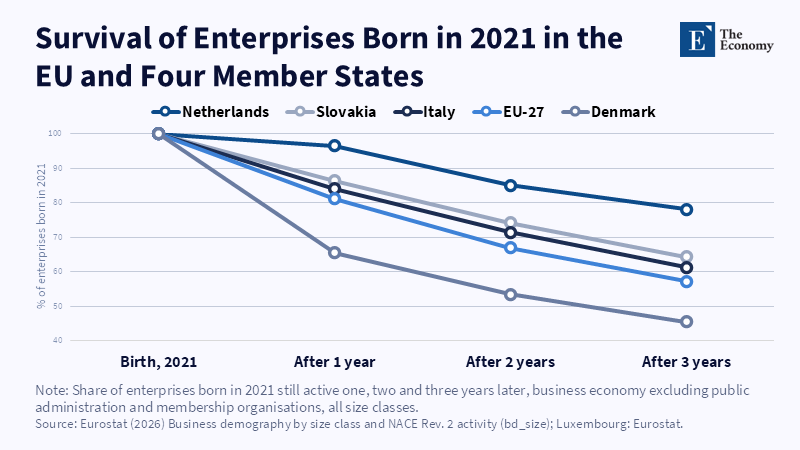
Survival data show why enterprise stability and workers' labour-market prospects need separate measures. Of the enterprises born in the EU business economy in 2021, 57.2% were still active in 2024. Denmark's survival rate was 45.4%, the lowest among the countries compared here, while its long-term unemployment share in 2025 was only 14.1%. The Netherlands combined 78.1% enterprise survival with a long-term unemployment share of 13.7%; Italy and Slovakia had higher survival than Denmark but much larger long-term shares. The enterprise series covers industry, construction and market services, with most firms having no employees at birth. Registration practices, industrial composition and breaks in some national series also affect comparisons. The figures show that enterprise survival and the prevalence of long-term unemployment need not rank countries in the same order. They concern different years and do not track the same people, so they cannot establish how quickly employees of failed ventures regain comparable work.
The EBRD's conclusions point to a mix of instruments, favouring guarantees, co-investment and deeper domestic and regional capital markets over subsidies to individual businesses. The Economy's June analysis of space funding argued that public money should grow more demanding as technical and commercial uncertainty falls, through staged commitments, and that logic carries over to start-ups. Protecting a worker's ability to move is different from protecting a particular company. The lasting policy commitment should be to mobility and recovery; support for individual firms should remain conditional on performance and additionality.
The Berlin Debate Measured Capital Better Than It Measured Risk
Against the questions this article set out to test, the investment discussion was strongest on capital and did not develop employee-transition risk. Proposals centred on market integration, a European company regime, safe assets and the route from venture funding to a listing. Attitudes towards risk appeared in a contrast between American ambitions of getting rich and European hopes of a secure retirement, with greater optimism about younger generations, particularly in emerging Europe. The later AI discussion suggested that repeated failed start-ups may be treated as experience in Silicon Valley while discouraging European founders. These were observations about incentives and culture, not evaluations of worker protections. EU Inc.'s stock-option scheme supplies one concrete employee-facing proposal from the wider policy debate, but its eligibility and final terms remain unsettled and it would not insure employees against losing their jobs.
The session did not present an evaluation showing whether the proposed measures changed recruitment or recovery after failure. A founder speaking from the floor described EU funding applications and administrative procedures as a burden, while another question asked whether public lenders crowd out private finance. The reply described an internal additionality test and a concern that Europe has too little funding rather than too much. An ex ante test cannot by itself establish whether a supported firm subsequently hired, experimented or grew differently; that requires follow-up evaluation and a credible comparison with what would have happened without support. Such assessment is not absent from development finance: an EIB evaluation published in March 2026 examined required ex-post assessments and identified gaps in their completeness and consistency. The remaining question here is who carries which risk. Investors can spread financial losses across a portfolio, public exposure depends on the guarantee or investment involved and employees face separate earnings and career-transition risks shaped by their labour market and social protection.
A Package Should Name the Test It Could Fail
The investment discussion did not establish whether better funding alone resolves recruitment difficulties or present an evaluated employee-transition scheme, so the labour-policy claim remains conditional. The order of priorities should follow the evidence for each market. Late-stage finance comes first where hiring difficulty clearly follows from capital scarcity. EU Inc.'s proposed tax deferral could ease the cash cost of receiving employee equity, but final eligibility, legislative agreement and implementation still need to be settled; an end-2026 political target is not an operating date. Benefit portability and routes back into work should be assessed alongside finance where transition costs remain a barrier. Existing rights already protect some accrued benefits, so the task is to identify and test the gaps rather than assume that every move starts without protection.
Each element should be judged on outcomes that announced money cannot imitate: how long supported firms take to fill posts, what share of their staff are back in comparable work within a year of a closure, whether private investors follow public money into later rounds and whether products reach paying customers. Generous insurance has a price in taxes, administration and safeguards against abuse and stronger employment protection can slow the reallocation the strategy is supposed to speed up. Whether a package that passes these tests costs less than the experiments Europe now forgoes is something the available data cannot yet settle.
This independent series by The Economy Review examines questions on the agenda of the Chatham House Berlin Conference 2026 and develops the publication's earlier research. The articles draw on public sources and, where indicated, discussions at the conference. The analysis and conclusions are those of the authors; references to the conference do not imply endorsement by Chatham House.
References
Baumann, A., Gati, Z., Vinci, F. and Wolf, G. (2026) Europe's venture capital gap and the financing of high-growth firms. ECB Economic Bulletin, Issue 5/2026, 4 August.
Chatham House Berlin Conference (2026) Investment and China discussions, 25 November; AI discussion, 26 November. Conference recordings, transcripts and online audience questions.
Faccini, R., Kim, S. and Miranda, J. (2026) Safety in Unemployment and Risky Experimentation of Young Firms. Danmarks Nationalbank Working Paper 224, 9 October.
European Bank for Reconstruction and Development (2026) Transition Report 2026–27: Foreword and Executive Summary. London: EBRD, 17 November.
European Commission (2026) EU Inc.: A new harmonised corporate legal regime. Proposal COM(2026) 321 final, 18 March.
European Commission (n.d.) Supplementary pensions. Guidance on existing protections and limits of portability.
Council of the European Union (2026) EU Inc: Council adopts position on a new EU corporate law for innovative companies, 23 October; negotiating text ST 14376/2026, Articles 78–79.
European Parliament (2026) Legislative Observatory: EU Inc., procedure 2026/0074(COD). Status checked 27 November.
European Investment Bank (2024) The Scale-Up Gap. Luxembourg: EIB; sample and exit findings, pp. 4–5 and 15–18.
European Investment Bank (2026) Evaluation of the Additionality and Impact Measurement framework. Independent evaluation, March.
Eurostat (2026a) Business demography by size class and NACE Rev. 2 activity (bd_size). Three-year survival of the 2021 cohort observed in 2024; scope and methodology.
Eurostat (2026b) Long-term unemployment by sex, annual data (une_ltu_a). 2025, total sex, ages 15–74, percentage of unemployed people.
Eurostat (2026c) Unemployment by sex and age, annual data (une_rt_a). 2025, total sex, ages 15–74, percentage of the labour force.
The Economy (2026a) 'Artificial Intelligence Market in Europe: Compute, Adoption and the Scale Gap'. The Economy Review, 30 September.
The Economy (2026b) 'Chinese automakers expand European production, but local labor rules pose an unexpected hurdle'. The Economy, 25 November.
The Economy (2026c) 'Europe's Innovation Trap: When Industrial Maturity Makes Risk-Taking More Expensive'. The Economy Review, 11 November.
The Economy (2026d) 'Pay Transparency Meets a Labor Market That Is Hiring Less'. The Economy Review, 11 November.
The Economy (2026e) 'Space Innovation Funding Is the Missing Half of Market-Making'. The Economy Review, 8 June.
Working across research, policy, and data-driven analysis, the Editorial Board ensures that published pieces reflect a consistent institutional perspective grounded in quantitative reasoning and long-term structural assessment.