[European Strategic Autonomy] Financing Europe's Space Autonomy

Working across research, policy, and data-driven analysis, the Editorial Board ensures that published pieces reflect a consistent institutional perspective grounded in quantitative reasoning and long-term structural assessment.
Authored On
Modified
Europe needs dependable secure communications more than full ownership
Public instruments should match the specific risk being financed
Critical services need staged support with an openly stated cost

On 16 October 2026, as Ukrainian units reported restrictions on the Starlink links their drone operations depend on, the EU's foreign-policy chief told reporters before summit talks in Brussels that in the short term "Europe can't replace this capability." The admission came nine months after the EU's pooled governmental satellite service, GOVSATCOM, began initial operations and ten weeks after the implementation agreement announced on 7 August moved its own secure constellation, IRIS², towards deployment, with first launches planned for 2029. Between those dates sits the practical problem of financing Europe's space autonomy: deciding which services Europe must obtain on its own terms, who should carry the risk of building them and how public money can buy that reliability without guaranteeing every incumbent a future. The dependency worth paying to remove is specific: secure links, including those used to relay surveillance data, for forces in contact. Kyiv reported renewed Starshield disruptions on 12 November; SpaceX said there had been no change to its service. Discussion at the Chatham House Berlin Conference on 25 November also raised dependence on US technology, including Starlink. For secure communications, the financing test begins with the military requirement rather than the whole commercial market.
Space Autonomy Is a Service Requirement Before It Is an Ownership Target
Secure communications carry the argument best because their failure is easy to picture. A border agency or a brigade that loses its satellite link during a crisis loses coordination at the worst moment and the useful question is less whether every satellite, ground station and chip is European than whether the service stays encrypted and available when a supplier outside European jurisdiction decides otherwise. Ownership is one way to secure that. Contracted capacity from several providers, pooled national assets and pre-agreed fallback arrangements are others, potentially at lower cost depending on the service required.
Substitution speed is where the Ukrainian case teaches most. Switching from Starlink to OneWeb would require compatible user terminals as well as available orbital capacity; replacing equipment at scale adds time and expense. Civilian dependence has grown at the same time: the European Space Agency reported nearly 2 million Starlink broadband subscribers in Europe at the end of 2025, up from 850,000 a year earlier.
A larger commercial market does not by itself guarantee the secure access governments need. EUSPA's EU Space Market Report, published on 26 May 2026, expects annual data-service revenues from EU users of secure satellite communications to rise from just over €200 million in 2025 to nearly €1.2 billion by 2040. This is a relatively small secure-connectivity market, but an annual segment forecast cannot be compared directly with IRIS²'s multi-year investment cost or treated as its entire addressable market. The financing case requires a realistic account of government purchases, commercial revenues and operating costs. EUSPA presented the report as evidence of what the sector means for Europe's economy, resilience and autonomy. The strategic claim is fair, yet the wider benefits of navigation, observation and connectivity do not automatically accrue in full as operator revenue or tax receipts for the sponsoring government. Forecasts for separate segments also need to be checked for scope and overlap before being used to size an addressable market.
The strongest objection is that established international providers may be cheaper and more reliable than a new European system. A premium for autonomy becomes defensible under narrower conditions: when interruption can be decided by a foreign government or a single owner, when sensitive operations require European control of encryption and ground segments, or when redundancy across suppliers is itself what is being bought. Each is an appraisal question with a price attached and no fixed percentage settles it in advance.
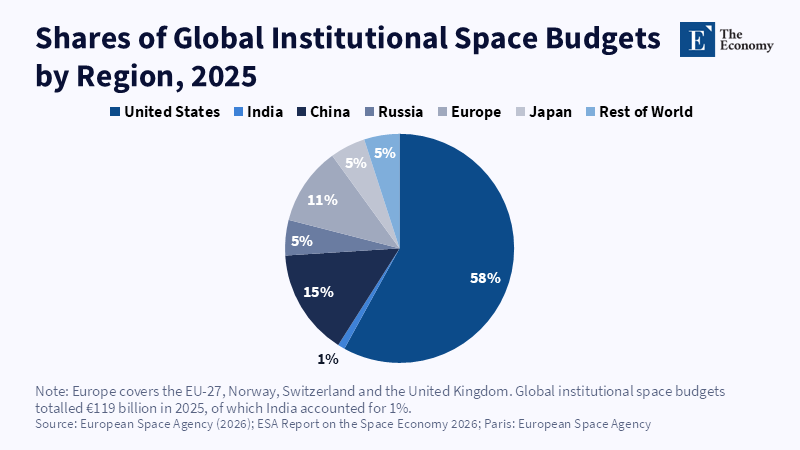
The appraisal matters because the public purse is limited. European space budgets rose 12% to €13.5 billion in 2025, driven mainly by national defence spending led by Germany, yet Europe, defined in ESA's data as the EU-27 plus Norway, Switzerland and the United Kingdom, still accounted for 11% of a global institutional total of €119 billion, against 58% for the United States.
The Instrument Has to Match the Risk Being Financed
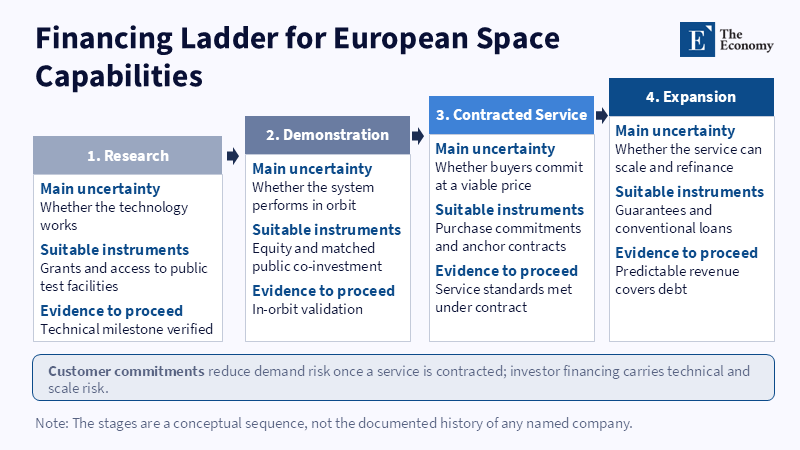
A space venture moves through stages with different uncertainties. A grant can absorb the technical risk of research because nobody expects repayment and equity suits a demonstration whose outcome is uncertain but whose upside is visible. A firm with a working system and no customers faces demand risk, which a purchase commitment addresses directly. Guarantees and conventional loans are generally better suited to firms with credible repayment capacity, while contingent loans and venture debt can be structured for earlier stages. A publicly backed loan to a company without revenue requires explicit risk-sharing and a credible route to repayment; otherwise it can defer recognition of losses and transfer them to taxpayers.
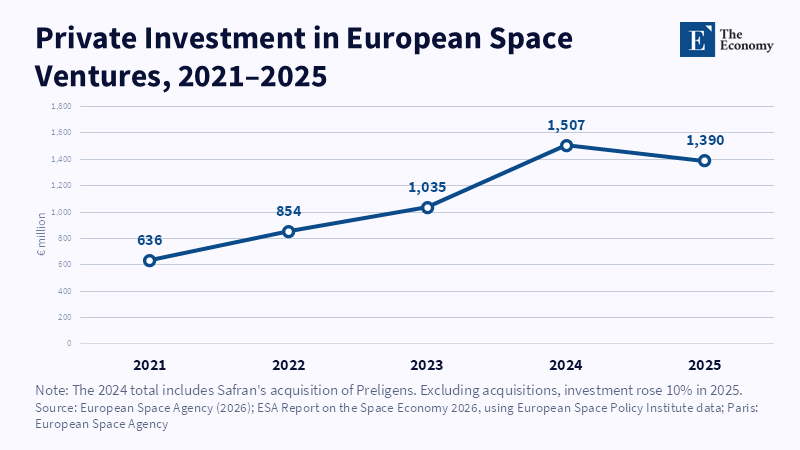
This article extends The Economy's earlier analysis in Space Innovation Funding Is the Missing Half of Market-Making, which argued that a credible government customer does not remove the need for patient, milestone-based risk finance, by examining the terms on which public money buys strategic capability. European space ventures attracted €1.39 billion in investment in 2025, down from €1.51 billion in 2024. The earlier total was boosted by Safran's acquisition of Preligens; excluding acquisitions, investment rose 10% in 2025. None of the nine European space-venture scale-up rounds tracked by ESPI in 2025 was led by a European private investor. More recent data show a recovery: European space ventures raised €1.6 billion in the first half of 2026, including €1 billion for scale-ups, according to ESPI figures reported by the EIB. The 2025 dip is therefore not evidence of a continuing decline, although the sources and terms of growth capital still matter.
The European Investment Bank's Space TechEU lending envelope of €500 million produced its first transaction, announced in July 2026: a €150 million guarantee to Intesa Sanpaolo that, with 50% risk-sharing, is intended to support €300 million of lending to about 80 space-related businesses over two years. The bank expects the envelope to mobilise up to €1.4 billion, a target rather than evidence of additional investment. In 2020 the EIB announced a €100 million contingent loan to ArianeGroup for Ariane 6, with repayments linked to the launcher's commercial success, a loan built to behave like risk capital. Each instrument should be judged by whether it brings in investment that would not otherwise happen or merely changes who absorbs the losses.
IRIS² Shows Public Money Absorbing Most of the Cost Growth
The IRIS² concession signed on 16 December 2024 gave the SpaceRISE consortium of SES, Eutelsat and Hispasat a 12-year contract to develop, deploy and operate a 290-satellite system, with the EU as anchor customer and services then planned by 2030. The Commission noted that funding beyond 2027 depended on successor programmes. The implementation agreement announced on 7 August 2026 expanded the main constellation to 348 satellites, including a 66-satellite layer for defence and security users.
Cost moved with scope. Hispasat put the total planned investment above €15.6 billion, against roughly €10.55 billion at the 2024 signing, with €11.6 billion of public funding from the Commission and ESA and up to €4 billion from the three operators, so public money now covers close to three-quarters of the programme. The detailed terms have not been audited for this analysis and an assessment would need to know how milestones are verified, who pays for delays, what service standards bind the operators, how much commercial risk the consortium retains and under what rules a supplier can be replaced.
Whatever the contract says, European governments remain exposed to the operational consequences of delay. First launches and initial government services are planned from 2029, while Eutelsat expects the commercial Ku-band low-Earth-orbit constellation to be fully operational by mid-2032. Slippage would prolong reliance on existing suppliers, whatever financial penalties the contract assigns to the consortium. Keith Lee, Executive Editor of The Economy Review, submitted an online question during the conference asking how long Europe would need to field a Starlink-class system and whether it has the talent and engineering capacity to do so in time. The interim options have limits. Operator figures put OneWeb at more than 600 satellites and Starlink at more than 11,000, although satellite counts alone do not measure service capacity or substitutability. A 2025 report by the Netherlands' Advisory Council on International Affairs gave indicative terminal prices of about €9,000 for OneWeb and €500 for Starlink. These describe different terminal ecosystems rather than a current like-for-like procurement quote. Bridge purchases belong in the wider comparison of autonomy strategies; additional costs caused by delays should be identified separately from spending that would have occurred anyway.
Shared Satellite Capability Needs Clear Owners and a Defined Exit
The parts of a secure communications service differ in how much common control they need. Encryption, government access priority and parts of the ground segment justify common European procurement, whereas terminals, launch and commercial capacity can sustain competition. GOVSATCOM plans to add commercial providers to its catalogue in 2027. Its hub already pools governmental capacity from France, Greece, Italy, Luxembourg and Spain, and Cyprus completed the first operational acquisition through it in March 2026, shared access built on existing national assets rather than a new constellation. Allied cooperation may suit other layers if governance, access rights, industrial allocation and cost overruns are settled first, the same ownership and burden-sharing questions The Economy raised about middle powers and artificial intelligence.
A workable test has three parts: the capability is needed, the intervention addresses a demonstrated obstacle and no alternative provides comparable resilience at a lower total cost. Strategic benefit should be assessed separately from employment, market growth and investor returns, which are welcome but answer a different question.
Governments already pay for secure communications, so a need for the service is established. The harder obstacle is committing enough demand and finance over time: a constellation needs money that survives several budget cycles, while EU defence spending, which the European Defence Agency put at €418 billion in 2025 and projects at €454 billion for 2026, is pulled toward munitions, air defence and the other gaps left by decades of underinvestment. Industrial scale comes next. Europe has not yet fielded an operational reusable orbital launcher, and Airbus, Thales and Leonardo signed an October 2025 memorandum of understanding to combine their space activities, targeting operations in 2027 subject to approvals and other closing conditions. Purchase commitments and multi-year funding at EU level should therefore come first, with national programmes lined up behind them instead of bidding for the same suppliers. Germany has already put a number on its own part: its defence ministry announced in September 2025 that it would spend €35 billion on military space projects by 2030, including new satellite constellations for early warning, reconnaissance and communications, and work more closely with European and other allies.
Public support can tolerate technical failure if it demands learning, competition and disclosure in return and stage gates give that bargain a shape. Some critical services may never stand on commercial revenue and continuing support for them can be justified, but it should be defended as an ongoing public purchase with a visible annual cost rather than presented as a temporary commercial subsidy that keeps being renewed.
For the rest of this decade, the workable course looks like a bridge. Europe can buy access to US and other available services on contracts with clear terms, while IRIS² is built against a dated schedule and judged by launches and service milestones. Expanding space-based intelligence, surveillance and reconnaissance presents a separate capacity gap: a June 2026 European Parliamentary Research Service briefing cited estimates of five to ten years to build sufficient capacity, contingent on political commitment and investment. This concerns the scale of capability Europe needs, not the absence of existing national reconnaissance systems. Whether governments can keep paying through that wait and admit the dependence while it lasts is not yet clear.
This independent series by The Economy Review examines questions on the agenda of the Chatham House Berlin Conference 2026 and develops the publication's earlier research. The articles draw on public sources and, where indicated, discussions at the conference. The analysis and conclusions are those of the authors; references to the conference do not imply endorsement by Chatham House.
References
Agence France-Presse (2026) Europe must tackle dependency on Starlink, EU leaders say, Courthouse News Service, 16 October.
Advisory Council on International Affairs (2025) Governing Space Safety and Security, June.
Airbus, Leonardo and Thales (2025) Joint announcement of a memorandum of understanding on space activities, 23 October.
Bundeswehr (2025) Warum ohne Weltraum nichts mehr geht, 8 October; reporting the military-space investment commitment through 2030.
Chatham House Berlin Conference (2026) Defence-industrial discussion and audience questions, 25 November. Conference recording, transcript and online chat.
European Commission (2024) Commission takes next step to deploy the IRIS² secure satellite system, 16 December.
European Commission (2026) GOVSATCOM. EU Space Programme; accessed 27 November.
European Defence Agency (2026) EU defence spending: €418 billion in 2025, projected to €454 billion in 2026, 16 July.
European Investment Bank (2020) European Commission and European Investment Bank Group join forces to boost space-sector investment, 21 January.
European Investment Bank (2026) How the EU's financing arm backs Europe's space ambitions. Luxembourg: EIB.
Clapp, S. (2026) EU joint defence capability development, European Parliamentary Research Service, June, PE 789.322.
European Space Agency (2026a) ESA Report on the Space Economy 2026, July.
European Space Agency (2026b) IRIS² reinforced and accelerated as implementation advances, 7 August.
European Space Policy Institute (2026a) Space Venture 2025. Vienna: ESPI.
European Space Policy Institute (2026b) Space Venture 2026 update, 10 September.
European Union Agency for the Space Programme (2026a) Cyprus completes first operational use of EU GOVSATCOM Hub services, 10 March.
European Union Agency for the Space Programme (2026b) EUSPA launches new EU Space Market Report, 26 May.
Eutelsat (2026a) Eutelsat to play central role in delivering the next phase of Europe's sovereign connectivity, 7 August.
Eutelsat (2026b) Eutelsat procures a further 229 OneWeb LEO satellites from Airbus, 10 September.
Hispasat (2026) IRIS² implementation and investment announcement, 7 August.
Parsonson, A. (2026) 'IRIS2 gets green light with more money and more satellites', European Spaceflight, 8 August.
President of Ukraine (2026) Statement on Starshield disruptions, 12 November; SpaceX response reported by Ars Technica the same day.
Starlink (2026) Network update, 6 October.
The Economy Review (2026a) 'Space innovation funding is the missing half of market-making', The Economy Review, 8 June.
The Economy Review (2026b) 'Middle powers and artificial intelligence: why the collective coalition remains unlikely', The Economy Review, 16 September.
Working across research, policy, and data-driven analysis, the Editorial Board ensures that published pieces reflect a consistent institutional perspective grounded in quantitative reasoning and long-term structural assessment.