[European Strategic Autonomy] What Makes Defence Production European?

Working across research, policy, and data-driven analysis, the Editorial Board ensures that published pieces reflect a consistent institutional perspective grounded in quantitative reasoning and long-term structural assessment.
Authored On
Modified
"European" defence production means five distinct, sometimes conflicting tests
Localisation brings factories faster than it brings design rights
A price premium for control needs a named benefit
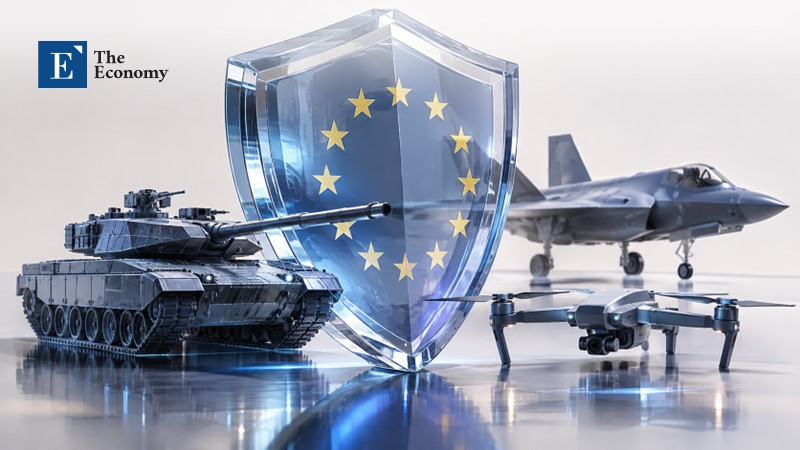
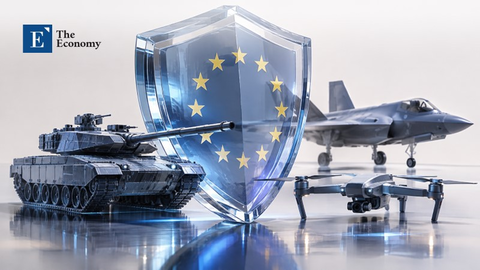
European governments want more of their weapons made in Europe, but the label conceals several different objectives. A Korean howitzer scheduled for assembly in Romania, a fighter under joint development by British, Italian and Japanese engineers and a Ukrainian drone planned for production in Germany all illustrate competing claims to the label. European defence production is now backed by serious money: EU member states spent €418 billion on defence in 2025, including €115 billion on equipment, according to the European Defence Agency. The useful question for a buyer is which mix of domestic capacity and foreign partnership gives the most dependable military options and the answer shifts with the horizon.
European Defence Production Can Be Measured in Five Different Ways
Take two purchases, both invented for illustration. In the first, a government buys armoured vehicles assembled on its own soil by a foreign group's subsidiary, yet every software upgrade and resale still needs a licence from the parent company's home government. In the second, it joins a multinational programme in which its engineers help design the system and its industry shares the right to change it later. The first looks more European on a factory map; the second gives more say late in the equipment's service life, when much of its cost is paid.
Five separate tests sit behind the word. One is where production takes place and another is who controls the contractor. A third is where the important components come from, since a locally assembled system can still hang on one imported seeker or engine. The fourth, usually the least visible, is who holds the right to modify, upgrade and sustain the equipment and the fifth is whether supply continues when a crisis arrives and producers face competing national priorities. These are The Economy's analytical categories rather than legal criteria and they often point in different ways.
EU funding rules choose among them. The SAFE regulation, adopted on 27 May 2025, offers up to €150 billion in long-maturity loans for common procurement. Under its basic rule, components from outside the EU, the EEA-EFTA states and Ukraine may account for no more than 35% of an end product's estimated component cost. Local sourcing alone does not make a Korean or American supplier eligible: contractors must also meet requirements on establishment, executive management, control and facilities. A foreign-controlled subsidiary established in the eligible area can participate under verified safeguards. For category 2 systems, including air and missile defence, larger drones in NATO classes 2 and 3, space assets and electronic warfare, contractors must also have authority over design changes, including the ability to replace restricted components. That writes the fourth test into law. The European Defence Industry Programme, adopted on 8 December 2025, provides €1.5 billion in grants for 2025–27 and the EU's first security-of-supply framework for defence. Neither instrument prohibits a government from using national funds to buy equipment from an ally; these eligibility rules determine access to EU-backed support.
A preference for European content has real security value, since domestic industrial depth can reduce exposure to another government's export controls and inconvenience to exporters does not make a rule unjustified. What can be tested is whether each requirement is proportionate to the dependency it targets. This article extends The Economy's earlier analysis of how 'Buy European' arms rules shut out South Korea and Japan by asking the question from the buyer's side.
Localisation Brings Factories Sooner Than It Brings Design Rights
Imports of major arms by the 29 European NATO states rose by 143% between 2016–20 and 2021–25, SIPRI reported, with the United States supplying 58% in the latter period and South Korea, at 8.6%, the second-largest source. Poland accounted for 17% of those imports; South Korea supplied 47% of Poland's imports and the United States 44%. These are shares of SIPRI's measure of major-arms transfer volume, not expenditure or all procurement, and they exclude domestically produced equipment.
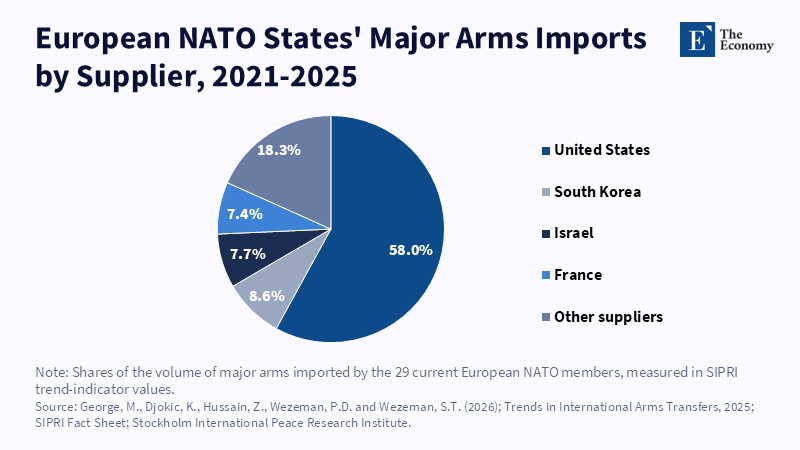
Korean suppliers have responded by localising. In a 12 February 2026 announcement, Hanwha Aerospace reported groundbreaking at Petrești in Romania on what it calls its first production site in Europe, planned for assembly, integration, testing and lifecycle support of the K9 howitzer and K10 resupply vehicle. The company targets up to 80% localisation through more than 30 Romanian partners and says the facility is scheduled to become operational in 2027. The groundbreaking establishes an investment and an intended role. It does not establish actual output, how much design authority will move to Romania or whether Romanian-built vehicles could be re-exported without Seoul's approval. Nor can the localisation target be treated as proof that SAFE's separate component-origin calculation has been met.
The Economy's October analysis of Korean groups moving into Europe separated assembly from component origin and from control and the distinction still holds. Once operational, a Romanian plant would improve the production-location test and may improve local repair, but modification rights and continuity of supply also depend on licensing and support arrangements not established by these announcements. A government buying K9s for urgent replenishment can accept that uncertainty more easily than one planning a twenty-year artillery force around them.
Shared Design Authority Pays Off Over Decades but Cannot Fill an Urgent Gap
The development route trades speed for rights. Edgewing, launched on 20 June 2025 by BAE Systems, Leonardo and Japan Aircraft Industrial Enhancement, is the design authority for the Global Combat Air Programme aircraft for the life of the product, expected to run beyond 2070. It received a £4.6 billion contract on 3 July 2026 covering design and development to the end of 2027, with service entry targeted for 2035. The Economy's earlier work on Japan's move from technology supplier to co-developer argued that a seat in design governance can outweigh any share of assembly. GCAP is financed from British, Italian and Japanese national budgets; its governance does not establish eligibility for EU procurement funding.
Co-development carries high technical risk, requires coordination among three governments and does nothing for a country that needs air-defence interceptors next year. Discussion at the Chatham House Berlin Conference 2026 advanced the case for future joint programmes led by two or three nations sharing one design, rather than large groups bargaining over industrial packages, and cited the German-Norwegian submarine programme. Its first boat is due in Norway in 2029. On 6 July 2026, Canada's government selected TKMS as the preferred supplier for negotiations over up to 12 boats of the same Type 212CD design. That selection was a step towards a contract, not a completed purchase.
A third route took shape in the week of the Berlin conference and reverses the usual assumption about who supplies the design. On 24 November, Ukraine's defence ministry announced that German and Ukrainian companies would form a joint venture in Germany to build several thousand Ukrainian-designed reconnaissance drones in 2027, with Germany financing production, capacity and further support. German-Ukrainian industrial cooperation also came up in discussion at the conference. The ministry counts the venture as its twelfth joint production project with partner countries. Ukraine is an eligible origin under SAFE's basic rules, but the announcement does not disclose the full component mix or contractual rights over design changes, intellectual property and exports. Ukrainian technology alone therefore establishes neither SAFE eligibility nor who will control future modifications. Whether this route gives a buyer more autonomy than a Korean howitzer built in Romania depends on those terms.
Table 1: Four Routes to a European Defence Capability Compared
| Route and example | Delivery horizon | Local sustainment | Design authority | Export permissions | Unresolved evidence |
|---|---|---|---|---|---|
| Existing foreign-led system: F-35 | Set by production schedules and the buyer's order | European facilities within the US-led global support system | US-led programme; modification rights depend on programme arrangements | Transfers remain subject to applicable US export approvals | Spares, software and upgrade access in a crisis |
| Local assembly or licensed production: Hanwha K9 plant in Romania | Facility scheduled to become operational in 2027; output ramp-up remains to be demonstrated | Planned assembly, testing and lifecycle support in Romania | Licence terms not established by the public announcements | Re-export arrangements not disclosed | Licence terms, origin of critical components, actual output |
| Joint development: GCAP through Edgewing | Long; service entry targeted for 2035 | Future arrangements across the three partner countries | Multinational design authority for the product's life | Subject to partner-country export controls and programme arrangements | Cost, schedule and terms for third-country buyers |
| Partner design built in Europe: Ukrainian reconnaissance drones in Germany | Short; several thousand planned for 2027 | German funding includes further support; arrangements not disclosed | Ukrainian technology; contractual control not disclosed | Not disclosed | Component origins, modification rights, volumes after 2027 |
Defence Spending Has Outrun Europe's Ability to Buy and Build Together
Equipment spending in the EU rose 26% in real terms in 2025, yet the EDA reports that only 24% went through collaborative procurement, including arrangements with non-EU partners. Its European-only collaborative procurement series recorded 11%, based on returns from 19 member states, against the 35% European collaborative benchmark set in 2007. Discussion at Chatham House identified industrial capacity as a binding constraint, criticised earlier joint programmes for bargaining over national work shares and questioned national standards where a NATO standard would suffice. Industry's contribution stressed that firms need reliable, long-term orders to expand production. SAFE normally requires at least two participating countries, although a transitional exception covers single-state contracts signed by 30 May 2026, and procurement still runs through national systems. The financing is moving: by 29 October, the Commission reported 16 loan agreements and almost €13.5 billion disbursed to 11 member states, alongside a further €21.3 billion call for proposals. These figures establish financial progress, not how much additional production capacity or usable equipment the loans have delivered.
The conference's investment discussion also raised the difficulty small countries face in offering contracts large enough to attract producers and the paperwork that can exclude start-ups. The EBRD's Transition Report 2026–27, published on 17 November, found that about 18% of defence technology firms in emerging Europe with pre-seed or seed funding had reached Series A or beyond, compared with 42% in advanced Europe and 50% in the United States. These are observed financing stages in the report's Dealroom dataset, not eventual failure rates for all firms; emerging Europe also extends beyond the EU.
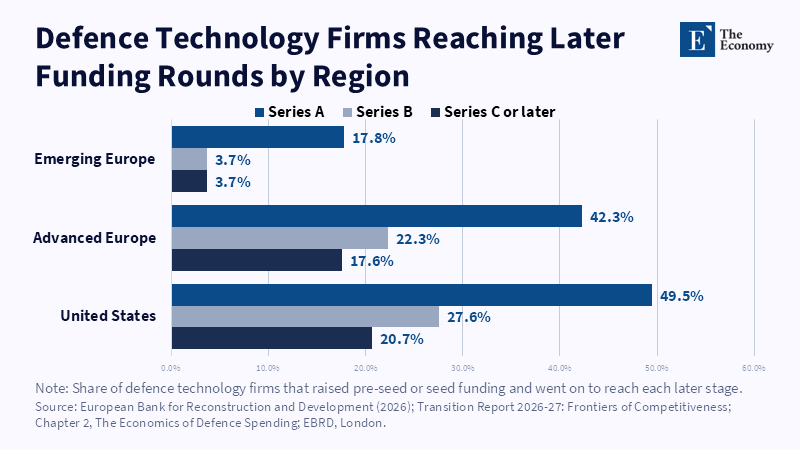
The Economy's reading of the Berlin discussions is that Germany has started to accept a larger production role for the continent while still correcting its own years of underinvestment. Frontline states meanwhile have strong reasons to prioritise suppliers that can deliver soonest. The investment discussion at Chatham House also called for European interests to take precedence over national approaches where scale determines competitiveness.
A Premium for Control Has to Buy a Benefit Someone Can Name
A buyer may rationally pay more for local repair, wider modification rights or a supply chain that survives a blockade, but a factory address alone is weak evidence of continuity of supply. Chatham House analysis published on 6 July 2026 reported that US officials had privately warned Britain, Poland, Lithuania, Estonia and Germany that orders from American contractors would probably be delayed while the United States rebuilt its stocks after the Iran war. Discussion in Berlin also included industry's assessment that US counterparts want Europe to expand capacity because American production cannot meet domestic demand. These accounts expose a risk to continuity of supply even between allies and strengthen the case for diversifying suppliers.
Immediate availability comes from stockpiles and warm production lines wherever they are, capacity growth comes from multi-year orders large enough to justify new plants and lasting authority comes from modification rights, licences and design governance. Applying the same eligibility preference to all three horizons can slow urgent replenishment in the attempt to secure longer-term control.
The reciprocity argument in The Economy's earlier work still stands with a condition attached. Partners are not owed EU money, yet asking them to carry strategic exposure with no durable industrial role weakens the partnership Europe wants. The Commission confirmed requests from South Korea, Japan and Türkiye for SAFE association in December 2025; requests alone do not confer access on Canada's terms. Canada's agreement, signed on 14 February 2026, shows a negotiated bargain: Canadian components may account for up to 80% of component cost, with at least 20% originating in the EU, EEA-EFTA states or Ukraine and additional limits on other third-country content. Canada owes a 15% participation contribution on qualifying Canadian contract value where content from that European area accounts for 65% or less. The calculation deducts non-Canadian subcontracting from Canadian prime contracts and includes Canadian subcontracts under other primes; it is not simply a charge on Canadian-made components. A comparable deal with Korea or Japan would negotiate the price and conditions of access and European buyers could seek enforceable modification and support rights in return.
If SAFE contracts over the next two years produce European lines that deliver on schedule, with modification rights buyers can use, the case for accepting their eligibility costs will be stronger. If they mainly delay purchases from trusted partners without moving design authority or securing supply, the criticism grows stronger and borrowing states will bear the cost. Procurement policy would be easier to judge if each programme identified the dependency it is meant to reduce, the price of doing so and the delivery milestones that would demonstrate success.
This independent series by The Economy Review examines questions on the agenda of the Chatham House Berlin Conference 2026 and develops the publication's earlier research. The articles draw on public sources and, where indicated, discussions at the conference. The analysis and conclusions are those of the authors; references to the conference do not imply endorsement by Chatham House.
References
BAE Systems (2025) Industry partners launch joint venture company Edgewing to deliver next-generation combat aircraft, 20 June.
Chatham House Berlin Conference (2026) Investment and defence-industrial discussions, 25 November. Conference recordings and transcripts.
Chatham House (2026) Tensions between the US and Europe loom large over NATO summit, 6 July.
Council of the European Union (2025a) Council Regulation (EU) 2025/1106 establishing SAFE, 27 May, particularly Articles 4, 16 and 17.
Council of the European Union (2025b) European defence industry programme (EDIP). Policy page.
European Bank for Reconstruction and Development (2026) Transition Report 2026–27, Chapter 2. London: EBRD, 17 November.
European Commission (2025) Midday press briefing: requests for SAFE association, 12 December.
European Commission (2026) Commission invites Member States to use €21.3 billion under SAFE to boost defence readiness and support Ukraine, 29 October.
European Defence Agency (2026) Defence Data 2025–2026. Brussels: EDA, 16 July; defence-data benchmark definitions.
George, M., Djokic, K., Hussain, Z., Wezeman, P.D. and Wezeman, S.T. (2026) Trends in International Arms Transfers, 2025. SIPRI Fact Sheet. Stockholm: SIPRI.
Government of Canada and European Union (2026) Agreement on Canadian participation under the SAFE Instrument, signed 14 February, particularly Articles 5–6 and Annex, Article 2.
Government of Norway (2026) Canada enters historic submarine cooperation with Germany and Norway, 6 July.
Hanwha Aerospace (2026a) Hanwha Aerospace breaks ground on K9 production facility in Romania, 12 February.
Hanwha Aerospace (2026b) Hanwha showcases unmanned and AI capabilities at BSDA 2026 to advance European partnerships, 14 May.
HM Government (2026) Over £4 billion invested in next-generation fighter jet with new international contract, 3 July.
Prime Minister of Canada (2026) Prime Minister Carney announces preferred supplier for the Canadian Patrol Submarine Project, 6 July.
The Economy (2026a) 'South Korean Defense Groups Shift to European Production'. Strategy Review, 17 October.
The Economy (2026b) 'Japan's Defense Industry Enters Europe's Industrial Partnerships: From Technology Supplier to Strategic Co-Developer'. Strategy Review, 17 October.
The Economy (2026c) 'How "Buy European" Arms Rules Shut Out South Korea and Japan'. Strategy Review, 17 October.
Ukrainian Ministry of Defence (2026) Ukrainian reconnaissance drone production in Germany, 24 November.
US F-35 Joint Program Office (2026) Italy's Cameri visit reinforces commitment to expanding F-35 sustainment in Europe. DVIDS.
Working across research, policy, and data-driven analysis, the Editorial Board ensures that published pieces reflect a consistent institutional perspective grounded in quantitative reasoning and long-term structural assessment.