[European Strategic Autonomy] What Must Europe Offer Its Next Strategic Partners?

Working across research, policy, and data-driven analysis, the Editorial Board ensures that published pieces reflect a consistent institutional perspective grounded in quantitative reasoning and long-term structural assessment.
Authored On
Modified
Europe's wish for partners obliges no country to join
Partners judge offers by jobs, processing and access
Türkiye's limited access exposes the gap between partnership and preference
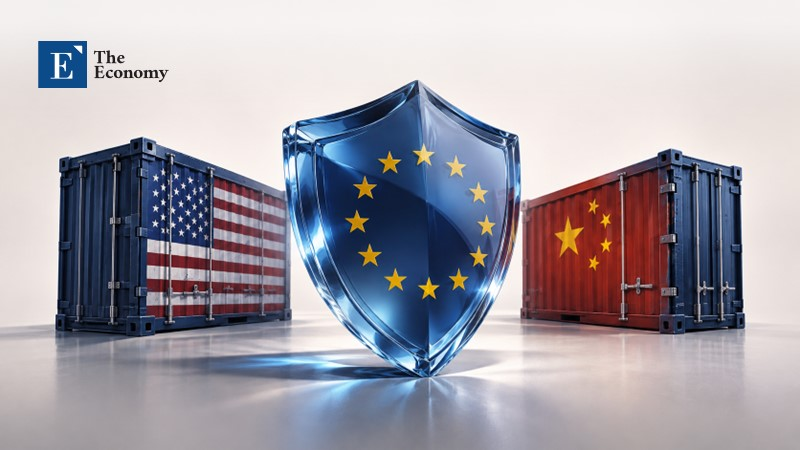
A government in Astana, Brasília or New Delhi weighing an offer from Brussels starts with its own arithmetic: how much processing stays at home, which exports gain access, who carries the construction risk and whether the deal survives the next quarrel between Washington and Beijing. Europe's wish to diversify answers none of those questions. In 2026 the EU concluded trade negotiations with India and Australia and began provisionally applying its Mercosur interim agreement. On 25 November Washington proposed new tariffs on 14 economies, South Korea, Japan and the EU among them. These developments create an opening for closer partnerships, but they do not make a European offer automatically preferable. Europe's desire for a third pole does not create demand for one led by Europe. It widens its own options only where partners gain access, investment, productive capability or security they can measure, on terms negotiated around both sides' interests rather than presented as a benefactor's gift.
Partners Judge an Offer by the Problem It Solves at Home
A prospective partner rarely starts from Europe's need to diversify. The African Union's Agenda 2063 frames the continent's goals around manufacturing, industrialisation and value addition, a skills revolution and faster integration, a list of things to build rather than things to sell. The first EU summit with the five Central Asian states, held in Samarkand in April 2025, produced a €12 billion Global Gateway package, principally covering transport, critical raw materials, water and energy. Discussion at the Chatham House Berlin Conference on 26 November 2026 gave the other side of that ledger: Central Asian states want infrastructure, easier access to European markets, industrial zones, joint production and skills. They want European engagement to add options alongside their ties with Russia and China rather than replace them. Europe wants partners to increase its freedom of action; those partners want Europe to increase theirs.
A hypothetical shows how objectives can drift apart. Suppose Europe wants a dependable supply of a battery mineral and the producer wants investment and a larger share of the value. A long-term offtake contract can secure supply and help finance investment, but it does not by itself guarantee local processing or a larger share of value for the producer. A refinery near the mine could serve both objectives if the site has reliable power, trained workers and a route to port that does not erase the cost advantage. The EU's diplomatic service made the general argument in September 2024, calling for partnerships that help producer countries build industries and add domestic value to their resources.
Local processing is neither automatically efficient nor automatically beneficial. A refinery that survives only on subsidy, or whose gains stay with a few officials while neighbouring communities absorb the pollution, is a poor outcome presented as a good one and a government's stated priorities are not the same as the preferences of people living next to the site.
Europe's Strategic Partners Now Carry Comparable Economic Weight
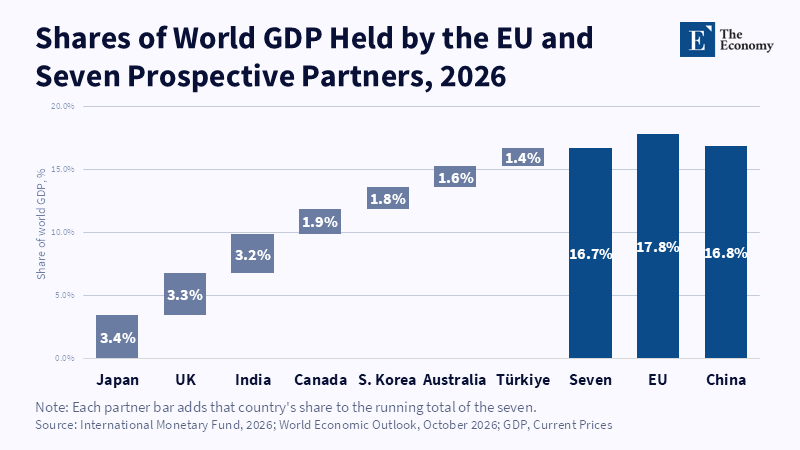
Much of Europe's partnership language still casts the Union as provider and the partner as recipient, a habit formed over decades of development aid. The economic comparison makes that hierarchy increasingly unhelpful. On the IMF's October 2026 projections, the EU accounts for 17.8% of world output at market exchange rates this year, while Japan, the United Kingdom, India, Canada, South Korea, Australia and Türkiye together account for 16.7%, close to China's 16.8%. India's share has more than doubled since 2000, to 3.2%, while the share of the same current 27 EU members has fallen from 21.2%. These are nominal GDP comparisons, with India following the IMF's fiscal-year convention. The seven countries do not form a single negotiating bloc, nor is each individually comparable in size to the EU. The point is that they collectively command substantial markets and capabilities, and each has interests Europe must address. In The Economy's reading, an offer framed as help for the needy misreads that position. A partnership must share value whether or not the parties have equal GDP.
One framework discussed at the Chatham House Berlin Conference grouped prospective partners into three circles: democracies such as Canada, Japan, Australia and South Korea; states pursuing multiple alignments, including India, Brazil, Indonesia, South Africa, Türkiye and the Gulf states; and regional bodies including ASEAN, the African Union and Mercosur. The discussion stressed that many partners want protection against coercion without being forced into a single camp, and questioned an approach that attaches political conditions to every step. This was not a unanimous description of every country's position, as the later exchange over Türkiye made clear. The reluctance to accept an exclusive alignment is visible in Kazakhstan, which has joined initiatives led by both Washington and Beijing, including the US-led Pax Silica framework, as The Economy reported in August 2026.
Keith Lee, Executive Editor of The Economy Review, submitted an online question asking what concrete economic opportunities and security commitments Europe could offer to make closer partnership worthwhile from the partner's side. His example was South Korea, which must weigh shared concern about Russia-North Korea cooperation against the risk of Russian retaliation for supporting Ukraine. The moderator took up the broader question of Europe's offer. At their Brussels summit on 10 June 2026, the EU and South Korea strongly condemned Russia-DPRK military cooperation. Yet Seoul's Foreign Ministry reaffirmed on 2 July that it would not supply lethal weapons to Ukraine, and said on 15 October that its support policy was unchanged. Russian warnings are part of the strategic context, not a demonstrated sole cause of Seoul's position. Europe can matter greatly to a country and still be unable to secure the particular action it wants.
An Offer Counts Only When Its Delivery Can Be Checked
The Economy's earlier analysis of a middle-power trade network argued for commitments that are observable, enforceable and compatible across agreements. The agreements advanced in 2026 are at different stages. The EU and India concluded negotiations on 27 January, and the Commission projects that the agreement could double EU exports to India. The Mercosur interim agreement has been provisionally applied since 1 May. Negotiations with Australia concluded on 24 March alongside a Security and Defence Partnership. Canada's SAFE agreement, concluded by the Council on 15 June, entered into force on 1 August and permits Canadian-origin components to account for up to 80% of eligible end-product component cost, subject to its other conditions. Discussion in Berlin connected Canada's interest to security, resources and influence over decisions, while describing a broader framework as still under development. Mercosur and Canada already have operative arrangements; Indian and Australian trade preferences still depend on completing the remaining signature and approval procedures. Announcing a partnership cannot substitute for explaining what either side can now do that it could not do before.
Global Gateway, the EU's infrastructure and investment offer, is harder to read. Team Europe announced in October 2025 that it had mobilised more than €306 billion over 2021–2024, but this headline aggregates financing instruments and planned investments, including guarantees, development-bank finance and associated private investment. It does not measure cash disbursed or completed assets. A European Parliament resolution of 26 March 2026 criticised limited funding transparency and top-down project selection. The Chatham House discussion included criticisms that the initiative was Eurocentric and extractive, and better known for announcements than completed projects. Europe's reputation cannot bridge an indefinite delay between the risk a partner takes today and the benefit Europe promises later.
Access on paper can still fail in use, and the CPTPP's chapters, from rules of origin to government procurement, show how many permissions real access requires. Conditions are part of any offer, yet earlier discussion at the conference raised partners' objections to carbon-border measures, palm-oil restrictions and due-diligence requirements. A condition is defensible when it is clear, proportionate and matched by benefits partners value enough to accept it voluntarily.
Table 1: What Each Side Gives and Receives in Four Documented Arrangements
| Arrangement and status | Partner objective | European offer | Reciprocal commitment | Observable delivery milestone |
|---|---|---|---|---|
| EU-India free trade agreement, negotiations concluded 27 January 2026 | Preferential access for more than 99% of Indian exports by value, according to India's commerce ministry | Broad tariff liberalisation and wider services access, with sensitive-product exceptions, partial concessions and staged implementation | Indian tariff reductions on European cars, wine and other goods; trade and sustainable-development commitments | Signature and completion of approval procedures; entry into force and actual preference use |
| EU-Mercosur interim trade agreement, provisionally applied from 1 May 2026 | Wider access for agri-food and industrial exports to the EU | Tariff reductions and tariff-rate quotas, with staged liberalisation | Mercosur tariff reductions on products including cars, pharmaceuticals, wine and olive oil; Paris Agreement commitment as an essential element | Preference utilisation and quota fill rates; completion of the full partnership agreement's ratification |
| EU-Central Asia Global Gateway package, announced 4 April 2025 | New markets, transport corridors and local processing, alongside existing partners | €12 billion package across transport, critical raw materials, water, energy, climate and digital connectivity | Declaration of intent on critical raw materials and sustainable value chains; project-specific cooperation | Project-level contracts, disbursements and completed infrastructure |
| EU-Canada SAFE agreement, in force since 1 August 2026 | Broader participation in EU-financed defence procurement | Canadian-origin components may account for up to 80% of eligible end-product component cost, subject to other eligibility and security conditions | Initial €10 million: €2.5 million for administration and €7.5 million credited against participation contributions; a 15% contribution on qualifying Canadian contract value where EU/EEA-EFTA/Ukrainian content is 65% or less | Awarded and delivered SAFE-financed contracts with Canadian participation |
Türkiye Shows Where Europe's Own Rules Undercut Its Offer
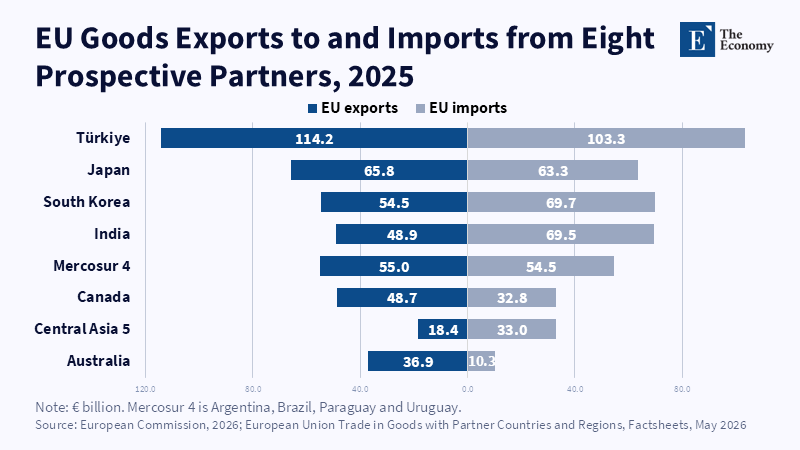
When discussion in Berlin placed Türkiye among states reluctant to join a Western camp, the objection was that it already sits inside Europe's security architecture and that EU membership remains its strategic goal. The exchange acknowledged that the classification had given the relationship too little attention. The commercial relationship also deserves weight. The Commission's May 2026 factsheets put EU goods exports to Türkiye at €114.2 billion in 2025 and imports at €103.3 billion, more two-way goods trade than with Japan, South Korea or India. The customs union agreed in 1995 underpins much of that relationship. Türkiye hosted NATO's July 2026 summit in Ankara, where it, Bulgaria and Romania widened their Black Sea mine-countermeasures task group's mandate to protect critical underwater infrastructure. In The Economy's reading, the Russian threat has made Türkiye one of Europe's most important partners for Black Sea security, with its role reinforced by its application of the 1936 Montreux Convention.
Europe's instruments have not caught up with the strategic argument. Canada has negotiated broader SAFE access, while Türkiye has no comparable agreement. That does not exclude every Turkish component from SAFE-financed supply chains: ordinary third-country sourcing remains possible within the 35% component-cost limit and the regulation's other eligibility and security conditions. Greek objections also involve unresolved security disputes, so the obstacle is not solely industrial preference. The Centre for European Reform nevertheless argued in July that Türkiye's drone industry could fill gaps in European supply chains. Industrial policy creates another test. The fourth Presidency compromise on the Industrial Accelerator Act, dated 23 November, would recognise normal vehicle-assembly eligibility in the EU/EEA, the United Kingdom and Switzerland, leaving Türkiye, Japan and South Korea outside that assembly rule. Japanese and Korean components could still qualify under the draft's conditions, and fleet flexibility prevents the assembly rule from being an absolute ban on support for every vehicle made elsewhere. The March proposal already required EU assembly, so the latest text broadens treatment for some partners rather than withdrawing a general exemption they all previously held. It remains a negotiating draft, not adopted law. The criticism raised in Berlin still stands: production with Europe's partners needs a credible place in the offer. A seat at a European table has value only if it brings influence over decisions and a share of the opportunities.
Credibility is tested outside trade too. Discussion at Chatham House returned to perceived double standards over Gaza, Iran and Venezuela, the opportunities these create for authoritarian governments and the way Europe's domestic rhetoric on migration undermines the neighbourhood partnerships its migration policy relies on. Values, on the view put forward there, are rules Europe accepts being judged by. Partners will price Europe's record on its existing commitments into the next one.
The World Does Not Owe Europe a Third Pole
The longer-term gains from the 2026 agreements remain to be demonstrated. A question from the floor in Berlin challenged how much the EU-CPTPP dialogue, launched in November 2025, had delivered in its first year. On 26 November 2026 the EU and CPTPP members also launched a Supply Chain Early Warning Network to share information, identify risks and coordinate responses, with its first meeting scheduled for early 2027. That is a concrete commitment whose value will depend on how participants act on the warnings. Another conference question asked whether bilateral partnerships weaken the multilateral system they are meant to defend; the reply was that cooperation among different groupings can support it, as the coalition backing Ukraine illustrates. The Economy's earlier research on coexistence across differing systems suggests an arrangement should specify the shared behaviour it needs while leaving partners free to maintain other relationships.
A modest standard follows. A partnership counts when it widens useful options for both sides and survives ordinary changes in politics and prices. That means investment delivered, preferences firms actually use and dispute procedures that work when tested; repeated renegotiation or a partner's well-founded refusal would show that the offer needs revising. The Indian agreement's approval and implementation, the first full year of Mercosur preferences, delivery under Canada's SAFE agreement, the disbursement record behind the Central Asia package and any agreement broadening Türkiye's SAFE access are tests to watch. If Europe wants partners to accept new burdens, it has to say what it will contribute: opened procurement, support for viable production in partner countries, shared influence in joint institutions and investment delivered on a timetable that matters. Each can carry a domestic cost through sharper competition for European producers or decisions taken jointly. Europe can remain important without being the centre of every partner's strategy. Whether 27 governments can accept that price through the 2027 election cycle, as partnerships within economic security compete with louder calls for protection at home, is a question the agreements of 2026 leave open.
This independent series by The Economy Review examines questions on the agenda of the Chatham House Berlin Conference 2026 and develops the publication's earlier research. The articles draw on conference discussions and public sources. The analysis and conclusions are those of the authors; references to the conference do not imply endorsement by Chatham House.
References
African Union (n.d.) Our Aspirations for the Africa We Want: Agenda 2063.
Council of the European Union (2026a) SAFE: Council concludes agreement with Canada. 15 June; treaty register confirms entry into force on 1 August.
Council Presidency (2026) Industrial Accelerator Act: Fourth Presidency compromise text. Document 15418/26, 23 November; public copy hosted by Agence Europe.
European Commission (2025a) EU-Central Asia Summit factsheet. April.
European Commission (2025b) Global Gateway overview. Includes the investment-mobilisation total announced in October 2025.
European Commission (2026a) EU-Mercosur interim trade agreement starts to provisionally apply. 30 April.
European Commission (2026b) The EU-India trade agreement; proposal for signature, COM(2026)483, 11 September.
European Commission (2026c) The EU-Australia trade agreement.
European Commission, DG Trade and Economic Security (2026d) European Union trade-in-goods country and region factsheets. 20 May vintage.
European Commission (2026e) EU launches Supply Chain Early Warning Network with Trans-Pacific bloc. 26 November.
European External Action Service (2024) The Draghi Report and Europe’s geopolitical future. 26 September.
European Union and Republic of Korea (2026) Joint statement following the 11th EU-Republic of Korea Summit. 10 June.
European Parliament (2026) Resolution on Global Gateway: Past impacts and future orientation. 26 March, C/2026/4033.
Government of Canada (2026) Agreement with the European Union concerning participation under the SAFE Instrument. Articles 5–6 and Annex.
Government of India, Ministry of Commerce and Industry (2026) India-EU trade agreement factsheet. 27 January.
International Monetary Fund (2026) World Economic Outlook, October 2026. NGDPD, GDP at current prices in US dollars; author calculations using the current EU27.
Maddock, T. (2026) The EU and Türkiye: Can shared threats overcome mutual suspicion?. Centre for European Reform, 3 July.
Republic of Korea, Ministry of Foreign Affairs (2026) Spokesperson briefings of 2 July and 15 October.
Romanian Ministry of National Defence (2026) Romania, Bulgaria and Türkiye expand the MCM Black Sea TG missions. 8 July.
The Economy Review (2026) Middle-Power Trade Network: Europe’s Treaty Model for a Fragmented Trade Order. 27 June.
United States Trade Representative (2026) Determinations and proposed actions in 14 Section 301 investigations relating to structural excess capacity. 25 November.
Working across research, policy, and data-driven analysis, the Editorial Board ensures that published pieces reflect a consistent institutional perspective grounded in quantitative reasoning and long-term structural assessment.