[European Strategic Autonomy] Europe–China De-risking: What Should Resilience Investment Buy?

Working across research, policy, and data-driven analysis, the Editorial Board ensures that published pieces reflect a consistent institutional perspective grounded in quantitative reasoning and long-term structural assessment.
Authored On
Modified
Europe should insure against interruptions, not trade volumes
Narva shows that alternative magnet supply takes years
Public money belongs where restoration outlasts tolerable disruption

In early June 2025 CLEPA, the association of European automotive suppliers, reported that several production lines and plants across Europe had stopped because supplies of rare-earth magnets were interrupted and that only about a quarter of hundreds of export licence requests filed since April had been granted. The International Energy Agency puts rare earths at about 40% of permanent-magnet cost and under 1% of a vehicle's value, so a factory can lose output worth many times the price of the missing input. That gap between purchase price and the cost of going without is where resilience investment has to start, since it makes the duration of an interruption more informative than trade volume alone. On 9 November 2026, China's commerce ministry and customs authority extended the suspension of the wider October 2025 controls until 10 January 2027. The separate April 2025 licensing regime for seven medium and heavy rare earths remains in force. Europe faces a budgeting question with a near-term policy deadline: which interruptions to insure against, for how long and at what price.
Time to Restore Supply Sets the Cost of a Missing Input
Eurostat recorded €559.4 billion of EU goods imports from China in 2025 against exports of €199.6 billion, a deficit of €359.8 billion. Those totals say little about which part of the relationship could stop a factory. The Economy's earlier framework in Beyond Import Shares separated exposure, substitution and downstream criticality and distinguished a large trading relationship from a dangerous bottleneck. One operational test follows: compare the time a buyer needs to restore supply with the time production can tolerate an interruption. The probability of disruption, downstream losses and cost of protection then determine how much insurance is worth buying.
A buyer facing a cut-off has four broad responses and each runs on a different clock. Inventory can bridge shorter interruptions. A second supplier helps only once its parts are qualified: Neo Performance Materials completed initial sample production in April 2025 at Narva, Estonia, opened the plant formally that September and announced first commercial volumes to an electric-motor customer in September 2026, after automotive qualification for its initial programmes. Redesign can remove the need for a particular input. Rare-earth-free traction motors already existed before the shortage, including BMW's fifth-generation electric drive, but substituting a motor into an existing vehicle platform requires engineering and validation. Cutting output absorbs the loss when other options are unavailable. When nominally different suppliers depend on the same upstream processor, the list of suppliers can be longer than the list of practical alternatives.
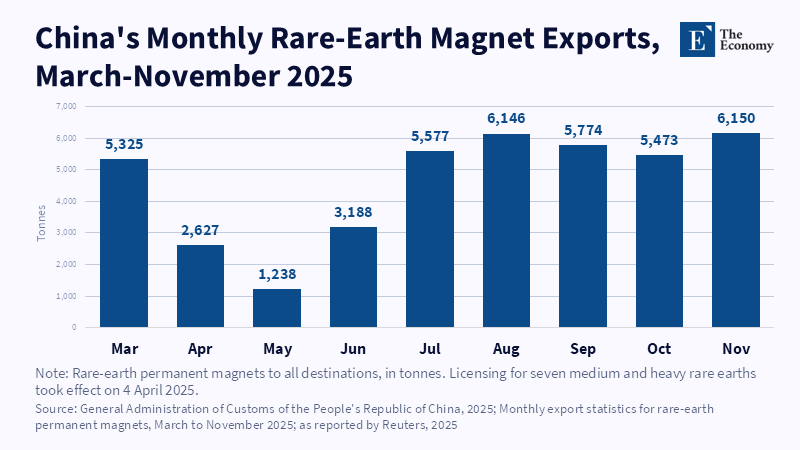
Reports of Chinese customs data show how quickly shipments changed in 2025. Exports of rare-earth permanent magnets fell from 5,325 tonnes in March to 2,627 tonnes in April, when the licensing rules took effect, and to 1,238 tonnes in May, roughly 77% below March. Shipments exceeded the March level in July, reaching 5,577 tonnes, as approvals accelerated and diplomacy sought to ease supply. The series records a recovery in exports from China; it does not measure replacement supply elsewhere or isolate every cause of the change. Licensing delays demonstrate disruptive capacity but do not by themselves establish political intent, a distinction drawn in The Economy's work on supply chains as statecraft. Resilience spending has to work whatever the motive.
Firms already manage this kind of risk and the case for public money depends on showing where private management falls short. Mercedes-Benz said in June 2025 that it was discussing rare-earth buffers with its main suppliers. Public involvement is strongest where losses spill beyond the buyer choosing its inventory or where coordination prevents firms from financing a shared remedy. A thinly stocked component maker can halt customers further down the chain, while a separation plant or common stockpile may benefit many buyers without any one of them securing enough of the return to finance it. Correlated exposure to one licensing system increases the potential damage, but it does not by itself prove the need for a subsidy. The public case has to identify the spillover or coordination failure that the intervention will address.
Each Form of Protection Buys a Different Amount of Time
The available interventions differ in their carrying costs and the dependence they leave behind. For eleven high-risk materials outside the dominant supplier, the IEA estimates initial stock purchases of $9.2 billion and net annual carrying costs below $900 million. Separately, it estimates that full implementation of expanded rare-earth controls could expose $6.5 trillion in annual downstream production outside China. That is production exposed, not output necessarily lost or protected by those stockpiles, so the two figures do not constitute a benefit-cost ratio. New capacity brings different costs: the IEA reports refining capital costs 20% to over 150% higher outside the dominant supplier and operating costs around 50% higher on average. It estimates about $60 billion to diversify magnet rare-earth supply chains over the next decade, a global requirement rather than an EU budget. Discussion at Chatham House linked Europe's position to earlier decisions to leave polluting processing overseas and to confidence that European firms would retain a technological lead.
Table 1: Resilience Interventions Compared by Time, Coverage, Cost and Residual Dependence
| Intervention | Implementation time | Disruption covered | Main costs | Residual dependence |
|---|---|---|---|---|
| Inventory buffer | Months to purchase and arrange suitable storage, subject to supply availability | Short interruptions within the chosen stock coverage | Storage, rotation, financing and material losses | Original dependence returns when the buffer is exhausted |
| Alternative supplier | Qualification is product-specific; Narva took more than a year from initial samples to first commercial volumes | Loss of a supplier or country of origin, if upstream supply is also independent | Potential price premium and continuing qualification costs | High if suppliers share a processor, feedstock or equipment |
| Product redesign | Platform-specific engineering, testing and qualification; rare-earth-free motors already exist | Prolonged or permanent loss of the input designed out | Engineering expenditure and possible performance or efficiency trade-offs | Lower for that input, but dependence can shift to another material |
| Additional production capability | Several years for new assets, including qualification and ramp-up | Long disruptions at the stages actually built and supplied | Possible operating support or offtake premium while costs exceed import prices | Imported feedstock, specialised equipment and know-how may remain |
The last row carries the distinction drawn in The Green-Digital Dependency Trap between assembling a product in Europe and controlling what keeps the line running. Neo has commissioned small-scale separation of terbium and dysprosium at Silmet and signed an August 2026 binding term sheet for future supply from Caremag, Carester's facility under construction in France. These are steps towards integration, but the announcements do not establish a fully operating and qualified chain outside China for all Narva's inputs. Equipment matters too: the IEA reports that grain-boundary diffusion equipment can cost more than ten times as much outside China. Discussion at Chatham House proposed joint ventures, European jobs and technology agreements as a return for market access. A question from the floor challenged whether such conditions would attract the leading Chinese firms Europe actually wants. Local investment alone does not settle access to know-how.
The strongest objection to making domestic capacity the default response comes from the OECD Supply Chain Resilience Review of June 2025. Its broad relocalisation scenarios could reduce global trade by more than 18% and global real GDP by more than 5% without consistently improving resilience to disruptions. Those are modelled effects of extensive relocalisation, not an estimate of the cost of a targeted European magnet plant. They strengthen the case for comparing each intervention with a diversified-trade alternative. Discussion at Chatham House similarly argued for targeting critical dependencies rather than every import relationship, using solar modules as an example. A delay in module imports generally slows new installations without stopping panels already operating; a magnet shortage can halt a vehicle assembly line. That distinction helps set priorities, while replacement needs and other dependencies still require their own assessment.
Partners and Offtake Contracts Decide Whether Alternative Capacity Survives
The Commission's RESourceEU action plan of 3 December 2025 aimed to mobilise up to €3 billion over twelve months for critical raw materials projects and develop a European Critical Raw Materials Centre. In December 2025, the Jacques Delors Centre criticised key tools, including joint purchasing and price stabilisation, as indicative rather than binding. Implementation has since advanced: a Commission unit bearing the Centre's name was established in June 2026, while its wider tools remained under development. By October, the voluntary Raw Materials Mechanism had produced 33 matches across ten materials, with commercial negotiations taking place outside the platform. Matching a refinery with a buyer does not secure revenue when cheaper imports return. Neo says its automotive magnet programmes are typically awarded for a vehicle platform's life, providing multi-year visibility, but its Bosch capacity reservation is a memorandum of understanding intended to become definitive projects. Revenue security depends on the eventual volumes, prices and obligations, not the announcement alone.
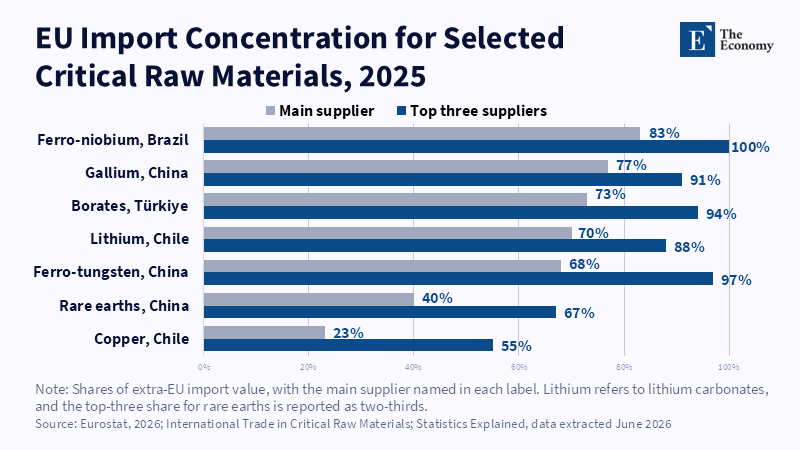
A 2024 Bruegel policy brief argued for de-risking through partnerships. Partners can share the fixed costs of alternative capacity, but partner supply is not automatically diversified supply. In 2025, China provided 92% of extra-EU magnesium imports by value, 77% of gallium and 68% of ferro-tungsten. Other suppliers held similarly concentrated positions: Brazil supplied 83% of ferro-niobium, Türkiye 73% of borates and Chile 70% of lithium carbonates. The top three origins accounted for 55% of copper imports and virtually all ferro-niobium imports. These are import-value shares rather than shares of total EU consumption, and equivalent concentration does not imply equivalent political or supply risk.
The German car industry, debated in the conference's third-pole session, shows the limit of what supply security can buy. Discussion at Chatham House questioned whether China is the root cause of German industrial weakness, identifying labour and energy costs and the diffusion of innovation as domestic challenges that Chinese competition makes harder. The Economy's reading runs the same way: resilience policy cannot replace improvements in industrial competitiveness. NIO and XPeng were founded in 2014 and Li Auto in 2015, illustrating how recently some of the competitors emerged, although founding dates cannot explain Germany's performance. A magnet supply chain secured at public expense keeps an assembly line commercially useful only if the cars it produces still sell. China recorded a goods surplus of about $1.19 trillion in 2025; securing inputs does not remove the need to compete for customers.
Resilience Investment Should Be Judged by the Interruptions It Shortens
Any resilience programme should be judged by whether it reduces the duration or severity of a plausible disruption. The evidence to ask for is operating capacity, qualified suppliers and a credible route to restoration. Narva's Phase 1A nameplate capacity is about 2,000 tonnes a year, equivalent to roughly 167 tonnes a month at full utilisation, compared with China's 6,150 tonnes of magnet exports in November 2025. Nameplate capacity is not actual output, and neither figure measures the share of Europe's specific requirements Narva can meet. Its planned expansion to about 5,000 tonnes a year remains in development. Discussion at Chatham House included an assessment that easing the rare-earth bottleneck could take a decade or more, an estimate rather than an established delivery schedule. Each stockpile proposal should state its coverage in weeks of usable supply and each capacity subsidy the price gap it would bridge and for how long. A continuing premium creates a standing fiscal commitment that must be justified by the security it buys.
Discussion at the Chatham House Berlin Conference 2026 also asked what separates de-risking from decoupling. The distinction depends on defining the risk: a narrow military exposure is different from an attempt to protect every industry or avoid all social disruption. The discussion warned that sweeping protection could leave Europe an "industrial museum". Restoration time gives that debate an operational test. Trade can remain open where interruptions are manageable, while public support targets cases in which the harm and difficulty of substitution justify its cost, including permanent magnets and their heavy-rare-earth inputs. Discussion also identified civil nuclear energy as a possible area for cooperation with Chinese expertise, alongside the tension over restrictions on strategic investment. The case for particular new plants would weaken if alternative suppliers or redesigned products could cover demand sooner and more cheaply; it would strengthen if bottlenecks in oxides, feedstock or equipment made apparent alternatives unusable. The suspension of the expanded controls runs to 10 January 2027, while the April licensing requirements remain. Europe may face another test of its ability to restore supply before many of the projects intended to improve it are operating.
This independent series by The Economy Review examines questions on the agenda of the Chatham House Berlin Conference 2026 and develops the publication's earlier research. The articles draw on public sources and, where indicated, discussions at the conference. The analysis and conclusions are those of the authors; references to the conference do not imply endorsement by Chatham House.
References
BMW Group (2020) Preparations for BMW iX3 start of production proceeding according to plan. Description of the fifth-generation electric motor without rare earths.
Chatham House Berlin Conference (2026) Third-pole and China discussions, 25 November. Conference recordings and transcripts.
CLEPA (2025) Urgent action needed as China's export restrictions on rare earths disrupt European automotive supply chains. Press release, 4 June.
European Commission (2025) RESourceEU Action Plan: Accelerating our critical raw materials strategy to adapt to a new reality. COM(2025) 945 final, 3 December.
European Commission (2026a) Critical raw materials newsletter: initial Centre established, June; first diversification-round results, October.
European Commission (2026b) China's export and import performance amidst escalating US–China trade tensions. Autumn 2026 Economic Forecast, citing Chinese customs data.
Eurostat (2026a) Trade in goods with China in 2025. Eurostat News, 10 April.
Eurostat (2026b) International trade in critical raw materials. Statistics Explained; 2025 extra-EU import values.
García-Herrero, A. and Vasselier, A. (2024) Updating the EU strategy on China: Co-existence while de-risking through partnerships. Policy Brief 27/2024. Brussels: Bruegel.
International Energy Agency (2026) Global Critical Minerals Outlook 2026. Paris: IEA; executive summary and stockpiling discussion, pp. 256–57.
Leichthammer, A. (2025) The EU's critical raw materials predicament: ReSourceEU to the rescue?. Jacques Delors Centre policy brief, 19 December.
Li Auto (2024) Annual Report 2023, Form 20-F. Corporate history.
Ministry of Commerce and General Administration of Customs, China (2025) Announcement No. 18 on export controls for specified medium and heavy rare-earth items, 4 April.
Ministry of Commerce and General Administration of Customs, China (2026) Announcement No. 58 continuing suspension of specified October 2025 controls, 9 November.
Neo Performance Materials (2025a) First-quarter investor presentation, May; European magnet-facility opening announcement, September.
Neo Performance Materials (2025b) Neo extends strategic partnership for high-performance magnets with Bosch, 19 September.
Neo Performance Materials (2026a) Neo partners with Carester to advance its European rare-earth supply chain. Company announcement distributed by CNW, 31 August.
Neo Performance Materials (2026b) Neo advances to commercial production at its European magnet facility, 14 September.
Neo Performance Materials (2026c) European separation facility named a Strategic Project under the EU Critical Raw Materials Act, 13 October.
Neo Performance Materials (2026d) Third-quarter management discussion and analysis, November.
NIO (n.d.) Investor-relations company profile; XPeng (n.d.) Company history.
OECD (2025) Elevated risks require co-ordinated efforts to strengthen supply chains, OECD evidence shows. Findings from the OECD Supply Chain Resilience Review, June.
Reuters (2025a) Mercedes-Benz: in talks with suppliers over rare earth buffers, 4 June, via Investing.com.
Reuters (2025b) China's rare-earth magnet shipments halve in May due to export curbs, June; July export figures, August; November export figures, December. Reporting of Chinese customs data.
Shanghai Metals Market (2025) March and April rare-earth permanent-magnet export data. Reporting of Chinese customs statistics.
The Economy (2026a) Beyond Import Shares: A Risk-Based Framework for EU Trade Dependence on China, 2 July.
The Economy (2026b) The Green-Digital Dependency Trap: China, Batteries, Photovoltaics and Europe's Industrial Autonomy, 3 July.
The Economy (2026c) When Supply Chains Become Statecraft: China and the Geopolitics of EU Strategic Autonomy, 4 July.
Working across research, policy, and data-driven analysis, the Editorial Board ensures that published pieces reflect a consistent institutional perspective grounded in quantitative reasoning and long-term structural assessment.