[European Strategic Autonomy] Can Europe Sustain the Cost of Resisting Economic Coercion?

Working across research, policy, and data-driven analysis, the Editorial Board ensures that published pieces reflect a consistent institutional perspective grounded in quantitative reasoning and long-term structural assessment.
Authored On
Modified
Europe's anti-coercion instrument has yet to produce a public response measure
Retaliation can concentrate losses in a few member states
Credibility needs funded loss-sharing before the next confrontation
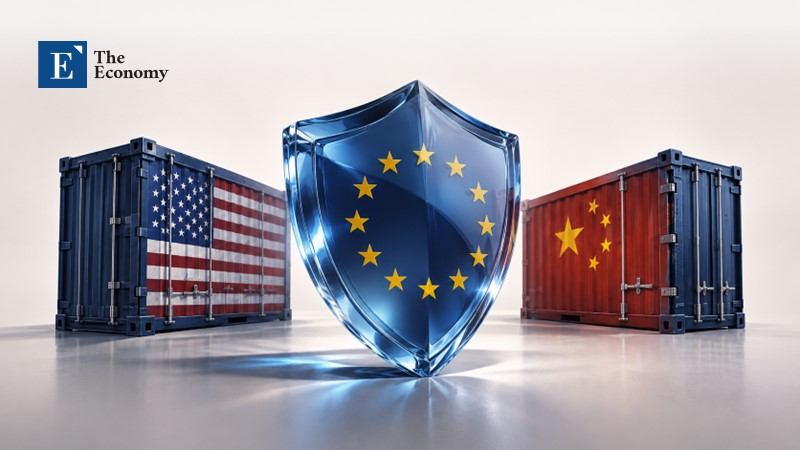
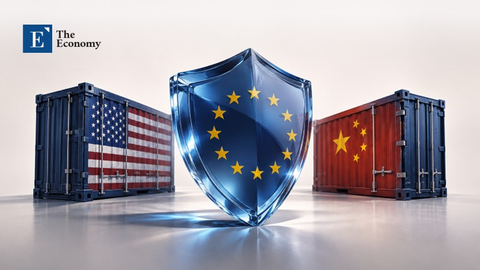
On 23 July 2026 the EU's 21st sanctions package against Russia subjected 14 companies in mainland China and Hong Kong to tighter export restrictions. The next day China's Commerce Ministry barred dual-use exports to 14 European entities, Rheinmetall among them, and prohibited overseas transfers of Chinese-origin dual-use items to those entities, subject to exceptional permission. Beijing explicitly linked its action to the EU sanctions. Brussels has had a legal framework for examining pressure of this kind since 27 December 2023, when the Anti-Coercion Instrument entered into force, yet no response measure under it had been publicly announced by 27 November 2026. Discussion at the Chatham House Berlin Conference on 25 November recalled its description on adoption as Europe's atomic bomb. A deterrent that stays in its case can still work, provided other governments believe it would be used coherently, that the member states hit by any counter-reply would hold their line and that a route back to normal trade exists. Whether Europe can sustain the cost of resisting economic coercion therefore turns on who inside the Union carries the losses, and on whether anyone has agreed in advance to share them.
Economic Coercion Begins With a Demand That a Government Change Course
A trade restriction can do real damage without trying to force a sovereign decision. Subsidy disputes, safeguards against import surges and plain industrial competition all impose costs, and they often run alongside political pressure. The regulation behind the Anti-Coercion Instrument, however, requires a third country to use or threaten trade or investment measures to make the EU or a member state adopt, change or drop a particular act, thereby interfering with a legitimate sovereign choice. The Commission first examines whether coercion exists, normally within four months. Following its proposal, the Council determines the matter by implementing act, normally within eight weeks and at most ten. Engagement follows through negotiation, mediation or other appropriate procedures. If those efforts fail, the Commission may, as a last resort and subject to the regulation's conditions, adopt response measures covering goods, services, investment, public procurement, intellectual property rights or export controls. The measures must end once they are no longer needed.
The autumn dispute over Chinese hybrid cars shows why the distinction matters. The Commission's safeguard regulation records imports from China rising from 106,542 vehicles in 2024 to 302,403 in 2025 and 486,582 in the twelve months to June 2026. A shared EU-China understanding on 9 October was followed by a safeguard investigation on 30 October and provisional import quotas published on 24 November. These take effect on 1 December for 200 days and cover several origins, with specified exceptions. China's allocation totals 191,780 vehicles over that period, roughly equivalent to 350,000 a year, rather than a permanent annual ceiling. An import surge, a safeguard response and a request for WTO compensation do not by themselves establish economic coercion. MERICS calculated that hybrids made up 2.06% of Chinese exports to the EU by value between January and August 2026, which helps explain why the Berlin discussion treated the negotiated outcome as a limited success. July's retaliatory dual-use restrictions raise a different question: whether supply pressure is being used to force a change in foreign policy. That requires the instrument's case-by-case assessment; retaliation alone is not a formal legal finding.
The Deal With Washington Shows That Market Size Does Not Settle a Negotiation
Europe's market is its main lever, but the framework agreed with the United States at Turnberry in July 2025 and set out in a joint statement on 21 August shows how far that lever bends under security pressure. The framework provided for the higher of the US most-favoured-nation rate or a combined 15% tariff on most EU goods, with sectoral exceptions. The EU said it intended to remove tariffs on US industrial goods and to purchase US energy worth an expected $750 billion through 2028 and at least $40 billion of US AI chips; it also expected European companies to invest a further $600 billion in the United States. The spending and investment figures were intentions or expectations dependent on subsequent commercial decisions. Discussion at Chatham House argued that the EU had been big enough to push back but chose not to because of security considerations. The China session also connected the Commission's negotiating position to disagreements among member states. The relevant questions are which alternatives existed, which commitments were obtained and which costs were avoided, and the answer to the last one depends heavily on where a member state sits.
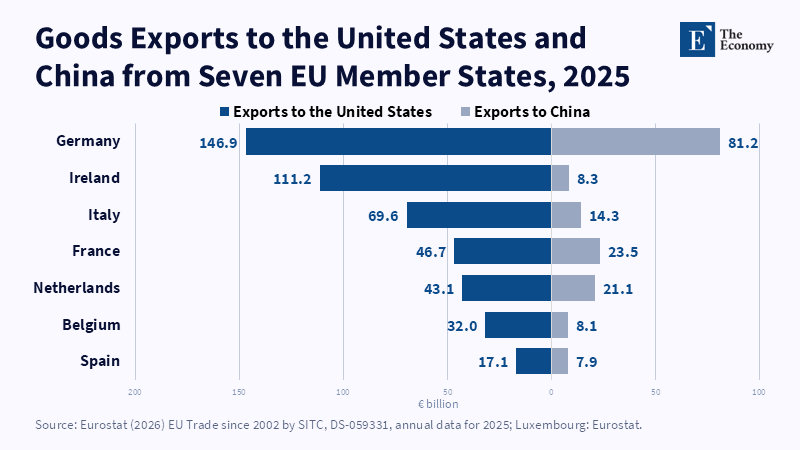
Trade flows changed unevenly during the tariff confrontation. Eurostat's February 2026 release recorded EU goods exports to the United States of €554.0 billion in 2025, 3.4% more than in 2024, after a surge in the first quarter and a marked fall in the second. In a separate analysis, the German Economic Institute found that EU automotive exports to the US fell 20.4%, with Germany, which supplied 64.9% of them, down 18.9%. Irish goods exports to the US rose 52.7%, supported by frontloading and tariff exemptions for major pharmaceutical categories. These movements reflect sectoral differences as well as the timing of shipments. Exposure to China is concentrated differently: Germany shipped €81.2 billion of goods there, roughly two-fifths of the EU total. A reply to Washington and a reply to Beijing would therefore expose different capitals, which is one practical reason a common line on retaliation is hard to hold.
Deterrence Weakens Where the Losses Fall on a Few Member States
A hypothetical case makes the problem concrete. A third country blocks imports of machine tools, an industry concentrated in one member state, to make that state reverse a political decision. The proposed European reply, an import restriction on a component the coercer dominates, would raise costs for assemblers in two other member states. The Union's combined market may offer substantial leverage, yet the firms involved care about liquidity, whether customers can switch and how long the uncertainty lasts, while their governments weigh jobs and alliances. Lithuania lived a version of this from December 2021, when the EU reported Chinese customs restrictions on Lithuanian goods and pressure on firms elsewhere using Lithuanian components. Reuters reported German companies urging Vilnius to de-escalate, illustrating how pressure on one state can divide businesses across the single market.
Discussion in Berlin emphasised Germany's substantial exposure to China and the range of measures Beijing could use in response to European restrictions. The China session described ASML as one of Europe's few technological chokeholds and argued that China holds more over Europe than Europe holds over China. Three conditions would make a European response credible on that reading, offered here as The Economy's evaluative criteria rather than existing EU commitments: a shared assessment that the pressure is coercive, a decision process that outsiders believe can actually run, and a funded way of managing concentrated losses that exists before the confrontation starts.
Paris and Berlin addressed the decision problem in a non-paper of 5 October 2026. They proposed a new instrument restricting single-market access that would take effect on a Commission proposal unless a qualified majority of governments opposed it. The proposal addresses systemic market distortions more broadly than the existing Anti-Coercion Instrument. It also calls for an inventory of retaliation Europe could face, assessments of member-state exposure and coordination among leaders, conceding that retaliation could test EU unity. On 16 October the Commission scheduled DiversifyEU for December and separately announced a Solidarity Mechanism for coercion or retaliation, without specifying that mechanism's financing or its own delivery date. The Berlin discussion considered the Franco-German approach potentially powerful if credible, while a Bruegel policy brief had already called for clearer principles governing economic-security responses. The objection is that a faster or more automatic response may fit some cases badly. The hybrid understanding was negotiated without the Anti-Coercion Instrument being deployed, showing that other routes remain available.
Lithuania's Case Shows How Hard Success Is to Prove
The Lithuania dispute became a prominent example of the problem the Anti-Coercion Instrument was designed to address, but the legislative initiative was already under development before the customs restrictions. The Commission presented its proposal on 8 December 2021, and the EU requested WTO consultations with China on 27 January 2022 in the case registered as DS610. On 28 November 2025 the EU told the WTO that it had ended the case because its key objectives had been met and the relevant trade had resumed. The record contains no adjudicated panel finding, and the Anti-Coercion Instrument, which entered into force two years after the pressure began, played no formal part.
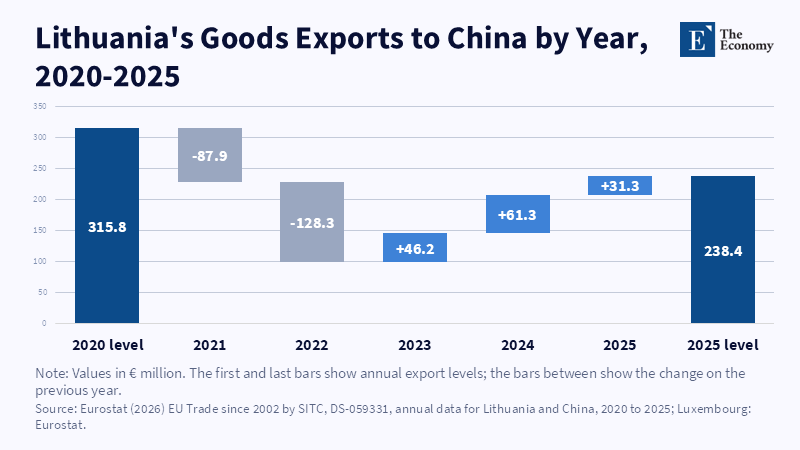
The recovery in Eurostat's trade series was incomplete. Lithuanian goods exports to China fell from €315.8 million in 2020 to €99.6 million in 2022 and recovered to €238.4 million in 2025, still about a quarter below the level before the dispute. Resumed trade does not establish that the commercial damage has been repaired. Deterrence also carries an identification problem: the WTO filing, quiet diplomacy, commercial adjustment by firms and Beijing's own interest in calmer relations with Brussels may each have played a part in the recovery. When pressure is never applied, its absence can reflect successful deterrence or motives that have nothing to do with Europe. What can be observed is narrower: the demand, the conduct that followed, the commercial recovery, who bore the costs and whether partners stayed together.
Table 1: Pressure, Response and Evidence in Recent EU Trade Confrontations
| Case | Pressure or demand | European response | Costs within Europe | Evidence of changed conduct |
|---|---|---|---|---|
| Lithuania, 2021 to 2025 | Customs restrictions reported from December 2021, after a Taiwanese Representative Office opened in Vilnius | WTO case DS610 from January 2022; ACI proposed in December 2021 but not yet in force | Exports to China fell from €315.8 million in 2020 to €99.6 million in 2022; pressure also affected firms using Lithuanian parts | EU ended the case on 28 November 2025, reporting resumed trade; exports reached €238.4 million in 2025; no adjudicated panel finding or proven causal attribution |
| EU and United States, 2025 | US tariff threats; August framework provided for the higher of MFN or a combined 15% tariff on most EU goods, with exceptions | Negotiated framework; no publicly announced ACI response measure | IW reported EU automotive exports to the US down 20.4%, German automotive exports down 18.9% and Irish total goods exports up 52.7% | A negotiated tariff framework; the independent effect of any European counter-threat is not established |
| Chinese dual-use listing, July 2026 | Restrictions on 14 EU entities on 24 July, explicitly linked by Beijing to the EU's 23 July sanctions | No publicly announced ACI determination or response measure as of 27 November | Direct exposure concentrated on listed entities, including Rheinmetall; wider supply-chain effects require separate assessment | No demonstrated withdrawal of the restrictions attributable to an ACI response |
| Hybrid vehicle safeguards, 2026 | Import surge; a safeguard dispute does not by itself establish coercion | 9 October understanding; 30 October investigation; provisional quotas published 24 November for 200 days from 1 December | China's allocation is 191,780 vehicles over the provisional period; effects differ across producers, importers and buyers | The provisional measure is not yet in force at the article's 27 November cut-off |
| Hypothetical, for illustration | Import ban on machine tools to reverse a political decision | Counter-restriction on a component the coercer dominates | Concentrated in one exporting state and in assemblers in two others | Would require evidence of pressure ending, commercial recovery and continued alignment among partners |
A Credible Response Needs a Budget for Losses and a Way Back to Trade
Pressure is unlikely to come from one direction at a time. The China discussion at Chatham House anticipated pressure from Washington through security ties and from Beijing through market access, alongside the temptation to wait for a different US administration. The third-pole session also raised the restrictive clauses in some US trade agreements and the US-led Pax Silica initiative, launched in December 2025, as signs of competing efforts to shape partners' choices. Such clauses have specific conditions; they should not be read as a universal prohibition on cooperation with China. The Economy's reading is that Europe weakens its own hand when it extends barriers to Japanese or Korean producers after watching China retaliate against EU measures. Partners able to absorb diverted trade are among those a coercer would most like to peel away. The conference's third-pole discussion described a wider European trading area as an insurance scheme for precisely this reason: somewhere else to go when market access is used as leverage.
Against the three conditions, the record as of 27 November 2026 is mixed. The legal procedure exists but has yet to produce a publicly announced response measure. The Franco-German proposal for faster market-access restrictions remains a proposal, and the promised solidarity mechanism still lacks published financing and an implementation timetable. Lithuania's export recovery and the hybrid understanding show that pressure can ease and negotiated arrangements can emerge, although neither establishes that the Anti-Coercion Instrument caused the outcome. July's dual-use restrictions have not produced a publicly announced response under it. Where losses are concentrated, Europe can sustain a common position only if the member states that would pay first know how much support the others will provide and for how long. DiversifyEU's promised December launch and the eventual terms of the solidarity mechanism will test different parts of that strategy. The decisive arithmetic is the funding, eligibility and duration of support, and the Franco-German paper's warning that retaliation could test EU unity suggests that this arithmetic is not yet settled.
This independent series by The Economy Review examines questions on the agenda of the Chatham House Berlin Conference 2026 and develops the publication's earlier research. The articles draw on conference discussions and public sources. The analysis and conclusions are those of the authors; references to the conference do not imply endorsement by Chatham House.
References
Council of the European Union (2026) 21st package of sanctions: EU hits Russian energy, financial services and crypto hard. 23 July.
European Commission (2026a) Protecting against coercion. Accessed 27 November.
European Commission (2026b) Statement following the October European Council. 16 October.
European Commission (2026c) Commission imposes provisional import quotas on hybrid passenger vehicles. 24 November.
European Commission (2026d) Implementing Regulation (EU) 2026/2614, 23 November. Official Journal, published 24 November.
European Union (2023) Regulation (EU) 2023/2675 on protection from economic coercion by third countries. Official Journal.
Eurostat (2026a) Trade in goods with the United States in 2025. 26 February.
Eurostat (2026b) International trade since 2002 by SITC, DS-059331. Annual data; 13 November release.
France and Germany (2026) Non-paper on strengthening European resilience, addressing global macroeconomic imbalances and market-distorting practices. 5 October.
García Bercero, I. and Poitiers, N. (2025) From strategy to doctrine: The next steps for European economic security. Policy Brief 32/2025. Brussels: Bruegel.
Kolev-Schaefer, G. and Sultan, S. (2026) Transatlantic trade at a crossroads. IW-Report 32, 3 July.
MERICS (2026) MERICS China Essentials special issue: EU-China economic relations enter critical phase. 22 October.
Ministry of Commerce of the People’s Republic of China (2026) Export-control Announcement No. 30 and related spokesperson statement. 24 July.
Reuters (2022) German big business piles pressure on Lithuania in China row. 21 January.
The White House (2025) Joint Statement on a United States-European Union Framework on an Agreement on Reciprocal, Fair, and Balanced Trade. 21 August.
World Trade Organization (2025) DS610: China, Measures Concerning Trade in Goods. Dispute record, including termination notification of 28 November.
Working across research, policy, and data-driven analysis, the Editorial Board ensures that published pieces reflect a consistent institutional perspective grounded in quantitative reasoning and long-term structural assessment.