[European Strategic Autonomy] Europe's Readiness Gap: From Budgets to Usable Power

Working across research, policy, and data-driven analysis, the Editorial Board ensures that published pieces reflect a consistent institutional perspective grounded in quantitative reasoning and long-term structural assessment.
Authored On
Modified
Defence spending does not guarantee readiness
Staffing and coordination remain key obstacles
Strategic autonomy requires deployable military capabilities

A government can announce a defence budget increase in an afternoon, while a commander who needs a crewed frigate, a maintained radar and political permission to use both on a given night works to a clock measured in years. EU member states spent €418 billion on defence in 2025, 20% more in real terms than in 2024, and the European Defence Agency projects €454 billion for 2026 at 2025 prices. These figures record reported expenditure and projected spending, rather than whether the forces purchased can deploy, operate with allies and keep going. That distance between the two clocks is Europe's defence readiness problem and it ran through discussion at the Chatham House Berlin Conference 2026, whose opening session on 25 November asked whether Europe is ready for war. That discussion, read alongside the North Atlantic examples, suggests that the conversion of budgets into usable power can break down at more than one point and that each breakdown needs a different remedy.
Defence Readiness Cannot Be Read Off a Share of GDP
NATO's Hague Summit Declaration of 25 June 2025 committed allies to spend 5% of GDP on defence and security by 2035, with at least 3.5% of GDP allocated to core defence requirements and up to 1.5% to wider defence- and security-related spending. Allies must submit annual plans showing a credible path. By NATO's July 2026 estimates, five allies were expected to meet the 3.5% guideline in 2026. A share of GDP is an input measure, though. It cannot show which missions are covered, whether the forces it buys can deploy or how long they could keep operating and EU and NATO totals cover different groups of countries.
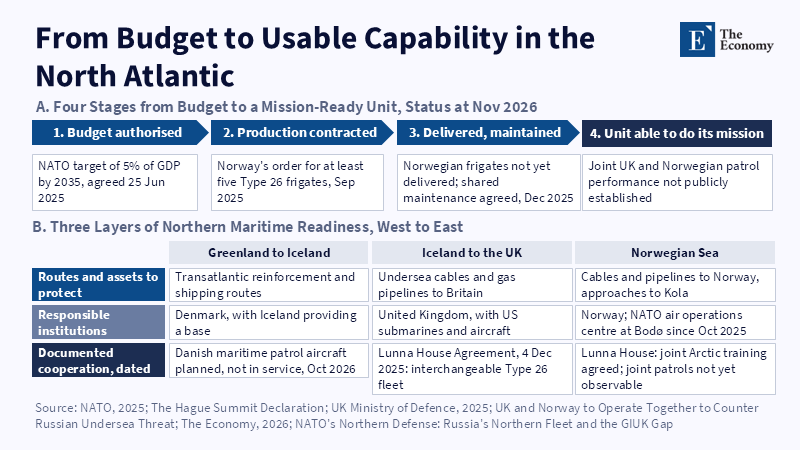
Money becomes readiness through four observable stages: an authorised budget, contracted production, equipment delivered and maintained and a unit able to carry out its assigned mission. Public expenditure data are easier to compare than operational availability. The EDA reports equipment procurement of €115 billion in 2025 and expects investment, comprising equipment procurement and defence R&D, to reach 36% of defence spending in 2026. Collaborative procurement, including arrangements with non-EU partners, accounted for 24% of equipment spending in 2025. The agency also distinguishes forces held in national inventories from those operationally available. Where only an announcement exists, it should be reported as one.
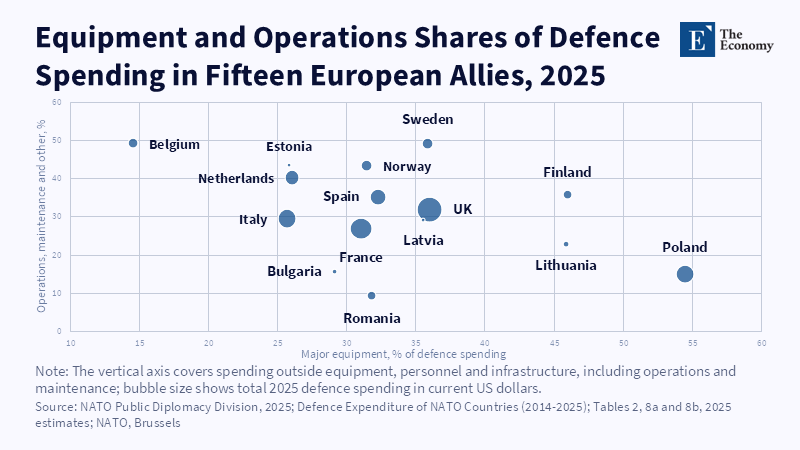
What happens after delivery depends on budget lines that draw far less attention than procurement. NATO's estimates for 2025, using information available on 3 June 2025, showed Poland putting about 54% of its defence spending into major equipment and related R&D and about 15% into the residual 'Other' category, while Sweden and Belgium each placed close to half of their spending in that category and Romania about 9%. 'Other' includes operations and maintenance, other R&D and spending not assigned elsewhere; it is not a pure upkeep measure. Later NATO releases revised these estimates, so Figure 1 retains that dated snapshot. A small share of a large budget can still fund substantial support. These shares do not establish whether maintenance is adequately funded; they show why procurement announcements need to be read alongside staffing, sustainment and the full lifetime cost of new equipment.
The strongest objection is that rearmament has to begin with money and that secrecy limits a public audit of readiness. Both points hold: credible funding is needed before orders can be placed and governments withhold much operational-readiness information. That does not make spending the same as capability. Spending data need complementary evidence, including staffing, exercises and maintenance performance, and cannot alone support a reliable continent-wide estimate of a readiness deficit.
Frontline States Treat Readiness as a Task for the Whole of Society
Discussion at the conference kept returning to the need to prepare society as well as buy hardware. Finland anchors defence in society through conscription for men and voluntary military service for women and its Security Strategy for Society, renewed in January 2025, gives authorities, businesses, NGOs and citizens defined roles before a crisis. Because private companies run much critical infrastructure, cooperation with them must be arranged in advance. Discussion at Chatham House stressed that such coherence takes time to build and cannot be improvised once a crisis arrives. Examples also included preparedness that families discuss at home and public guidance delivered through phone apps.
Lithuania's approved 2026 national budget puts defence spending at €4.79 billion, or 5.38% of GDP, its highest ever, and the German presence there offers a concrete example of the personnel constraints behind rearmament. Germany's 45th Panzer Brigade is intended to be operational with around 4,800 troops and 200 civilian staff based in Lithuania by the end of 2027. In September 2026, the Bundeswehr confirmed that compulsory postings would be needed in the mid-three-figure range, with volunteers filling about 80% of positions at that point and shortages in specialist areas including logistics and IT. These are assignments of military personnel, rather than the conscription of new civilian recruits.
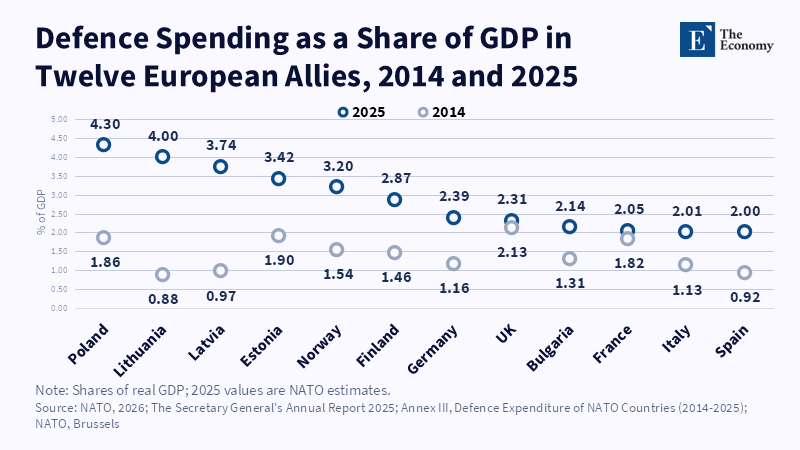
Discussion at Chatham House also described Europe as correcting years of strategic underinvestment while still falling short of its requirements and stressed that hardware needs continuity of government, public trust and protected infrastructure behind it. National plans show the scale of the catch-up: Bulgaria's plan envisages core defence spending rising from about 2.1% of GDP to at least 3.5% by 2035, alongside 1.5% for wider security-related expenditure. Germany's new military service, in force since 1 January 2026, keeps service voluntary while requiring German men turning 18 to complete a questionnaire. The conference also considered the outlook of a generation raised to expect lasting peace, now facing cyber attacks, espionage and disinformation. The spread in effort is wide: on NATO estimates published in March 2026, Lithuania, Latvia and Poland spent between 3.7% and 4.3% of GDP on defence in 2025, France, Italy and Spain about 2% and Germany, with the largest expenditure among European NATO allies, 2.39%. Figure 2 retains that March snapshot; subsequent estimates revised some values.
In the North Atlantic, Coordination Is Itself a Capability
The waters between Greenland, Iceland and the United Kingdom show why readiness cannot be judged country by country. Across the wider North Atlantic and adjacent seas, the routes, cables and pipelines carrying reinforcements, data, electricity and gas form a regional security problem, while the ships and aircraft protecting them belong to separate governments, a mismatch sharpened by Russian naval activity. Detection is only part of the task, as The Economy's October analysis argued, because a submarine can outwait a patrol aircraft and the response depends on sensors linked to forces that can act. Denmark's responsibilities around Greenland form part of a wider allied surveillance effort; coverage cannot be divided neatly by coastline. Its July 2026 preliminary decision to acquire two P-8A maritime patrol aircraft promises additional capacity but does not provide it immediately. The same coordination problem recurs at the digital layer: discussion at Chatham House described NATO's priority of building a warfighting cloud through which different systems across 32 allies can exchange data securely.
The Lunna House Agreement signed by Britain and Norway on 4 December 2025 tries to turn that coordination into a capability. It sets out plans for an interchangeable fleet of at least 13 Type 26 anti-submarine frigates, eight British and at least five Norwegian, alongside shared maintenance, year-round Arctic training and coordinated North Atlantic operations. Cooperation already has a practical foundation: the Royal Navy published 2026 plans for Royal Marines to deploy to Norway for NATO operations and training. But Norway's new frigates have not been delivered and the agreement's announcement does not quantify the additional readiness it will produce. Joint patrol days, maintenance turnaround times and crews working across national fleets would help establish that improvement.
North America offers a partial comparison. The Economy's November analysis of US and Canadian cooperation found that exercises such as TUNDRA MERLIN had exposed and helped resolve practical joint-headquarters obstacles, including liaison arrangements and access to information systems, ahead of Canada's planned patrol-aircraft and radar deliveries. The maritime exercise used NORTHCOM/ALCOM command arrangements, distinct from NORAD's binational warning and aerospace-defence functions. Those legal and command relationships differ from Europe's, but the practical lesson travels: procedural barriers can be addressed before procurement matures.
Civil preparedness carries the same logic onshore. A Chatham House policy paper published on 18 November proposes that a coalition of European states link compulsory national service to a shared civilian preparedness reserve, with a three-to-four-month placement in another country. Civilian participants could serve in ports, airports, hospitals, energy suppliers or logistics firms. Such placements could test the handovers on which reinforcement depends. The costs are real: the paper cites France's €2.3 billion budget for its new military service scheme over 2026–30. Compulsion also raises national legal and political questions, which help explain its preference for a coalition retaining national responsibility rather than an EU-wide obligation. Even the proposed EU military mobility regulation, introduced in November 2025, required further negotiation after the Council agreed its position in June 2026, with adoption sought by the end of the year.
Defence Budgets Should Answer Four Questions Before They Count as Readiness
A public test of improvement does not need a readiness league table, which unreconciled national definitions would make unreliable. It needs each budget line to answer four questions.
Table 1: Four Questions a Defence Budget Line Should Answer
| Question | What it separates | Public evidence that would answer it |
|---|---|---|
| Which mission is funded? | Money spent from a task assigned | A named capability target or plan line, such as anti-submarine patrol of the gap between Greenland, Iceland and the UK under the Lunna House Agreement |
| Which organisation is accountable? | National ownership from shared responsibility | A named command or lead nation, with the responsibilities of the relevant NATO command and national authorities specified |
| When does the capability become usable? | An order from an operational date | A stated full-capability target, such as end-2027 for the 45th Panzer Brigade |
| What keeps it usable? | Delivery from sustained availability | Published staffing and maintenance commitments, such as brigade staffing levels or shared British and Norwegian frigate maintenance |
The answers point to different remedies. If production is the binding constraint, longer contracts and supply-chain investment help; where equipment exists but cannot be combined effectively, doctrine, training and information exchange matter more and where the political authority to use force is uncertain, more platforms leave that uncertainty in place. Discussion at Chatham House identified constraints in industrial capacity, coordination and society's willingness to sustain a long effort, without establishing one bottleneck for every country. The German brigade in Lithuania exposes a further constraint, people, that neither budget totals nor production data capture. Exercises and joint activity provide evidence of cooperation, but claims that new arrangements shorten delays require measurable results. One concrete milestone is already scheduled: whether the 45th Panzer Brigade is fully staffed, equipped and based in Lithuania by the end of 2027. The conference discussion identified secure communications, base protection and interoperability with partners among its requirements.
Europe's Readiness Gap Is Widest in the Years Before It Closes
From a South Korean perspective, the public awareness of persistent military risk described at the conference is familiar. Europe's frontline states have different histories of preparedness, with Finland maintaining a longstanding system of comprehensive security. The shared challenge is to turn public awareness into forces that can be sustained. Economic weight remains a constraint. Lithuania and Bulgaria have much smaller national economies and depend on collective defence, while Germany and other large western European states face pressure to shoulder more of the burden as they correct their own underinvestment. The Economy's reading is that a stronger European role will take years to translate into forces and supporting capabilities. If US priorities shift further towards China, European allies would have to cover more of the gap before they can reproduce the full range of support Washington provides.
That interim period is where the gap matters most. Budgets set for 2035 do not protect a cable in 2027 and the conference left open how quickly Europe can close critical capability gaps. Concurrent crises in Europe and Asia could stretch US support before those gaps are filled. Strategic autonomy on this reading means credible choices when an ally is unavailable or priorities diverge and it can grow through deeper cooperation with Britain, Norway and Canada as much as through EU capacity. Discussion at Chatham House emphasised the importance of Britain and Norway to European defence. Which of industry, coordination or civil preparedness deserves the next euro differs by country and the conference offered no single ranking for the continent as a whole.
This independent series by The Economy Review examines questions on the agenda of the Chatham House Berlin Conference 2026 and develops the publication's earlier research. The articles draw on public sources and, where indicated, discussions at the conference. The analysis and conclusions are those of the authors; references to the conference do not imply endorsement by Chatham House.
References
Bulgarian Ministry of Defence (2026) Statement on the national plan for defence and security expenditure, 1 September.
Bundeswehr (2026a) Neuer Wehrdienst. Explanation of the service framework effective from 1 January 2026.
Bundeswehr (2026b) Brigade Litauen: Verpflichtende Maßnahmen, 14 September.
Chatham House Berlin Conference (2026) Opening defence-readiness session and defence-industrial discussion, 25 November. Conference recordings and transcripts.
Chatham House (2026) National service with a European purpose: the case for shared defence preparedness and Erasmus-style exchanges. Policy paper, 18 November, including recommendations and policy trade-offs.
Council of the European Union (2026) Military mobility: Council agrees its negotiating position, 17 June.
Danish Ministry of Defence (2026) Danmark anskaffer nye maritime patruljefly, 7 July.
European Defence Agency (2026) Defence Data 2025–2026. Brussels: EDA, 16 July.
Finnish Government (2025) Finland's comprehensive security reinforced through new Security Strategy for Society, 16 January.
Lithuanian Ministry of National Defence (2025) The Seimas approves record defence budget of €4.79 billion or 5.38% of GDP in 2026, December.
NATO (2025a) The Hague Summit Declaration, 25 June.
NATO (2025b) Defence Expenditure of NATO Countries (2014–2025), Tables 8a–8b; information cutoff 3 June 2025.
NATO (2026a) The Secretary General's Annual Report 2025, 26 March; expenditure tables use information available on 16 March 2026.
NATO (2026b) Defence investment update: Record spending in Europe and Canada, 7 July; updated expenditure workbook.
Royal Navy (2026) Royal Marines return to the Arctic for NATO operations, 2 January.
The Economy (2026a) '[Arctic Maritime Strategy] NATO's Northern Defense: Russia's Northern Fleet and the GIUK Gap'. Strategy Review, 24 October.
The Economy (2026b) [Arctic Maritime Strategy] Canada's Arctic Military Expansion: Why U.S.–Canadian Defense Cooperation Is Deepening. Strategy Review, 9 November; updated 27 November.
The Economy (2026c) 'From the Baltic Sea to the North Atlantic: Rising Russia-NATO Military Tensions Put Europe's Deterrence to the Test'. The Economy, 16 November.
UK Ministry of Defence (2025) UK and Norway to operate together to counter Russian undersea threat through major new defence agreement, 4 December.
Working across research, policy, and data-driven analysis, the Editorial Board ensures that published pieces reflect a consistent institutional perspective grounded in quantitative reasoning and long-term structural assessment.