[European Strategic Autonomy] Can Europe Turn AI Growth into Fiscal Capacity?

Working across research, policy, and data-driven analysis, the Editorial Board ensures that published pieces reflect a consistent institutional perspective grounded in quantitative reasoning and long-term structural assessment.
Authored On
Modified
Aggregate data do not identify AI's contribution to EU tax revenue
Personal income taxes and social contributions dominate, so who gains from AI matters
AI fiscal gains count only net of public costs

EU revenue from taxes and social contributions increased by €401bn during 2025 to around €7.7 trillion. The ratio of this revenue to GDP increased in 19 EU countries according to Eurostat figures published on 29 October 2026. Between 2024 and 2025, the proportion of surveyed EU enterprises with at least 10 persons employed reporting AI use increased from 13.5% to 20%, although the 2025 questionnaire also broadened its coverage of generative AI. These aggregate statistics cannot identify how much, if any, of the increase in tax revenue was caused by AI adoption. Almost any debate on AI's fiscal implications must therefore bridge the gap between evidence of adoption and evidence of additional taxable income. Defence spending, support for Ukraine and energy network investment all point to sizeable future public expenditure. Expectations that AI-driven growth will help finance it need a clearer basis than rising usage alone. Actual outcomes will depend materially on the form of the income generated by increased productivity or output, its location and ownership, the timing and extent of taxation and the level of public expenditure incurred in generating it. This article extends The Economy's earlier analysis in Europe's AI Fiscal Capacity Depends on More Than Adoption by examining the conditions for a net increase in fiscal scope from a given degree and type of AI adoption. Discussion at the Chatham House Berlin Conference on 25 and 26 November advanced proposals for faster deployment, a stronger preference for European suppliers in procurement and government backing for frontier models. Financial costs were acknowledged, but the discussions did not supply quantified estimates of net fiscal returns or when they would arrive.
Higher Output Need Not Mean Higher Tax Receipts
If a company in the port of Rotterdam used an AI language model, hosted in the US, to complete documentation required for export formalities, it might process substantially greater volumes with unchanged staff numbers. A reduction in customers' prices could increase their real purchasing power without a proportionate increase in nominal tax receipts. There might also be an increase in profits, partly offset by payments to the model supplier. The owners could include Dutch pension funds or non-resident investors, but shareholder residence alone does not determine where the company's operating profits are taxed. Increased output, welfare, income of EU residents and public revenue would all be related, but there would be no fixed relationship between the sizes of the increases. Using models provided by non-EU suppliers need not prevent domestic productivity or fiscal gains. The result depends on the value created in Europe after purchasing the service, and on how that value enters taxable wages, profits and consumption.
Evidence of productivity gains exists, although their size and distribution depend on the firms and applications involved. A European Investment Bank working paper published on 13 January 2026, using matched data on over 12,000 non-financial companies in the EU and U.S., estimated a labour productivity gain of about 4% from AI adoption, driven by capital deepening rather than a reduction in employment. The gains were concentrated in medium and large firms, and the authors stressed uncertainty about longer-term effects. This firm-level estimate cannot be translated directly into aggregate income or fiscal receipts, nor does it determine the distribution of additional profits.
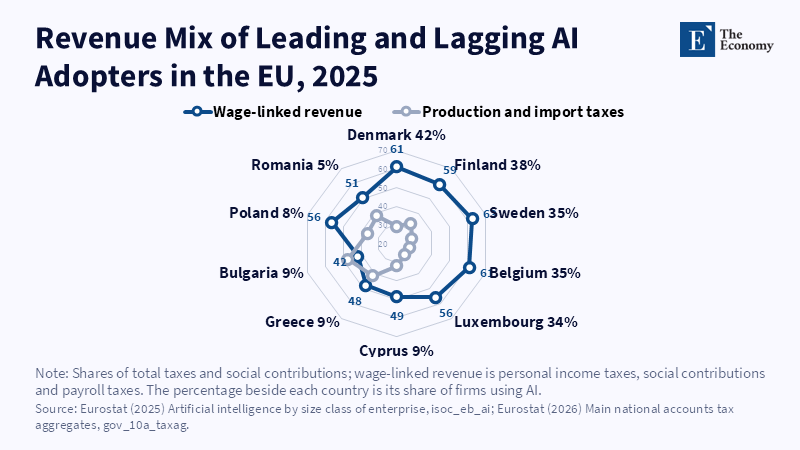
Reported AI usage ranges from 42% of surveyed firms in Denmark to 5.2% in Romania, leaving considerable scope for wider adoption. Countries with the highest proportions using AI also tend to be reliant on taxes on labour and household income. The Economy's calculation using Eurostat's 2025 enterprise and tax data finds that all eight EU countries with AI usage above 25% derived at least 55% of total tax and social-contribution revenue from personal income taxes, net social contributions and payroll taxes, reaching 66% in Germany. The unweighted average for the five countries with usage below 10% was 49%. These are broad categories, including taxes on non-wage household income; the comparison describes existing revenue structures rather than showing that AI adoption caused them.
Wages and Household Income Still Carry the Tax Base
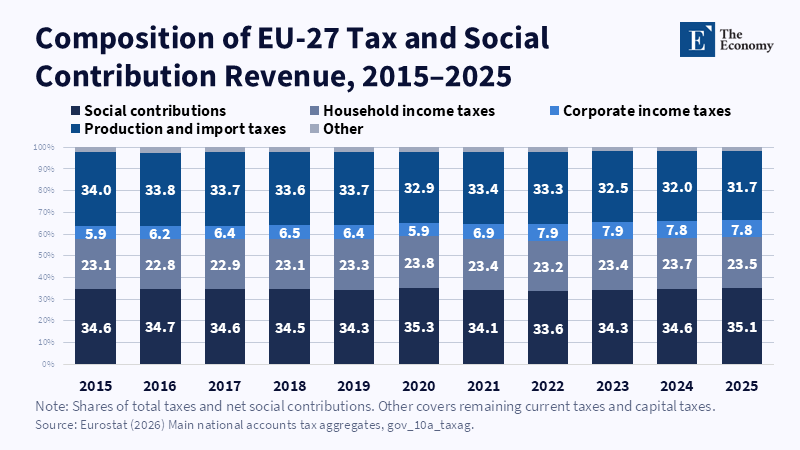
The respective shares of total tax and social-contribution revenue in 2025 accounted for by net social contributions, personal income taxes and corporation tax were 35.1%, 23.5% and 7.8%, according to Eurostat tax aggregates. Personal income taxes in this measure include taxes on household capital income and holding gains. Taxes on production and imports accounted for 31.7%, down from 34.0% in 2015. Corporation tax's share rose from 5.9% in 2015, but its revenue remained below one-quarter of that from net social contributions and is sensitive to the economic cycle.
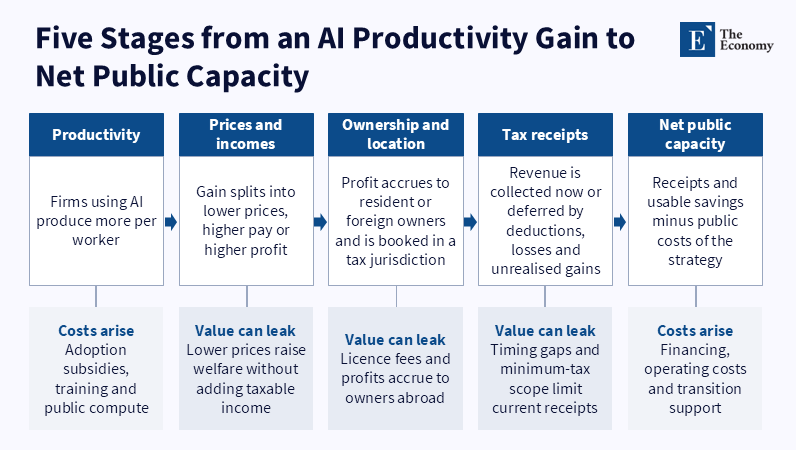
It would be necessary to consider, at least, the probable division of any increase in productivity between price reductions, wages and profits; the location of taxable activity and the residence of the companies and owners involved, which help determine the jurisdictions likely to levy significant taxes; and the timing of receipts. Depreciation allowances, current losses and unrealised capital gains reflected in higher share prices can all delay or alter tax payments within existing rules. Corporate taxation of operating profits and taxation of distributions or gains received by shareholders must be considered separately.
The OECD's Side-by-Side package, agreed on 5 January 2026, also limits the cross-border minimum-tax claims that other jurisdictions can make on eligible US-parented multinational groups. These groups can elect a safe harbour that deems top-up tax under the Income Inclusion Rule (IIR) and Undertaxed Profits Rule (UTPR) to be zero for fiscal years beginning on or after 1 January 2026. A Commission notice of 12 January confirmed that the safe harbours fall within Article 32 of the EU minimum-tax directive; their application still depends on the relevant domestic rules. Qualified domestic minimum top-up taxes remain unaffected, allowing EU countries to levy top-up tax on covered low-taxed profits arising within their jurisdictions. The arrangement limits one route to additional revenue without removing US groups from European taxation.
It may, however, be argued that these considerations exaggerate the likely loss of potential fiscal revenue, since widespread cheap access to AI could substantially increase output and employment in a range of manufacturing and other industries, increasing revenues from labour and profits. There could be a considerable net fiscal benefit, even with little prospect of significant EU provision of leading-edge models. The scale of such effects is difficult to determine at present.
AI Strategies Must Be Judged Net of Their Public Costs
Additional tax revenue and cash savings in public services would need to be assessed against a credible baseline and set against subsidies, public investment, tax concessions, operating costs, interest costs and expenditure to ease transitions, including retraining. Better public services can produce real benefits without releasing cash for other purposes; their value should not automatically be booked as a budget saving. The wider opportunity cost of labour, energy and capital also belongs in an economic appraisal, but should be distinguished from the government's cash and fiscal accounts. This framework identifies what must be measured; it does not itself establish a positive fiscal return.
Germany's investment package enacted in July 2025 permits declining-balance depreciation of up to 30% for qualifying movable business assets acquired or manufactured between 1 July 2025 and 31 December 2027. It also reduces the federal corporation-tax rate from 15% in annual one-percentage-point steps from 2028 to 10% in 2032, before trade tax and the solidarity surcharge. Revenue forgone has been acknowledged as substantial, although the effect of accelerated depreciation is partly a shift in timing. Policies of this type can therefore lower revenue over the next few years while their longer-term gains depend on the investment and growth they induce. The uncertainty in those gains must remain visible in any fiscal assessment.
Other policies could aim broadly to encourage general take-up, with some benefits appearing as lower prices and greater real purchasing power rather than higher nominal tax revenue; to develop particular capabilities and secure ownership, with taxpayers bearing investment risk and potentially sharing in profits; to procure goods and services for public bodies, improving provision but not necessarily developing successful exporters; or to secure appropriate taxation of specific benefits or rents arising. The last route accords with recommendations by IMF staff in 2024 to avoid a special tax on AI and strengthen general taxation of capital income. Its effectiveness still depends on policy design, international cooperation and the response of the activity being taxed.
Several proposals heard at the Chatham House Berlin Conference concerned public backing and procurement. Discussion included a government-supported European initiative to invest in frontier models, whose fiscal exposure would depend on its funding terms. It also included stronger preferences for European vendors in public procurement, which the Commission's scoreboard puts at around 15% of EU GDP, and governments acting as anchor clients for innovative firms. That procurement total covers much more than AI. German states' use of alternative software was cited; Schleswig-Holstein's ongoing move from proprietary software to open-source alternatives offers a concrete example of public-sector adoption, though not evidence of an AI-specific fiscal return. The discussion also acknowledged the cost of restricting supplier choice and the need to manage dependence on state support. It did not develop a quantified proposal for taxing AI-related rents. In The Economy's assessment, procurement with bounded costs and demonstrated net savings offers a more testable first priority than open-ended public exposure to frontier-model development.
Too Early to Count AI Growth as Fiscal Capacity
It would seem appropriate to require an account of the probable beneficiaries of increased productivity, the costs of implementation, the form of income entering the tax base, timing and sensitivity to adoption rates before assuming material fiscal scope from greater AI use. Additional spending commitments, for example on defence, Ukraine or infrastructure, should be assessed against credible net benefits. The EBRD's Transition Report 2025-26 argues that technological developments can alleviate, but not eliminate, the pressures from ageing populations and shrinking workforces. It does not treat automation of almost all economically useful activity as a basis for dismissing those pressures. Significant expenditure on pensions and health can therefore remain necessary alongside AI adoption. There is a strong case for encouraging productive uses of AI, but the evidence discussed here does not justify booking a large near-term fiscal dividend in advance.
The Berlin discussions did not supply the missing fiscal estimates. Proposals were framed around competitiveness, legal certainty and access to capital, without quantifying the domestic taxable income or public-service savings they would generate after public costs. Concerns about financing included competition for capital between technology companies and governments, and the effects of the Iran war. These arguments reinforce the need to test interest-rate assumptions rather than establish a single future borrowing-cost path. Discussion also turned to voters who expect governments to cushion repeated shocks, limiting room for outlays whose returns are distant. European strengths in applied AI were advanced as an alternative emphasis to frontier-model development. If deployment raises domestic wages and profits, the tax base can benefit even when the underlying model is foreign. How much reaches the budget, and when, still requires evidence.
This independent series by The Economy Review examines questions on the agenda of the Chatham House Berlin Conference 2026 and develops the publication's earlier research. The articles draw on public sources and, where indicated, discussions at the conference. The analysis and conclusions are those of the authors; references to the conference do not imply endorsement by Chatham House.
References
Aldasoro, I., Gambacorta, L., Pál, R., Revoltella, D., Weiss, C. and Wolski, M. (2026) AI adoption, productivity and employment: evidence from European firms. EIB Economics Working Paper 2026/02, 13 January.
Brollo, F., Dabla-Norris, E., de Mooij, R., Garcia-Macia, D., Hanappi, T., Liu, L. and Nguyen, A.D.M. (2024) Broadening the Gains from Generative AI: The Role of Fiscal Policies. IMF Staff Discussion Note SDN/2024/002.
Chatham House Berlin Conference (2026) Investment, AI and political-economy discussions, 25–26 November. Conference recordings and transcripts.
European Bank for Reconstruction and Development (2025) Transition Report 2025-26: Foreword and executive summary. London: EBRD.
European Commission (2026a) Commission Notice C/2026/253, Official Journal of the European Union, 12 January.
European Commission (2026b) Access to public procurement. Single Market and Competitiveness Scoreboard; accessed 27 November.
European Commission, Interoperable Europe (2026) Schleswig-Holstein's Open Source Strategy, a year on, 16 February, updated 24 March.
Eurostat (2025) 20% of EU enterprises use AI technologies, 11 December; including the methodological note on the additional 2025 category.
Eurostat (2026a) Tax revenue statistics, October release covering 2025.
Eurostat (2026b) Main national accounts tax aggregates [gov_10a_taxag] and Artificial intelligence by size class of enterprise [isoc_eb_ai]. The Economy's country comparison uses 2025 data; the tax measure combines personal income taxes, net social contributions and payroll taxes as a share of total taxes and social contributions. Low-adoption group averages are unweighted.
German Federal Ministry of Finance (2025) Investitionssofortprogramm Deutschland: Mehr Wachstum und Wettbewerbsfähigkeit, Monthly Report, August; explaining the law enacted in July.
OECD (2026a) Side-by-Side Package. OECD/G20 Inclusive Framework on BEPS, 5 January.
OECD (2026b) Corporate Tax Statistics 2026. Paris: OECD.
The Economy Editorial Board (2026) Europe's AI Fiscal Capacity Depends on More Than Adoption. The Economy Review, 19 July.
Working across research, policy, and data-driven analysis, the Editorial Board ensures that published pieces reflect a consistent institutional perspective grounded in quantitative reasoning and long-term structural assessment.