[European Strategic Autonomy] What Can Europe Credibly Guarantee Ukraine?

Working across research, policy, and data-driven analysis, the Editorial Board ensures that published pieces reflect a consistent institutional perspective grounded in quantitative reasoning and long-term structural assessment.
Authored On
Modified
Europe's financial commitments to Ukraine extend into 2027, but funding gaps remain
Its proposed military guarantees remain conditional and partly U.S.-dependent
Credible commitments need resources and procedures that outlast governments

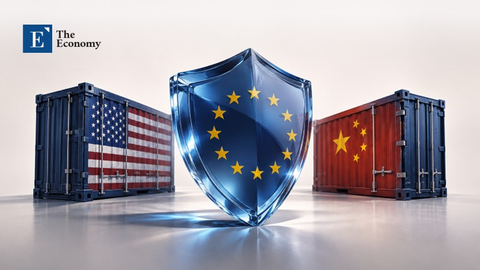
On 19 November 2026 in Berlin, the leaders of Germany, France, the United Kingdom and Ukraine set out what Ukraine security guarantees could include once a ceasefire takes hold: long-term military and financial support, a European-led Multinational Force in Ukraine supported by the United States, a proposed US-led monitoring mechanism and a legally binding commitment, subject to national procedures, to restore peace if Russia attacks again. Military and financial assistance is already being delivered, while the proposed post-ceasefire guarantees still require legal and operational implementation. With U.S. aid allocations down 99 percent in 2025 compared with the 2022–2024 annual average, according to the Kiel Institute for the World Economy, European governments and EU institutions carried most of the support to Ukraine and total aid stayed close to earlier levels. Europe’s willingness to finance support has been demonstrated. Promising in a way that Russia, investors and Ukrainian voters would all believe is harder and it turns on who is responsible for what, with which resources. Discussion at the Chatham House Berlin Conference 2026 pointed to an uneven answer: Europe has become a principal source of support for Ukraine's budget and arms production, while particular air-defence systems and missiles still come from the United States, often bought with European money. This article extends The Economy’s earlier analysis in Why a 20-Year U.S. Security Guarantee for Ukraine Is Essential for Durable Peace by examining which parts of such a guarantee Europe can supply itself.
Duration Means Little Until the Promise Is Specified
The earlier Economy case for a twenty-year American guarantee treated the term as a recovery window, the time Ukraine would need to rebuild an economy and an army at once. That reasoning still holds, but twenty years was never an empirical finding about the right length and a long agreement can stay weak if it leaves unclear what happens after a breach, who pays and which institution acts first, whereas a shorter programme with money attached can build real capacity while the wider settlement remains contested.
The joint security commitments signed by the EU and Ukraine on 27 June 2024 make the distinction concrete. They promise predictable, long-term support across equipment, training, intelligence, financial assistance and reconstruction. In the event of future aggression, the two sides undertake to consult within 24 hours at the request of either. Consultation establishes a process for agreeing further measures; it does not create a collective-defence obligation comparable to NATO’s Article 5 or commit any member state’s forces. Even Article 5 leaves allies discretion over the form of assistance, including whether to use armed force.
Deterrence can rest partly on an adversary’s uncertainty, yet the Berlin statement’s identified trigger—a future Russian armed attack—does not settle the response that would follow. Command arrangements have been established for the Multinational Force, but its final deployed size, sustainment and the precise scale of U.S. support remain incompletely specified in public documents. Investors, citizens and allies need enough clarity to tell an enforceable commitment from an aspiration, a lower bar than full disclosure and one the public documents have not yet fully cleared.
Europe’s Guarantees Remain at Different Stages of Implementation
Sorted by status, the European package reads less like a single guarantee than a stack of instruments with different owners and horizons. The financial layers are authorised and partly delivered, while the proposed post-ceasefire military arrangements remain at different stages. The Multinational Force has an established UK–French command structure and has rehearsed deployment through the Koalicja-2026 exercise in Poland, but its intended mission in Ukraine remains conditional.
Table 1: European and Allied Commitments to Ukraine by Implementation Status, November 2026
| Commitment | Military capability | Economic continuity | Responsible institution | Funding horizon | Implementation status |
|---|---|---|---|---|---|
| EU–Ukraine joint security commitments, 27 Jun 2024 | Equipment, training, intelligence; consultations within 24 hours after future aggression | Financial support, reconstruction, single-market integration | EU institutions and member states | No separate funding envelope created by this commitment | Signed; implementation ongoing |
| Ukraine Facility, 2024–2027 | None | Budget support and investment guarantees tied to Ukraine Plan reforms | European Commission and Council | Up to €50bn to end-2027 | Conditional payments underway; Ukraine Plan aggregate reached €40bn by 20 Nov, including Support Loan funding and external contributions |
| Ukraine Support Loan, 2026–2027 | €60bn for defence procurement and industry | €30bn budget support | EU borrowing; 24 member states under enhanced cooperation | €90bn to end-2027 | Authorised; partly disbursed since 25 Jun 2026; further releases conditional |
| Additional Ukraine support proposed for 2027 | Up to €25bn proposed for military assistance | Up to €20bn proposed for budget support | European Commission proposal; adoption by EU institutions required | Up to €45bn proposed for 2027 | Proposed on 18 Nov; further Council discussion planned for December |
| NATO allied pledge for 2026 | €70bn in equipment, assistance and training | None | NATO Allies, through national budgets | 2026; “at least equivalent” in 2027 | Collective pledge; delivery through national contributions |
| Multinational Force Ukraine | Reassurance in the air, at sea and on land; regeneration of Ukrainian forces | Indirect | UK–French command; participating states; proposed U.S. support | Not publicly established | Established; deployment rehearsed; intended mission in Ukraine conditional |
| U.S.-led ceasefire monitoring | Verification of a ceasefire | None | United States, with European participation | Not publicly established | Announced as a proposal |
| Binding response to a future attack | Measures to restore peace and security | None | Participating states, subject to national procedures | Not publicly established | Proposed; requires legal implementation and national procedures |
The €70 billion for 2026 is an aggregate pledge by NATO Allies, including states outside the EU, and relies on national funding decisions. It should not be added to EU and national assistance totals as though it were a separate fund. The €90 billion Ukraine Support Loan rests on EU borrowing backed by budget headroom, agreed by 24 member states without Czechia, Hungary and Slovakia and repayment is structured around reparations owed by Russia, subject to the loan’s legal conditions. European money also keeps buying American capability: the Kiel Institute found that between January and June 2026 European donors procured at least €3 billion of military aid from U.S. defence companies, about 30 percent of Europe’s procurement-based military aid and it named Patriot as a system for which Europe has only limited alternatives.
The 2027 horizon nevertheless leaves a financing problem. On 23 November, the Council approved the remaining €45 billion allocation within the existing Support Loan for 2027: €13.3 billion for budget support and €31.7 billion for defence industrial capacity. This is separate from the additional €45 billion proposed on 18 November against an estimated further €70 billion financing gap for that year. In its account published on 27 November, the European Council presidency said leaders would return to the additional-loan question in December. Authorised programmes extending into 2027 therefore do not establish that Ukraine’s needs are fully covered.
Military Staying Power Depends on a Working Economy
The fifth Rapid Damage and Needs Assessment, released on 23 February 2026 by the Government of Ukraine, the World Bank Group, the European Commission and the United Nations, puts recovery and reconstruction needs at almost $588 billion over the next decade, nearly three times Ukraine’s estimated 2025 nominal GDP, using damage recorded through 31 December 2025. It is neither a one-year bill nor a military requirement. Transport, energy and housing account for about $277 billion of the total.
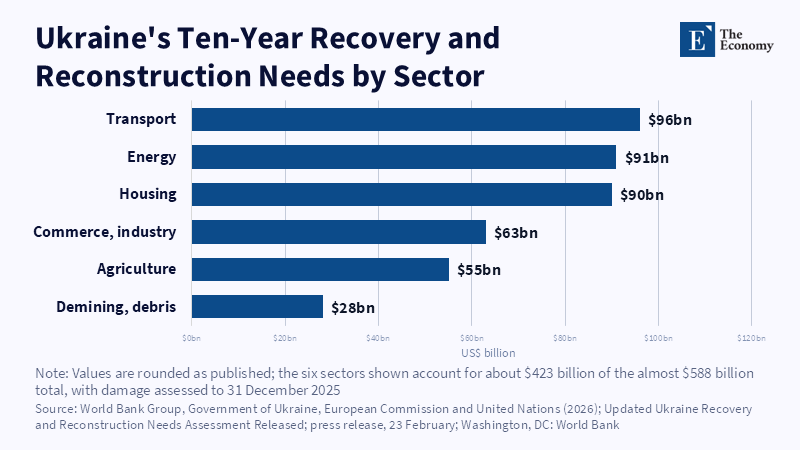
Those sectors bear on security through economic channels first. A grid that fails every winter pushes firms to relocate, damaged housing keeps families abroad and broken rail and port links raise the cost of moving grain and ammunition alike. A Chatham House research paper of 28 May 2026 cited estimates that Ukraine needs roughly 4.5 million additional workers and a UNHCR scenario in which about two million people might return under a fragile peace, warning of a “grey zone” in which investors stay cautious.
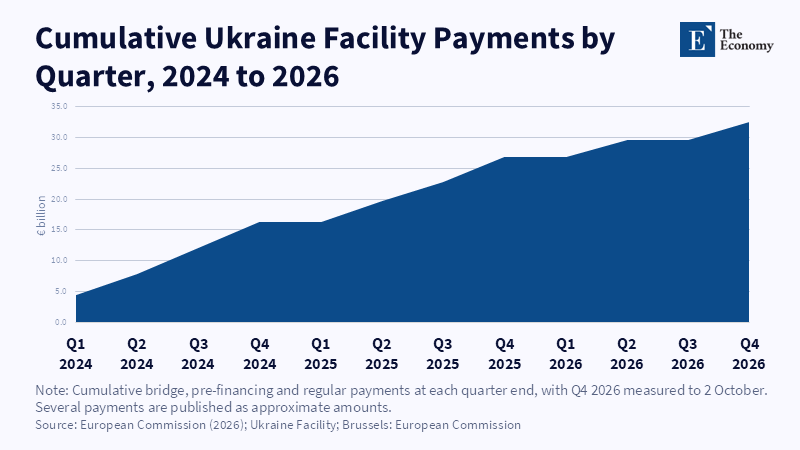
The Ukraine Facility shows what predictable financing with conditions looks like. Its envelope of up to €50 billion for 2024 to 2027 includes loans of up to €33 billion, regular payments are scheduled quarterly, subject to fulfilment of the relevant conditions. The Commission reported €40 billion provided under the Ukraine Plan by 20 November 2026, an aggregate that includes external contributions and Support Loan money channelled through the Plan. It is not simply expenditure from the original €50 billion envelope. Calling the distance between that envelope and the RDNA5 total a funding gap would compare a four-year mix of budget support and guarantees with a decade of needs that Ukraine’s budget, private investors and other donors also share.
The Economy’s book The Cost of Order argues that deferred costs are redistributed across time and actors rather than eliminated. Stop-start support plausibly raises later reconstruction and deterrence costs through delayed investment, interrupted production and skilled workers who settle elsewhere, although none of those channels has been priced well enough to support a counterfactual figure. Budgets are finite and the Chatham House paper cited projected defence needs of $68 billion to $105 billion annually in 2027–2028, even under a ceasefire scenario, so a credible answer runs through prioritisation and Ukraine’s own productive capacity rather than through larger headline pledges.
Commitments Have to Outlast the Governments That Made Them
The willingness of a sitting government is the easiest part of a commitment to secure and the first to erode. Multi-year appropriations, production contracts, maintenance networks and transparent review raise continuity without making a democratic choice irreversible. Both the Ukraine Facility and the Support Loan have current funding plans covering the period through 2027, a year that includes France’s presidential election. The Chatham House paper also warned of serious political and legitimacy risks surrounding Ukraine’s own next election, whenever it is held.
Each mechanism protects against a different failure. A supply contract gives producers the order book needed to expand lines and a training partnership raises the value of equipment already delivered. Reform-linked finance protects accountability but can slow money when a reform stalls: the Facility’s seventh regular payment, on 8 June 2026, came more than five months after the sixth on 22 December 2025, the longest interval in the Commission’s published chronology through 20 November. The regular-payment chronology does not measure all EU support, and payment dates alone cannot establish how much of an interval reflects reform timing or administrative sequencing.
Ukrainian agency belongs at the centre of that assessment. Arrangements that expand Ukraine’s own defence production, drone expertise and fiscal base widen its freedom of action and the Chatham House paper argues for drawing Ukraine into the European Defence Fund and PESCO on that basis. Reconstruction priorities and accountability rules are better set jointly with Kyiv than by donors alone.
Joint production offers a concrete answer to the uncertainty Ukraine faces. In May 2026, Ukraine’s defence ministry described an agreement to set up a German-financed joint venture on German soil to build AI-enabled mid-range strike drones for Ukraine's armed forces, with several thousand units envisaged initially. Such arrangements can turn assistance into an order book a factory can plan around, although the announcement itself does not establish delivery. The defence discussion at the Chatham House Berlin Conference made the same point from the supply side, linking manufacturers’ expansion plans to predictable government demand alongside certification and procurement reform. PURL addresses urgent requirements by enabling allies and partners to finance U.S.-sourced equipment for Ukraine. The conference’s AI discussion also counted Ukraine among Europe's complementary technology partners, with wartime innovation that could find civilian uses after the war and whose Ukrainian ownership should be respected.
Europe Can Fund the Present More Readily Than It Can Guarantee the Future
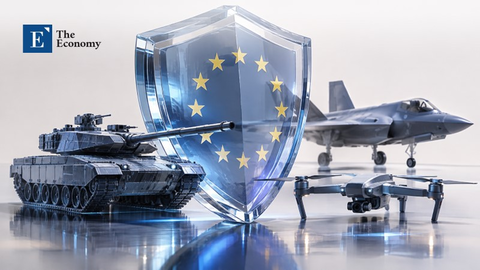
A European contribution becomes credible when identified responsibilities connect to resources, usable capabilities and procedures for responding to a changed security environment. Measured that way, the financial layer has established programmes and actual disbursements, but still requires additional resources and timely payments. The deterrent layer has an identified contingency and an established coalition command, but its final force package, sustainment and American contribution remain incompletely specified in public. The Economy’s earlier warning that defence spending must become interoperable capacity applies most sharply to a coalition force whose preparations must still translate into a sustainable mission in Ukraine.
As discussed at the conference, European allies have carried much of the support for Ukraine through bilateral donations and EU instruments such as the Support Loan, while U.S.-sourced capabilities remain important. NATO’s November account of PURL identified Patriot equipment and air-to-air missiles among the capabilities supplied through the mechanism. Space moves more slowly: the EU’s revised IRIS² schedule targets first launches in 2029, with early secure services to follow. Ukraine continues to use American satellite communications, but that launch schedule does not by itself establish when particular dependencies can be overcome. In The Economy's assessment, the question is whether Western Europe can provide frontline states with a sustained military backstop comparable to the role of the United States in South Korea. The period that counts is the one before additional European capacity becomes available.
How the package should change depends on the course the war takes. While fighting continues, speed matters most: discussion at the Chatham House Berlin Conference criticised delays in military support and raised the argument that enough equipment before Ukraine's Kharkiv counter-offensive in 2022 could have ended the war. That remains an unproven counterfactual, rather than a measurable estimate of the cost of Western caution. The conference’s China discussion also examined how energy purchases and dual-use exports help sustain Russia’s war effort. Under a pause, the proposed guarantees in the Berlin statement would require legal and operational implementation, and the conference discussion emphasised designing credible enforcement before agreeing new terms with Russia. If fighting resumes, a 24-hour consultation clause and a prepared coalition force would have to translate into timely decisions, resupply and a usable response. Europe has authorised substantial financial support extending into 2027 and is expanding its contribution to weapons production, but further financing and reliable delivery remain necessary. Whether that adds up to deterrence depends on the capabilities available, the credibility of the response and the durability of allied cooperation, including the American contribution. Those arrangements must remain usable even without political change inside Russia.
This independent series by The Economy Review examines questions on the agenda of the Chatham House Berlin Conference 2026 and develops the publication's earlier research. The articles draw on public sources and, where indicated, discussions at the conference. The analysis and conclusions are those of the authors; references to the conference do not imply endorsement by Chatham House.
References
Council of the European Union (2024) 'Joint security commitments between the European Union and Ukraine', press release, 27 June. Brussels: Council of the European Union.
European Commission (2026a) Ukraine Facility. Brussels: European Commission.
European Commission (2026b) 'Commission disburses €2.86 billion to Ukraine for drones, missiles and urgent battlefield needs', news release, 27 October. Brussels: Directorate-General for Defence Industry and Space.
European Commission (2026c) 'Commission proposes €45 billion in additional financial support for Ukraine in 2027', press release, 18 November. Brussels: European Commission.
European Commission (2026d) 'Commission disburses €7.9 billion to strengthen Ukraine’s financial stability and advance reform efforts', press release, 20 November.
European Commission (2026e) 'The European Union is accelerating and reinforcing IRIS²', news release, 7 August.
Council of the European Union (2026) Implementing Decision (EU) 2026/2623, adopted 23 November, published 25 November. Official Journal of the European Union.
European Council (2026) Remarks following the Special European Council meeting of 26 November 2026, published 27 November.
European Parliament and Council of the European Union (2026) Regulation (EU) 2026/467 establishing the Ukraine Support Loan for 2026 and 2027. Official Journal of the European Union.
Germany, France, United Kingdom and Ukraine (2026) Joint statement by the leaders of Germany, France, the United Kingdom and Ukraine, Berlin, 19 November. Kyiv: Office of the President of Ukraine.
Kiel Institute for the World Economy (2026) 'Ukraine Support Tracker: Europe leads on aid, US weapons remain key', press release, 13 August. Kiel: Kiel Institute for the World Economy.
NATO (2025) 'Collective defence and Article 5', updated 12 November.
NATO (2026a) 'Relations with Ukraine', updated 8 October.
NATO (2026b) Opening remarks at the Ukraine Defence Contact Group, 17 November.
UK Ministry of Defence (2026) 'The Multinational Force-Ukraine', guidance, 3 November.
Ministry of Defence of Ukraine (2026a) 'Germany and Ukraine as leaders in European security: building a win-win partnership', 13 May.
Ministry of Defence of Ukraine (2026b) 'Starlink and Starshield speed restored in Ukraine', 24 October.
Smith, Simon, Lutsevych, Orysia, Lough, John and Giles, Keir (2026) How a Russia–Ukraine ceasefire could imperil Ukrainian and European security. London: Chatham House.
The Economy (2026a) The Cost of Order: Ukraine and the Remaking of Europe, 18 February.
The Economy (2026b) 'Europe's new burden: why European defence responsibility can no longer wait', Strategy Review, 26 February.
The Economy (2026c) 'Why a 20-Year US Security Guarantee for Ukraine Is Essential for Durable Peace', Strategy Review, 26 February.
The Economy (2026d) 'How "Buy European" Arms Rules Shut Out South Korea and Japan', Strategy Review, 17 October.
Trebesch, Christoph and Nishikawa, Taro (2026) Europe steps up: Ukraine support after four years of war. Kiel Policy Brief 203. Kiel: Kiel Institute for the World Economy.
World Bank (2026) 'Updated Ukraine Recovery and Reconstruction Needs Assessment Released', press release, 23 February. Washington, DC: World Bank.
Working across research, policy, and data-driven analysis, the Editorial Board ensures that published pieces reflect a consistent institutional perspective grounded in quantitative reasoning and long-term structural assessment.